With today's cars, there are way too many blind spots to deal with because every new car has about 10 cameras to monitor your surroundings. If the car design was better, they wouldn't need even one camera and parking that tank would be a breeze.
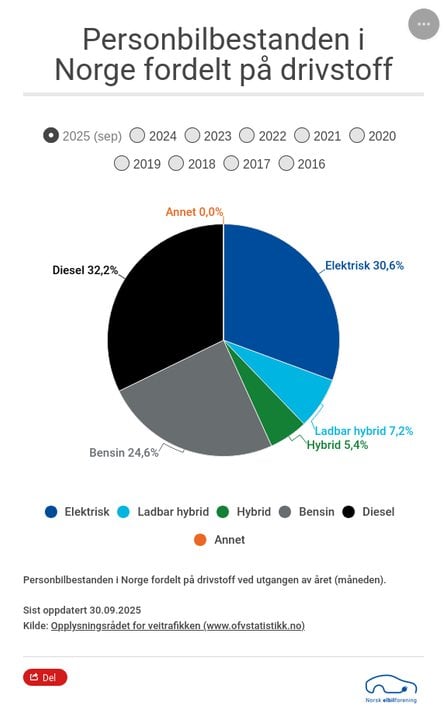
@swirlie Over 30% of the cars on the road in Norway are EVs, over 90% of new cars sold are EVs. In the two biggest cities, Oslo and Bergen more than 40% of cars on the road are EVs.
The ferry across the fjord where I live is electric, the bus to town is electric and almost all urban buses are electric. We have lots of electric heavy goods vehicles too.
Here's a pie chart showing the kinds of private cars in Norway
https://elbil.no/om-elbil/elbilstatistikk/elbilbestand/ If you visit the web page you can see the figures for preceding years and see the development. It's in Norwegian of course but it's pretty easy for an English speaker.
@ninalanyon I don't really see a problem with a maximum range being about 330 kms, especially when there are charging stations everywhere you look in Norway.
In Canada, charging stations are roughly 50km apart from each other and on the open high-speed motorways, those charging stations are closer to 100 kms apart... which of course is a problem, right!
The infrastructure for charging was installed AFTER the EVs were introduced into the Canadian marketplace... ass-backwards.
In the USA the situation is more dire. The US government is decommissioning charging stations faster than EVs are coming online. Along the Canada/US border, all the EV charging stations have been decommissioned because of lack of use, so if you show up in the USA thinking that you can charge up, forget it!
There have been numerous incidents where Canadians have crossed into the USA while driving EVs, only to find the charging stations are non-existent, which is contrary to what the maps all show.
There have also been numerous cases where Canadians have had their EVs towed back to Canada on the back of a flatbed tow truck when they weren't able to re-charge their vehicle in the USA. Pathetic really.
@swirlie 100 km between charging stations is practical for my car even with detours and side trips. Also a large proportion of Norwegian EV owners can charge the car at home overnight so it is always fully charged in the morning. I charge exclusively at Tesla chargers because my car has free charging. I drive from Norway to the UK and back with a long detour in to central France and almost never have to go far out of my way to charge. I've been doing this for eight years now and while it has got easier as Tesla has built more stations it wasn't particularly difficult even in December 2017 when I set off on a thousand mile international (eight countries) journey within a week of getting my car.
But of course if the 100 km spacing turns into 200 km because a charging station has been decommissioned then you are in trouble. However in the countries I normally drive through (UK, France, Belgium, Netherlands, Germany, Denmark, Sweden, Norway) any one charging network going offline would merely be an inconvenience rather than a cause for calling out a rescue service.
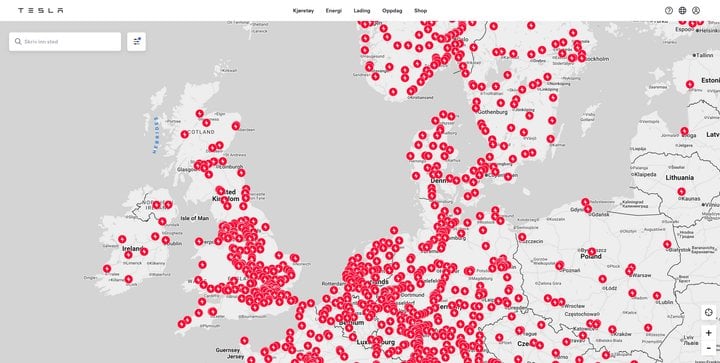
Here is Tesla's map of just Tesla's own stations in Northern Europe/Southern Scandinavia
As any profit making enterprise is apt to do Tesla has placed the chargers where they think people who can afford their cars actually live. So central Wales which has very few people and even fewer wealthy people has very few chargers. But my route: Norway-Denmark-German-Belgium-UK is very well served.
And in addition there are thousands of non-Tesla chargers.
Tesla's brilliant idea was to build both the cars and the chargers and it worked in Europe. But we have a denser and generally more evenly spread population than the US or Canada so I think it was easier and cheaper here.