This page is a permanent link to the reply below and its nested replies. See all post replies »
swirlie · 31-35
With today's cars, there are way too many blind spots to deal with because every new car has about 10 cameras to monitor your surroundings. If the car design was better, they wouldn't need even one camera and parking that tank would be a breeze.
Midnightoker1 · 61-69, M
@swirlie 👍
ninalanyon · 61-69, T
@swirlie My car only has two cameras and a set of ultrasonic range sensors. If I have to park between two other cars I usually let the car have a go first. Then if it decides it won't do it I will often try somewhere else because if the car can't do it then often there really isn't space for me to do it either. Just once in a while it is a bit too cautious and then I'll try myself.
swirlie · 31-35
@ninalanyon
I love that feature on a car, though I don't have any problem parallel parking as long as I can see my 4 corners. With more modern cars, particularly SUVs, the window sills are too high which means you can't see where the sidewalk is beside you and you can't see where the corner of the front bumper is either because the top hood line has cosmetic protrusions which rise up and block one's view of where their car's corners are.
Self-parking cars would be fun to use!
I love that feature on a car, though I don't have any problem parallel parking as long as I can see my 4 corners. With more modern cars, particularly SUVs, the window sills are too high which means you can't see where the sidewalk is beside you and you can't see where the corner of the front bumper is either because the top hood line has cosmetic protrusions which rise up and block one's view of where their car's corners are.
Self-parking cars would be fun to use!
ninalanyon · 61-69, T
@swirlie I found it quite alarming the first time I let the car park itself because it moves quite quickly. In fact the first time I did it I chickened out and stamped on the brake! But now I often prefer to let the car do it. This one is pretty low to the ground so even though it's a reasonably big car (Tesla Model S) the visibility of the surroundings is better than in the big SUVs. And the mirrors automatically tilt so that you can see the ground.
Still parking was a lot easier when I had an original Mini!
swirlie · 31-35
@ninalanyon
That sounds like so much fun! I do a lot of technical research and this kind of technical toy is right up my alley!
ninalanyon · 61-69, T
@swirlie Mine's an old car in EV terms, ten years old now. From the stone age of EVs. But I'm pretty sure that other brands like Mercedes and perhaps Lexus had self parking even before EVs. Any car with parking sensors and electrically operated steering and gearbox should be able to do it. It's just easier with EVs because the drive train is already computer controlled so you only need some extra software and an electric steering column.
I've just done a quick search, it seems that it's been an option on quite a lot of expensive cars and is now available on some mid-priced cars too. See https://www.motorsearches.com/cars/20-cars-that-can-literally-park-themselves/22
swirlie · 31-35
@ninalanyon
Have you ever had to replace the battery on your Tesla? I understand the battery has an 8 year warranty and life expectancy as well.
ninalanyon · 61-69, T
@swirlie Yes mine failed at seven and a half years ad was replaced under warranty. But it seems from what little statistics that I have seen that mine failed earlier than average.
As a very unscientific check I've just picked a random 13 cars older than eight years from Finn.no, Norways biggest trading site. Of those thirteen cars, four have had the main battery replaced or repaired.
Then I picked another random 16 cars newer than eight years, none have had the battery replaced.
Batteries have been improving all the time so it's reasonable to assume that they will outlive the warranties by longer and longer times as time goes on. Pretty much all the makers have an 8 year battery warranty. Also battery prices have been falling so replacing one out of warranty is no longer as crippling a cost as it once was, When my car was new in 2015 a new battery was priced at over 250 kNOK (about 25 kUSD) now it is probably about 50 kNOK (5 kUSD).
Edit: I should have made it clear that I chose only Tesla Model S for my unscientific survey.
As a very unscientific check I've just picked a random 13 cars older than eight years from Finn.no, Norways biggest trading site. Of those thirteen cars, four have had the main battery replaced or repaired.
Then I picked another random 16 cars newer than eight years, none have had the battery replaced.
Batteries have been improving all the time so it's reasonable to assume that they will outlive the warranties by longer and longer times as time goes on. Pretty much all the makers have an 8 year battery warranty. Also battery prices have been falling so replacing one out of warranty is no longer as crippling a cost as it once was, When my car was new in 2015 a new battery was priced at over 250 kNOK (about 25 kUSD) now it is probably about 50 kNOK (5 kUSD).
Edit: I should have made it clear that I chose only Tesla Model S for my unscientific survey.
swirlie · 31-35
@ninalanyon
Very interesting stats you've come up with. Thanks for that! A question I've always wondered about is, what happens when it comes to trade-in time of an 8 year old Model S for example?
If you arrived at the car dealership with an 8 year old Tesla which had never undergone a battery replacement in it's period of service, who takes the financial hit when it comes to the Tesla's trade-in value?
... is it the Dealership who absorbs that cost in knowing that they'll likely have to replace that battery before re-selling that car on their car lot, ...or does that battery expense get passed on to YOU in the form of a reduced trade-in value for your car with how much $ they will offer you for your Tesla as a trade-in?
Very interesting stats you've come up with. Thanks for that! A question I've always wondered about is, what happens when it comes to trade-in time of an 8 year old Model S for example?
If you arrived at the car dealership with an 8 year old Tesla which had never undergone a battery replacement in it's period of service, who takes the financial hit when it comes to the Tesla's trade-in value?
... is it the Dealership who absorbs that cost in knowing that they'll likely have to replace that battery before re-selling that car on their car lot, ...or does that battery expense get passed on to YOU in the form of a reduced trade-in value for your car with how much $ they will offer you for your Tesla as a trade-in?
ninalanyon · 61-69, T
@swirlie I think calling my little survey stats is probably too flattering :-)
I'm not sure that the battery is as big a consideration as it was when selling an eight year old EV. The technology of the cars and batteries has been, and still is, undergoing such rapid development that cars like the Model S lose value very rapidly because you can buy a brand new car of a different brand or model for less money that, in some respects at least, is a better car (more range, faster charging, better driver assistance, etc.). So my 2015 car bought second hand at two years old cost me 500 kNOK, about 50 kUSD. The new price was over 700 kNOK two years earlier. I've just looked up cars for sale of the same age and specification as mine. The first one is 200 kNOK and has had the battery replaced and the second is 150 kNOK and is still on it's original battery. Perhaps the owner of the second car is pricing it lower because the battery is older or perhaps he just wants a quicker sale.
So the car has depreciated by between 550 and 600 kNOK in ten years from a new price of, say 750 kNOK. Someone with more knowledge of the car business might be able to say if this is an unusual rate.
I'm not sure that the battery is as big a consideration as it was when selling an eight year old EV. The technology of the cars and batteries has been, and still is, undergoing such rapid development that cars like the Model S lose value very rapidly because you can buy a brand new car of a different brand or model for less money that, in some respects at least, is a better car (more range, faster charging, better driver assistance, etc.). So my 2015 car bought second hand at two years old cost me 500 kNOK, about 50 kUSD. The new price was over 700 kNOK two years earlier. I've just looked up cars for sale of the same age and specification as mine. The first one is 200 kNOK and has had the battery replaced and the second is 150 kNOK and is still on it's original battery. Perhaps the owner of the second car is pricing it lower because the battery is older or perhaps he just wants a quicker sale.
So the car has depreciated by between 550 and 600 kNOK in ten years from a new price of, say 750 kNOK. Someone with more knowledge of the car business might be able to say if this is an unusual rate.
ninalanyon · 61-69, T
@swirlie
is it the Dealership who absorbs that cost in knowing that they'll likely have to replace that battery
Since when would a car dealer willingly spend money?
swirlie · 31-35
@ninalanyon
A dealer would willingly spend money if he took in a vehicle on trade, but then found out after the transaction that he had to put a set of brakes on the car or new set of tires because they were technically below standard when a closer look was done on the vehicle, yet none of that would have been known to exist prior to the trade-in transaction.
swirlie · 31-35
@ninalanyon
Your comparison between the car WITH a battery change versus the car WITHOUT the battery changed, answers my question.
Clearly, if a car is traded and the battery had NOT been replaced when it arrived at the dealer, the dealer will discount the trade-in value of that car to cover the cost of the dealer having to replace that battery before putting it back out there for sale on his car lot. That's precisely what I thought would happen.
Your comparison between the car WITH a battery change versus the car WITHOUT the battery changed, answers my question.
Clearly, if a car is traded and the battery had NOT been replaced when it arrived at the dealer, the dealer will discount the trade-in value of that car to cover the cost of the dealer having to replace that battery before putting it back out there for sale on his car lot. That's precisely what I thought would happen.
ninalanyon · 61-69, T
@swirlie I've never traded in a car. I have either scrapped or sold privately every car I have ever owned (usually for not much more than the scrap value). They are usually so old by the time I want another that they aren't worth anything to a dealer.
You might well be right that dealers will offer lower prices for cars with older batteries. I know that some dealers actually include 12 month guarantees and that has to be financed somehow I suppose.
ninalanyon · 61-69, T
@swirlie Don't read too much into the prices of the two cars I mentioned. Both are being sold privately and the prices are the asking prices just now, what someone actually pays for them might end up being quite different. The cheaper car has some cosmetic defects, a few dents and scratches and the chrome delete is apparently falling off. Also I've taken a closer look at the spec and now see that the more expensive one has pneumatic suspension which makes it a more attractive purchase.
swirlie · 31-35
@ninalanyon
Okay, understood. But the bottom line remains that 'someone' will have to eat the cost of replacing the battery when it comes to it's end of life journey. The question is, who will that be?
It will either be the new owner of that used car after the Dealer replaces the battery and passes the cost onto the next owner..
OR it will be the original owner who will have to replace that battery before he takes it to the Dealer for a trade-in...
OR it will again be the original owner who is paid a deeply depreciated price for his car at trade-in, which then covers the cost of battery replacement by the Dealer, who then sells the used car with a new battery installed... but NOT at the Dealer's expense
One of those scenarios will play out but the bottom line is, someone other than the Dealer will pay for a replacement battery 8 years down the road at sale time.
Okay, understood. But the bottom line remains that 'someone' will have to eat the cost of replacing the battery when it comes to it's end of life journey. The question is, who will that be?
It will either be the new owner of that used car after the Dealer replaces the battery and passes the cost onto the next owner..
OR it will be the original owner who will have to replace that battery before he takes it to the Dealer for a trade-in...
OR it will again be the original owner who is paid a deeply depreciated price for his car at trade-in, which then covers the cost of battery replacement by the Dealer, who then sells the used car with a new battery installed... but NOT at the Dealer's expense
One of those scenarios will play out but the bottom line is, someone other than the Dealer will pay for a replacement battery 8 years down the road at sale time.
ninalanyon · 61-69, T
@swirlie The problem is that no one know what the most likely lifetime of the battery is. The vast majority of Tesla batteries are still in operation, most of them far in excess of their warranty and most longer than expected. The same applies to Nissan and other manufacturers
It is very much not the case that batteries invariably fail shortly after the warranty expires. So dealers can't discount the price for a trade in by as much as it would cost to replace the battery for each car, they have to guess how likely it is that the battery will fail. And at the moment it is very much a guess.
Another thing that complicates the calculation is that as EVs become more mainstream more companies are created that can replace or repair batteries. Often when a battery fails it is just part of it that has failed and it can be repaired by removing the failed module and replacing it with a new one. But it is simpler for Tesla and other makers to simply replace the battery rather than refurbish it. At the moment there are too few such repair shops, even in Norway where EVs are extremely popular simply because it takes time for people to obtain the necessary certification to work on high voltage devices and to convince themselves that it is worth doing. And of course there are still plenty of ICE cars on the road here and will be for the foreseeable future. But eventually every mechanic will have to consider retraining to handle EVs and that will start to push prices down and increase the amount of choice people have.
It is very much not the case that batteries invariably fail shortly after the warranty expires. So dealers can't discount the price for a trade in by as much as it would cost to replace the battery for each car, they have to guess how likely it is that the battery will fail. And at the moment it is very much a guess.
Another thing that complicates the calculation is that as EVs become more mainstream more companies are created that can replace or repair batteries. Often when a battery fails it is just part of it that has failed and it can be repaired by removing the failed module and replacing it with a new one. But it is simpler for Tesla and other makers to simply replace the battery rather than refurbish it. At the moment there are too few such repair shops, even in Norway where EVs are extremely popular simply because it takes time for people to obtain the necessary certification to work on high voltage devices and to convince themselves that it is worth doing. And of course there are still plenty of ICE cars on the road here and will be for the foreseeable future. But eventually every mechanic will have to consider retraining to handle EVs and that will start to push prices down and increase the amount of choice people have.
swirlie · 31-35
@ninalanyon
Very encouraging to hear that EVs are extremely popular in Norway, as they should be everywhere else as far as I'm concerned.
What kind of driving speeds and distances are typically done on a daily basis among commuters in Norway? In Canada where I live, the average speed and distance each way for a commuters during the weekdays is about 100Kph and about 100 kms each way on average.
Very encouraging to hear that EVs are extremely popular in Norway, as they should be everywhere else as far as I'm concerned.
What kind of driving speeds and distances are typically done on a daily basis among commuters in Norway? In Canada where I live, the average speed and distance each way for a commuters during the weekdays is about 100Kph and about 100 kms each way on average.
ninalanyon · 61-69, T
@swirlie I don't think many in Norway would be willing to commute 100 km each way every weekday by car. If you are a salaried employee in Norway and your job can be done from home you pretty much have the right to do just that. You go into the office for meetings that are impractical to do online or to work in a laboratory, do physical work on the shop floor etc.
My boss would occasionally send us an email saying that he'd be out of the office for the rest of the week because he had rented a cabin in the mountains. The email would remind us that he would be available for video and phone meetings and that he was just going to work there and spend some time cross country skiing.
Of course plenty of people do commute but it's usually much shorter distances.
But if you are quoting those distances with regard to EV range, well it would only be a problem for old small cars. Mine has a practical usable range of about 330 km. It varies depending on weather, temperature, road conditions, etc. But in many cases even a car with a much shorter range can do that commute because a lot of employers provide AC charging (some do it for nothing, others charge a small fixed monthly fee). So you plug your car in when you get to work. A big, heavy, powerful car like my Model S will gain about 4 km range for every kWh of charge so at 230 V, 10 A single phase you get about 10 km for each hour of charging. If it's plugged in for an eight hour working day you get 80 km. That's pretty much the slowest charge you ever get. A more typical charging point is three phase 230 V phase to phase 25 A giving roughly 10 kW which will charge most EVs from flat to full in far less than eight hours.
Lighter cars and newer versions of the Model S get more range from the same size battery.
My boss would occasionally send us an email saying that he'd be out of the office for the rest of the week because he had rented a cabin in the mountains. The email would remind us that he would be available for video and phone meetings and that he was just going to work there and spend some time cross country skiing.
Of course plenty of people do commute but it's usually much shorter distances.
But if you are quoting those distances with regard to EV range, well it would only be a problem for old small cars. Mine has a practical usable range of about 330 km. It varies depending on weather, temperature, road conditions, etc. But in many cases even a car with a much shorter range can do that commute because a lot of employers provide AC charging (some do it for nothing, others charge a small fixed monthly fee). So you plug your car in when you get to work. A big, heavy, powerful car like my Model S will gain about 4 km range for every kWh of charge so at 230 V, 10 A single phase you get about 10 km for each hour of charging. If it's plugged in for an eight hour working day you get 80 km. That's pretty much the slowest charge you ever get. A more typical charging point is three phase 230 V phase to phase 25 A giving roughly 10 kW which will charge most EVs from flat to full in far less than eight hours.
Lighter cars and newer versions of the Model S get more range from the same size battery.
ninalanyon · 61-69, T
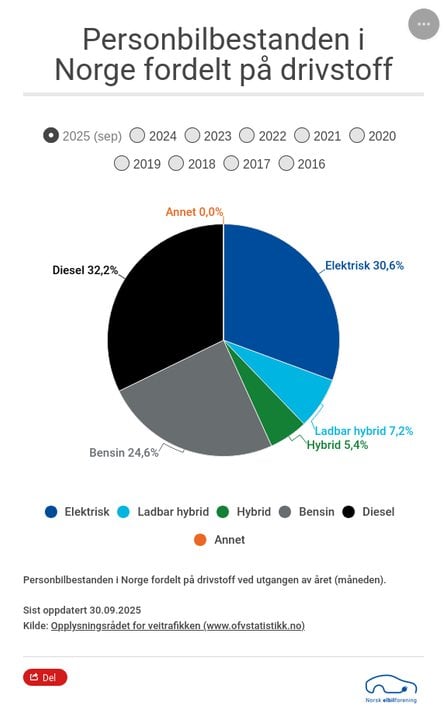
@swirlie Over 30% of the cars on the road in Norway are EVs, over 90% of new cars sold are EVs. In the two biggest cities, Oslo and Bergen more than 40% of cars on the road are EVs.
The ferry across the fjord where I live is electric, the bus to town is electric and almost all urban buses are electric. We have lots of electric heavy goods vehicles too.
Here's a pie chart showing the kinds of private cars in Norway
https://elbil.no/om-elbil/elbilstatistikk/elbilbestand/
If you visit the web page you can see the figures for preceding years and see the development. It's in Norwegian of course but it's pretty easy for an English speaker.
The ferry across the fjord where I live is electric, the bus to town is electric and almost all urban buses are electric. We have lots of electric heavy goods vehicles too.
Here's a pie chart showing the kinds of private cars in Norway
https://elbil.no/om-elbil/elbilstatistikk/elbilbestand/
If you visit the web page you can see the figures for preceding years and see the development. It's in Norwegian of course but it's pretty easy for an English speaker.
swirlie · 31-35
@ninalanyon
I don't really see a problem with a maximum range being about 330 kms, especially when there are charging stations everywhere you look in Norway.
In Canada, charging stations are roughly 50km apart from each other and on the open high-speed motorways, those charging stations are closer to 100 kms apart... which of course is a problem, right!
The infrastructure for charging was installed AFTER the EVs were introduced into the Canadian marketplace... ass-backwards.
In the USA the situation is more dire. The US government is decommissioning charging stations faster than EVs are coming online. Along the Canada/US border, all the EV charging stations have been decommissioned because of lack of use, so if you show up in the USA thinking that you can charge up, forget it!
There have been numerous incidents where Canadians have crossed into the USA while driving EVs, only to find the charging stations are non-existent, which is contrary to what the maps all show.
There have also been numerous cases where Canadians have had their EVs towed back to Canada on the back of a flatbed tow truck when they weren't able to re-charge their vehicle in the USA. Pathetic really.
I don't really see a problem with a maximum range being about 330 kms, especially when there are charging stations everywhere you look in Norway.
In Canada, charging stations are roughly 50km apart from each other and on the open high-speed motorways, those charging stations are closer to 100 kms apart... which of course is a problem, right!
The infrastructure for charging was installed AFTER the EVs were introduced into the Canadian marketplace... ass-backwards.
In the USA the situation is more dire. The US government is decommissioning charging stations faster than EVs are coming online. Along the Canada/US border, all the EV charging stations have been decommissioned because of lack of use, so if you show up in the USA thinking that you can charge up, forget it!
There have been numerous incidents where Canadians have crossed into the USA while driving EVs, only to find the charging stations are non-existent, which is contrary to what the maps all show.
There have also been numerous cases where Canadians have had their EVs towed back to Canada on the back of a flatbed tow truck when they weren't able to re-charge their vehicle in the USA. Pathetic really.
ninalanyon · 61-69, T
@swirlie 100 km between charging stations is practical for my car even with detours and side trips. Also a large proportion of Norwegian EV owners can charge the car at home overnight so it is always fully charged in the morning. I charge exclusively at Tesla chargers because my car has free charging. I drive from Norway to the UK and back with a long detour in to central France and almost never have to go far out of my way to charge. I've been doing this for eight years now and while it has got easier as Tesla has built more stations it wasn't particularly difficult even in December 2017 when I set off on a thousand mile international (eight countries) journey within a week of getting my car.
But of course if the 100 km spacing turns into 200 km because a charging station has been decommissioned then you are in trouble. However in the countries I normally drive through (UK, France, Belgium, Netherlands, Germany, Denmark, Sweden, Norway) any one charging network going offline would merely be an inconvenience rather than a cause for calling out a rescue service.
Here is Tesla's map of just Tesla's own stations in Northern Europe/Southern Scandinavia
As any profit making enterprise is apt to do Tesla has placed the chargers where they think people who can afford their cars actually live. So central Wales which has very few people and even fewer wealthy people has very few chargers. But my route: Norway-Denmark-German-Belgium-UK is very well served.
And in addition there are thousands of non-Tesla chargers.
Tesla's brilliant idea was to build both the cars and the chargers and it worked in Europe. But we have a denser and generally more evenly spread population than the US or Canada so I think it was easier and cheaper here.
But of course if the 100 km spacing turns into 200 km because a charging station has been decommissioned then you are in trouble. However in the countries I normally drive through (UK, France, Belgium, Netherlands, Germany, Denmark, Sweden, Norway) any one charging network going offline would merely be an inconvenience rather than a cause for calling out a rescue service.
Here is Tesla's map of just Tesla's own stations in Northern Europe/Southern Scandinavia
As any profit making enterprise is apt to do Tesla has placed the chargers where they think people who can afford their cars actually live. So central Wales which has very few people and even fewer wealthy people has very few chargers. But my route: Norway-Denmark-German-Belgium-UK is very well served.
And in addition there are thousands of non-Tesla chargers.
Tesla's brilliant idea was to build both the cars and the chargers and it worked in Europe. But we have a denser and generally more evenly spread population than the US or Canada so I think it was easier and cheaper here.