This page is a permanent link to the reply below and its nested replies. See all post replies »
ninalanyon · 61-69, T
Sunday 8th March 2026, 21:17
I also made a loaf of bread. This was also inspired by something seen on the web, probably YouTube. It was about a Middle Ages farming practice called maslin. Or was it just the mixture of grains that is called maslin or the bread made from it?
I thought I had mentioned it earlier but can't seem to find it. Anyway the point was that farmers would plant wheat, rye, and barley in the same field as means of reducing the effect of cereal pests because each pest specialises in, or at least prefers, one kind of cereal. So if one fails you still have some rain and also because the pests specialise they find it harder to spread in fields of mixed cereals.
I really don't know how true any of this really is; neither whether farmers really did it often nor whether it is actually effective. I can think of at least one complication and that is that the different grains ripen at different rates and times so harvesting might be difficult.
Anyway, one of the people commenting said they would try making bread according to this idea. They suggested proportions of different flours and the degree of hydration. So I thought I'd try it too.
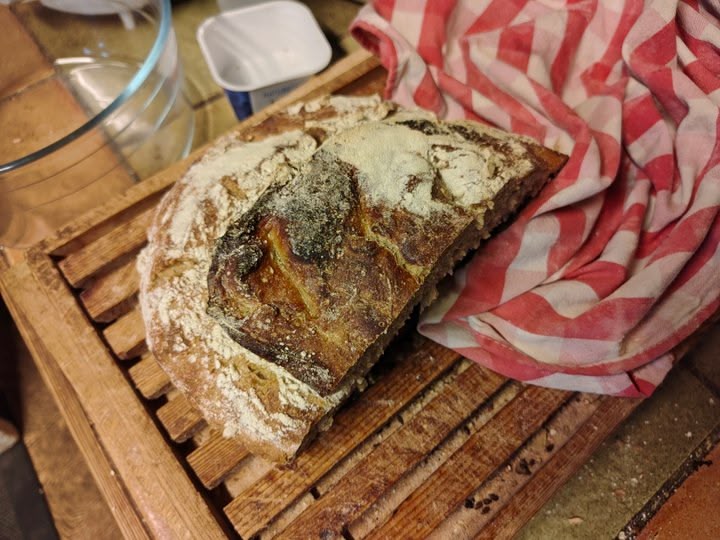
Here's a rather poor photograph what's left of the loaf:
Here are the notes I made in my personal recipe book. It's very simple recipe that requires only about ten minutes of actual work. In my notes I make the assumption that whole flours would have been used at the time, is this actually true?
Maslin is a mixture of wheat, rye, and barley.
This is inspired by a YouTube video and a comment on it. The commenter said they were going to try 70% wheat, 20% rye, 10% barley, 70% hydration, 24 hour fermentation.
Lahey's recipe for no knead bread uses 2 g dried yeast in 900 g of flour, 720 g water. that is, 80% hydration.
Neither recipe specify whether the flours are whole or not. But Lahey's is clearly white flour.
Maslin was grown as a measure against crop pests in the Middle Ages so I presume that whole flours would have been used. I don't have enough whole wheat to be worth using just now (20260207 Saturday) The rye has 8% fibre and the barley has 12%.
So here is the recipe I'll try, just a single round loaf for now:
Ingredients
350 g white bread flour
100 g rye flour
50 g barley flour
10 g salt
350 g water (70% hydration)
Very roughly 1g dried yeast, actually 1/4 teaspoon, level.
Method
In a large bowl mix the flours and salt. Mix the yeast with the water. Pour the water into the flour and mix until there is no sign of dry flour.
Cover and ferment for at least 12 hours.
Carefully remove from the bowl and fold over a few times. Sprinkle some flour in the bowl and place back in the bowl and prove for a couple of hours.
Half an hour before the dough finishes proving place a cast iron pot with a lid in the oven and heat the oven to 230 C.
Take the pot out of the oven and tip the dough into it. Cut a shallow slit in the top with a sharp knife or razor blade or use kitchen scissors to cut several smaller slits to allow steam to escape. Replace the lid and put the pot in the centre of the oven. Bake at 230 C for 30 minutes with top and bottom heat. Remove the lid and continue baking for a further 15 minutes.
The internal temperature should reach 90 C.
Cool on a rack fro a couple of hours before slicing.
I also made a loaf of bread. This was also inspired by something seen on the web, probably YouTube. It was about a Middle Ages farming practice called maslin. Or was it just the mixture of grains that is called maslin or the bread made from it?
I thought I had mentioned it earlier but can't seem to find it. Anyway the point was that farmers would plant wheat, rye, and barley in the same field as means of reducing the effect of cereal pests because each pest specialises in, or at least prefers, one kind of cereal. So if one fails you still have some rain and also because the pests specialise they find it harder to spread in fields of mixed cereals.
I really don't know how true any of this really is; neither whether farmers really did it often nor whether it is actually effective. I can think of at least one complication and that is that the different grains ripen at different rates and times so harvesting might be difficult.
Anyway, one of the people commenting said they would try making bread according to this idea. They suggested proportions of different flours and the degree of hydration. So I thought I'd try it too.
Here's a rather poor photograph what's left of the loaf:
Here are the notes I made in my personal recipe book. It's very simple recipe that requires only about ten minutes of actual work. In my notes I make the assumption that whole flours would have been used at the time, is this actually true?
Maslin is a mixture of wheat, rye, and barley.
This is inspired by a YouTube video and a comment on it. The commenter said they were going to try 70% wheat, 20% rye, 10% barley, 70% hydration, 24 hour fermentation.
Lahey's recipe for no knead bread uses 2 g dried yeast in 900 g of flour, 720 g water. that is, 80% hydration.
Neither recipe specify whether the flours are whole or not. But Lahey's is clearly white flour.
Maslin was grown as a measure against crop pests in the Middle Ages so I presume that whole flours would have been used. I don't have enough whole wheat to be worth using just now (20260207 Saturday) The rye has 8% fibre and the barley has 12%.
So here is the recipe I'll try, just a single round loaf for now:
Ingredients
350 g white bread flour
100 g rye flour
50 g barley flour
10 g salt
350 g water (70% hydration)
Very roughly 1g dried yeast, actually 1/4 teaspoon, level.
Method
In a large bowl mix the flours and salt. Mix the yeast with the water. Pour the water into the flour and mix until there is no sign of dry flour.
Cover and ferment for at least 12 hours.
Carefully remove from the bowl and fold over a few times. Sprinkle some flour in the bowl and place back in the bowl and prove for a couple of hours.
Half an hour before the dough finishes proving place a cast iron pot with a lid in the oven and heat the oven to 230 C.
Take the pot out of the oven and tip the dough into it. Cut a shallow slit in the top with a sharp knife or razor blade or use kitchen scissors to cut several smaller slits to allow steam to escape. Replace the lid and put the pot in the centre of the oven. Bake at 230 C for 30 minutes with top and bottom heat. Remove the lid and continue baking for a further 15 minutes.
The internal temperature should reach 90 C.
Cool on a rack fro a couple of hours before slicing.
SunshineGirl · 36-40, F
@ninalanyon When Poland was admitted to the EU in 2004, the bakery near my student lodgings in Cardiff invented a "golden korn" loaf to celebrate an influx of East European students. It was supposed to emulate a traditional Polish recipe, but largely replaced rye with wheat and tasted much better than Polish bread (not a difficult accomplishment). The multi-grain theme also appealed to the health conscious crowd ay the time . . the same people who probably refuse to touch bread these days.
ninalanyon · 61-69, T
@SunshineGirl I agree that Polish bread is not all that wonderful but they do make nice pastries there, at least in Krakow where I spent most of the time on numerous business trips.