Asking
Only logged in members can reply and interact with the post.
Join SimilarWorlds for FREE »

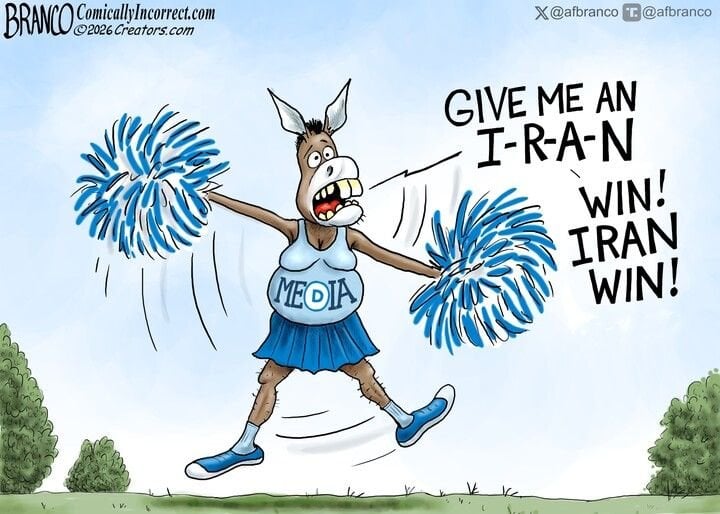
New York Times predicts America is headed for “strategic defeat” in Iran. What does that mean for us economically?


[i]Photo above: "I will carry out great vengeance on them and punish them in my wrath. Then they will know that I am the LORD, when I take vengeance on them.’”[/i]

U.S. Appears Headed for a Strategic Defeat in Iran

Is defeat better or worse when you put the adjective “strategic” in front of it? It sounds worse than “tactical”, for sure. America’s last “strategic” defeat was Vietnam. We had a tactical victory in the Iraq gulf war – we got regime change in a bullshit Iraqi dictatorship that turned out not matter at all, simply to prop up a few Saudi sheiks. The gulf war in Iraq didn’t do anything to improve America’s position economically or geopolitically.

This 2026 Iranian strategic victory over the USA is already costing us hundreds of billions – if not trillions. The direct cost of the war is now $1,000 per second, according to some debt clock similar to the national debt tracker. When numbers whiz by that fast they lose all meaning. CNN constantly has a “crawl” at the bottom of all their programming which shows that gas and diesel prices are up about $1.50 to $2.00 a gallon since February. Nobody believes the official CPI inflation numbers. Beef is up 12%. Texas just spent $100 million per mile to widen some highway, to accommodate all the people fleeing unaffordable California. Electricity is going through the roof everywhere because of data centers. Corporations have been duped into paying $500 billion a month for artificial intelligence because they don’t understand how AI tokens work.

Data centers costing $200 billion each are NOT an effect of the Iran War, however. But they ARE a strategic target. Who wants to spend money constructing a data center within reach of an Iranian “Shazam” missile? Iran is still blowing oil tankers, civilian airports, desalinization plants, and oil refineries in a dozen adjacent countries. They are using the internet to turn off our water. This is what strategic defeat looks like.

Pentagon generals told Trump this war wasn’t going to work on day zero. Despite Netanyahu’s PowerPoint presentation which breezily guaranteed that if we kill some bearded ayatollah, then ordinary Iranians without guns suddenly rise up and take on hundreds of thousands of Iranian Republican Guards armed with AK47s and extended magazines. Unarmed mobs haven’t defeated machine guns anywhere, at any time.

Back to the economics. America’s national debt will go up +/- $3 trillion this year. Subtract the White House ballroom, reflecting pool, and botched 4th of July wrestling show, and most of that money probably goes to fuel and munitions for the failed war. 6 months on, and we apparently still don’t know where Iran makes its drones, or launches them from. US Military readiness is so low that pentagon generals now theorize that we couldn’t come to Israel’s aid the next time they’re attacked. THAT’S what strategic defeat looks like. You can’t defend your own interests, or those of NATO, or those of other geopolitical allies. You are powerless.

America still ignores that there is no legitime Iranian government in power to negotiate with. All ceasefire agreements are immediately violated the moment the republican guards’ missile launchers are reloaded. Ships still cannot transit international waters in the gulf. Iran is still on track – a faster track – to threaten the world with nuclear weapons.

Ending Iran’s nuclear program was a good idea. So was safe shipping in the gulf. We might even throw in stopping the slaughter of Iranian dissenters in the streets as a good intention. But America - with the worlds most heavily armed, technologically advanced military - is losing lost a war to guys who pray to Allah 5 times a day when they’re not using pliers and screwdrivers to finish off their garage built drones.

And neither democrats or republicans are putting a halt to this. Both parties are still hoping that culture wars and extremist voters will hand them control of the senate and house in November. Eyes on the prize,, indeed !!!!

That’s a strategic defeat for the US constitution, and the American voter.

I’m just sayin’ . . .
Top | New | Old
Khenpal1 · M
The U.S. is caught between the domestic economic pain of a prolonged conflict and the massive risks of a full-scale regional escalation.

The administration actively backed away from the alternative path—massive military escalation—because those risks were deemed too catastrophic to absorb right now.

While the White House can issue public statements and social media posts, the actual trajectory of the crisis is being dictated by several rigid structural realities:

1. The Military Veto on Stockpiles The Pentagons Constraint: The U.S. military leadership has a direct, institutional veto over prolonged escalation.
Defense officials cannot simply invent new Patriot interceptor missiles or Tomahawk cruise missiles out of thin air.

The Supply Chain Reality: Because domestic defense manufacturing lines are locked in and projected to take until mid-2029 to replenish pre-war levels, the Pentagon will legally and operationally block Trump from launching sustained campaigns that would leave the U.S. entirely defenseless against other global threats like China.

2. The Sovereign Power of Middle Eastern Allies Base and Airspace Denial: Trump cannot launch a major regional air campaign if his partners refuse to participate. Saudi Arabia and the UAE hold total sovereign leverage over U.S. military movements.

Prioritizing Local Survival: By denying the U.S. Air Force the use of their airspace and military bases, regional leaders like Saudi Crown Prince Mohammed bin Salman can effectively force a pause on American military plans, rendering Trump's personal desires irrelevant.

3. Absolute Iranian Control of the Chokepoint
The Geography Factor: Geopolitics is dictated by geography, not political will. Iran holds the physical high ground over the Strait of Hormuz.

Asymmetric Supremacy: Trump cannot force a deal if Iran decides it can comfortably survive under the current status quo. Since Tehran has successfully demonstrated it can choke 20% of the world's oil supply using cheap, mass-produced drones and sea mines, Iran holds the ultimate leverage over global energy prices and U.S. inflation.

4. Congressional Financial Chains

The Power of the Purse: Under the U.S. Constitution, only Congress can authorize the massive, long-term funding required to sustain a major conflict.The Midterm Threat: With congressional Republicans deeply panicked about voter backlash over soaring gas prices and inflation, lawmakers are highly unlikely to sign off on open-ended emergency military spending.

If the November midterms flip control of Congress to the opposition, Trump's legislative and financial power to wage war will be completely frozen.

Because these structural forces hold all the real leverage, any final outcome will be shaped by supply chains, regional allies, and geography rather than individual rhetoric
ArishMell · 70-79, M
There is an old saw in war:

"Never underestimate the enemy".

That needs understanding the enemy too - and unfortunately the USA's government has failed dismally to both understand and estimate not only the country it has made into a more determined foe, but the rest of the world with it.

I stress "government" because its executive has the final say, but I am sure there are still very highly qualified people in the USA's military, diplomatic corps and civil-service, likely among both parties in the two parliamentary houses too, who do understand the outside world. It's the leaders who don't - and everyone else, both you Americans and we foreigners, who are affected by that.


By the way, you fall into the underestimating trap too. They being Muslims does not stop the Iranians being more technically sophisticated than your comment about spanners and screwdrivers in garages, implies. Including their recognising the engineering and military point that easily-built, low-cost weapons can be very effective, potentially more so than heavy projectiles and very complex, costly missile systems; and that their production and use is far easier to spread thinly and hide.

++++

I don't know if the Iranian military really is farming out weapons production to small businesses or to Revolutionary Guard men working at home, but the latter would have a historical precedent - from over 100 years ago !

In World War One, Britain's goverment sub-contracted making small, simple weapons components to willing model-engineers: amateur metal-workers making mainly model engines in their own workshops as hobbies. I don't know how successful this was, and it was not repeated in WW2.
GerOttman · 70-79, M
@SusanInFlorida That's because we play nice and the Israelis don't!
ArishMell · 70-79, M
@SusanInFlorida When did Israel "defeat" them?

Yes, the 20C, artificially-emplaced territory of Israel has so far managed to protect herself from nations (including Iran) and groups wanting to destroy her, while Netanyahu's armed forces and his country's illegal, increasingly violent land-grabbers have pretty well destroyed Gaza, but that's about all.

She has not defeated her enemies though; just moved the threat from one lot to another. The threat is still there, and the more Israel tries to take over that part of the world, the harder and more determined those opponents become to take over Israel.


Iran has not fallen to the USA partly because the USA has not tried to understand anything properly, including that the Iranians themselves do not want to be dictated to by foreigners; but also that Iran has learnt much more effective ways to fight what it thinks of as "The Great Satan".

Even at battle level, US military policy still seems stuck on sheer firepower by which it failed in Vietnam. WW2 was about the last really large war in which "traditional" fighting by large military units really worked for anyone. Even then there were huge attacks on civilians, accidental and wilful, by all sides.

The Cold War was builton the same premise but backed by the USSR and USA threatening each other and everyone in between with ballistic missiles carying nuclear weapons. And a ballistic missile in flight cannot be recalled or diverted, as the very adjective "ballistic" shows.


Shooting at each other is not becoming immediately outmoded. There will still a place for aircraft, tanks, ships and guided-missiles; but your rather colourful metaphor of Iranians making drones at home between praying (as if there is even a link) does hint at an emerging and very frightening new prospect.

That is the rapid development of autonomous weapons ("drones"), cheap and easy to produce in vast numbers. Something the Iranians are perfectly capable of.


So far autonmous weapons are still controlled by humans, and that does depend on the operator having some semblence of morality. If future ones are so autonomous they pick their own targets, and if designed to kill human beings directly, they may not be able to differentiate between the innocent civilian desperately trying to survive in the midst of a war, and the enemy soldier. Although as we have seen, soldiers do not always show such mercy even when not under attack.


While other drones are programmed to select and destroy civilian targets such as hospitals and electricity supplies. The AI-driven drone does not "know" its target's purpose. It simply "sees" a shape similar to embedded image-files, has no human attributes like morality or scruples, so attacks it.

A terrifying prospect those paid to understand these things properly are already airing - a prospect of warfare being blanket destruction, as in Gaza or Vietnam; with very little cost in money and lives to the attacker compared to conventional fighting with very expensive machines and thousands of men.

It's even possible insurgent groups could use them. During the Cold War there were fears that insurgents and terrorist could make nuclear weapons. That was very far-fetched indeed. That of them arming cheap, commercially-made drones with crude explosive or incendiaries, is not.

So your comment about home-made drones goes deeper than merely demeaning the RGC troops.
SusanInFlorida · 31-35, F
@GerOttman i don't endorse israel's carpet bombing of gaza civilian areas. that's every bit as much as war crime as the october 7th hamas attacks featuring civilian executions, hostage taking, rape . ..
GerOttman · 70-79, M
It won't matter much economically, there's a difference between strategic/tactical in the military v. political sense. It does look like a strategic failure as the Iranian government is more or less intact. Longer term we'll return to an uneasy status quo, which is the real strategic failure.

It's nothing but my own speculation but I think Israel/USA had an idea that provoking Iran would result in Iran attacking neighboring countries. That happened! What did not happen is those neighbor countries taking definitive action to remove the regime, thus getting rid of them and keeping our hands clean.

We now go back to what we had before and wait for the next Munich Olympics, Achille Lauro, or October 7th...
ArishMell · 70-79, M
@GerOttman The flaw being that as we saw, Iran did attack those countries, but they did so because those are somewhat pro-American and host American military bases.

So a bit self-defeating as most of the attacks were on those bases.
SusanInFlorida · 31-35, F
@GerOttman its hard to make a case for who is actually running iran? is it some ayatollah's son who is never seen in public. the president of iran, whose word is worthless at the bargaining table? the defatcto head of the iranian guards?

this is lawless terror state.
GerOttman · 70-79, M
@SusanInFlorida There are at least 3 competing factions as well as a couple shadow opposition groups. The civil government is all but powerless and subservient to the republican guards and religious hierarchy. Negotiations with one are futile at best.
This comment is hidden. Show Comment
ArishMell · 70-79, M
@jshm2 I don't think is quite so:

There is no trust or alliances left in the West - Trump has expended them all

The previous trust and alliances between other countries are still there. It is those between the USA and others that Trump has damaged or broken.
This comment is hidden. Show Comment

 
Post Comment