ArishMell · 70-79, M
Interesting photos - thankyou!
They didn't dive very deep with those things! Just as well.
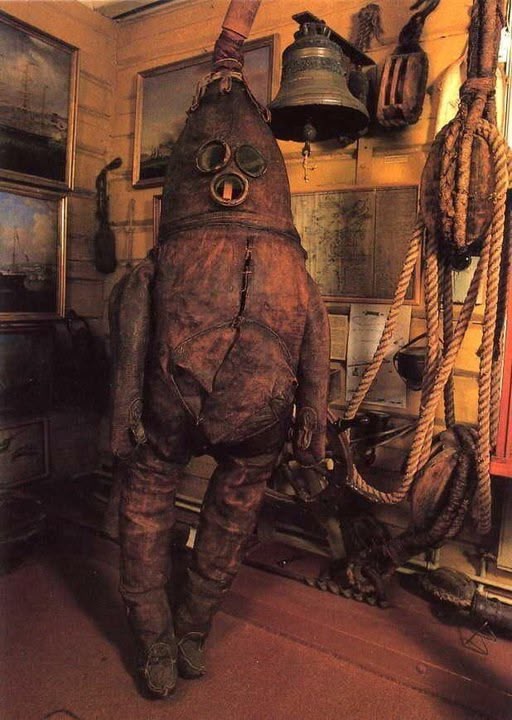
That leather one looks like someone's attempt to make a diving-suit privately; not a professional design at all even for 1882. Presumably it was at least trialled, but how successfully?
For the British-invented and made, Siebe Gorman hard-hat suit, with its characteristic spherical copper helmet fitted to a rubberised-canvas overall suit with sealed, weighted boots, was already in production and use. One such use was early in 1880, in the desperately sad task of recovering the bodies and clearing the wreckage of the Tay [railway] Bridge Disaster on New Year'sEve, 1879.
........
The second photograph's rigid-panel suit had a modern - and considerably sleeker, safer and effective - version in the 1970s, the JIM suit, originally for the developing North Sea oil-industry. Its operating depth was many hundreds of feet, not the two or three tens likely the safe limit of that 1882 suit.
Invented by Mike Humphrey and Mike Borrow of Underwater Marine Equipment Ltd (of Britain), it was inspired by an earlier suit invented by Joseph Perress, who assisted UMEL in this project. It was called the JIM suit after Perress' chief diver.
I understand some of the tests in England used a specially-built, water-filled pressure-vessel. The diver inside the suit was detailed to perform some simple mechanical-assembly tasks in the tank to verify sufficient flexibility, grip etc. I think the gauntlets were more hand-like, not the claw and hook on that early hard-suit, and a typical test task was bolting some pieces of steel together.
They didn't dive very deep with those things! Just as well.
That leather one looks like someone's attempt to make a diving-suit privately; not a professional design at all even for 1882. Presumably it was at least trialled, but how successfully?
For the British-invented and made, Siebe Gorman hard-hat suit, with its characteristic spherical copper helmet fitted to a rubberised-canvas overall suit with sealed, weighted boots, was already in production and use. One such use was early in 1880, in the desperately sad task of recovering the bodies and clearing the wreckage of the Tay [railway] Bridge Disaster on New Year'sEve, 1879.
........
The second photograph's rigid-panel suit had a modern - and considerably sleeker, safer and effective - version in the 1970s, the JIM suit, originally for the developing North Sea oil-industry. Its operating depth was many hundreds of feet, not the two or three tens likely the safe limit of that 1882 suit.
Invented by Mike Humphrey and Mike Borrow of Underwater Marine Equipment Ltd (of Britain), it was inspired by an earlier suit invented by Joseph Perress, who assisted UMEL in this project. It was called the JIM suit after Perress' chief diver.
I understand some of the tests in England used a specially-built, water-filled pressure-vessel. The diver inside the suit was detailed to perform some simple mechanical-assembly tasks in the tank to verify sufficient flexibility, grip etc. I think the gauntlets were more hand-like, not the claw and hook on that early hard-suit, and a typical test task was bolting some pieces of steel together.
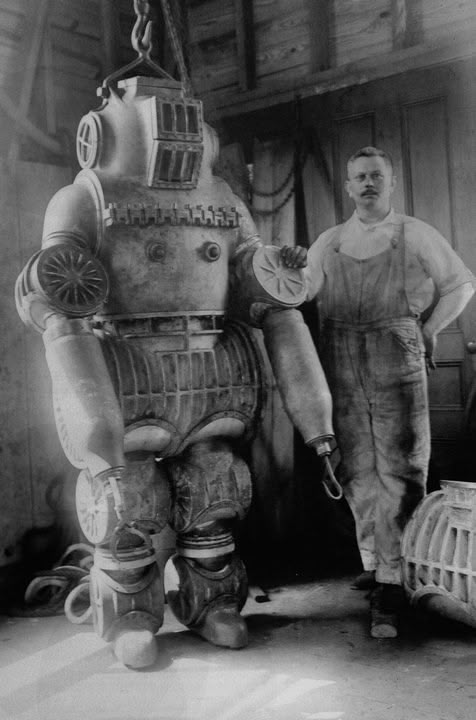
The one on the bottom looks like it has nipples.
Barefooter25 · 46-50, M
The one in the top looks like a 19th century version of a college football mascot. You put that thing on, whether you drown or suffocate, you're a goner.
ArishMell · 70-79, M
@Barefooter25 Presumably the hose projecting from the apex supplied your breathing air, but that hose does not inspire confidence.
The fatal flaw with that system is that if the air in the suit must always equal or slightly exceed the water-pressure outside. If the supply or exhaust-valve fails at depth, the water-pressure on the fabric suit may try to compress the diver into the rigid metal helmet....
Degbeme · 70-79, M
Nope, because nope
LunarOrbit · 61-69, M
‘Ummmm….I gotta pee’
robingoodfellow · M
That bottom one is crazy fascinating to look at. Googling it told me it weighed 550 lbs. and made a successful dive in Long Island sound
DearAmbellina2113 · 41-45, F
@robingoodfellow nightmare fuel
robingoodfellow · M
@DearAmbellina2113 yeah creepy
Banksy83 · 41-45, M
@DearAmbellina2113
Dont even go there Amby👀
forestG · 46-50, F
The hook hands. Lol!!!!
jackrabbit10 · M
no way.


