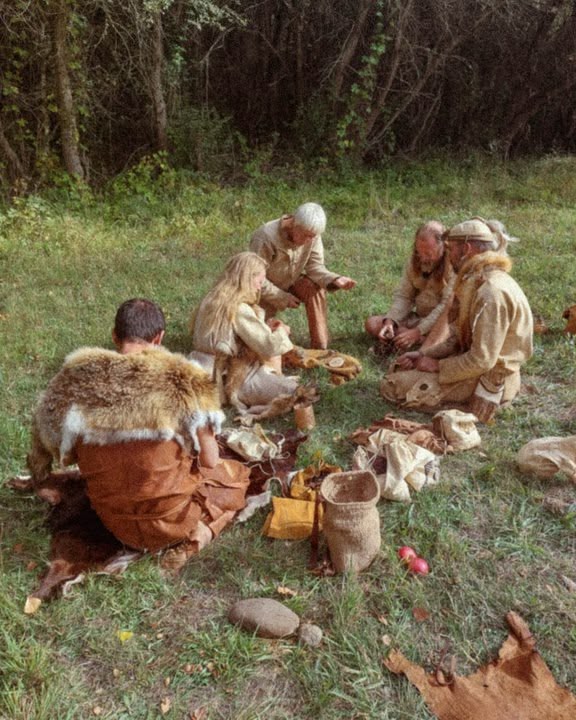
During much of the Stone Age over in Europe there was nothing much else than ice and virgin forestry. People were hunters and gatherings that were moving place to place. I've always wondered about that. How about if their journey wasn't that lineair each year?
How about that those stone age people actually rather going to the South of France in the winter and returning back to Denmark in the summer? How much privacy would they have then in those caves? How big a group was there necessary to provide all the necessities on the hoof? Plenty of questions that I'm posing this afternoon. Lets have a look if we can answer those.
During the European stone age most groups that utilized caves or rock shelters were small, mobile bands. Scientists generally estimate group sizes based on resource availability and social needs. Those were primarily small bands of twenty or thirty adults and children. Lets go through this. Women at the time have birth on average to about five to six children of which only two or three survived to adulthood.
The earliest hunter-gatherers in Europe had fewer kids, spacing births further apart due to the need to move frequently and keeping family sizes small. Morever, hunter-gatherer mothers had to carry infants, encouraging longer spacing between births, often up to 4 years. Stone age people were physically similar to modern humans but generally more robust, with powerful muscles due to a physically demanding, active hunter-gatherer lifestyle.
Average life expectancy then stayed low (often 20–35 years) due to high infant mortality, but adults who did survive childhood could live into their forties or older, with some reaching their sixties. Lets do the maths now. If the group is twenty in total then the composition could have been two couples of grandparents with four more couples bringing up eight infants. Am I right?
I spent a lot of my adult life learning skills that would keep me alive if civilization collapsed. I also know were there is a old overgrown gold mine in the bush. So I will be styling if we go back to the stone age. Cheers!
@val70 stunningly logical refutation. I'm so sorry it's not a personal subject. There's plenty more nor to know about ancient and pre history than you can deny here! And I'm not the topic. Of course you think in a certain way, Where we're the absolute pinnacle of civilization, the first; that's a tenet of true believers. Nothing in the rocks can shake such thoughts!
Morever, hunter-gatherer mothers had to carry infants, encouraging longer spacing between births, often up to 4 years.
I didn't know carrying infants was a form of birth control? 🤔 I don't think they practiced the same decorum as we do ... if you get my drift *wink, wink*
I didn't know carrying infants was a form of birth control? 🤔 I don't think they practiced the same decorum as we do ... if you get my drift *wink, wink*
It's not a form of birth control. It's nature at work. Carrying the child by itself, does not affect fertility, but carrying the child WHILE foraging for food is a different story. Same with carrying a chile, WHILE foraging for food AND breastfeeding a child for 4 years, that causes women to be "less" fertile. Nevertheless, women had a half dozen kids, most dying early, by the time the woman was 30, when she typically died of various reasons.
@Northwest What opinion? That you don't want to answer my answer? You can't even see my question at the end. You don't need to offer an opinion that my proposal of travelling the distance is wrong to answer my question. That shows how nice you are
This message was deleted by the author of the main post.
@val70 Small upwardly mobile groups, able to relocate at short notice would be best. Twenty might be about right. There's rather a lot of variables to take into consideration. It's an interesting thought exercise..
@val70 Absolutely, the surviival of small groups not only mastering shelters, hunting, and conflicts have to manage the social structure and overall survivability..
@Patriot96 yes, my people and Persia ran the entire Mediterranean and West Asia, and the silk road during that time. You were licking rocks and frogs and burning your women at the stake.