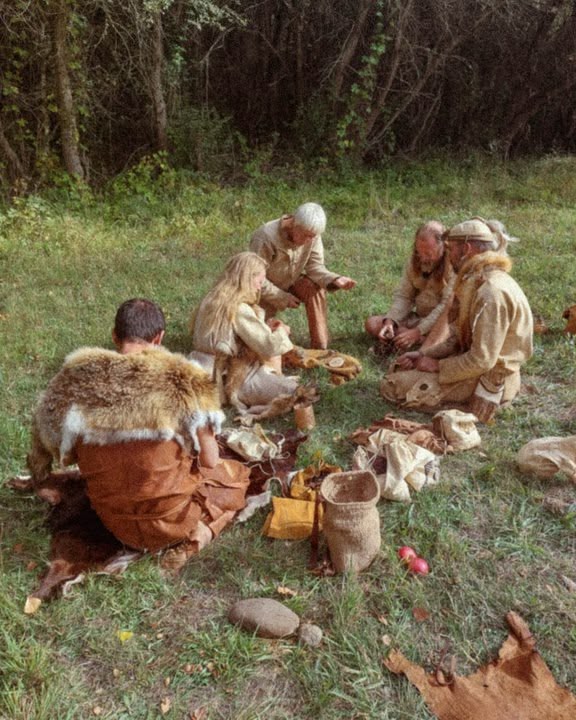
During much of the Stone Age over in Europe there was nothing much else than ice and virgin forestry. People were hunters and gatherings that were moving place to place. I've always wondered about that. How about if their journey wasn't that lineair each year?
How about that those stone age people actually rather going to the South of France in the winter and returning back to Denmark in the summer? How much privacy would they have then in those caves? How big a group was there necessary to provide all the necessities on the hoof? Plenty of questions that I'm posing this afternoon. Lets have a look if we can answer those.
During the European stone age most groups that utilized caves or rock shelters were small, mobile bands. Scientists generally estimate group sizes based on resource availability and social needs. Those were primarily small bands of twenty or thirty adults and children. Lets go through this. Women at the time have birth on average to about five to six children of which only two or three survived to adulthood.
The earliest hunter-gatherers in Europe had fewer kids, spacing births further apart due to the need to move frequently and keeping family sizes small. Morever, hunter-gatherer mothers had to carry infants, encouraging longer spacing between births, often up to 4 years. Stone age people were physically similar to modern humans but generally more robust, with powerful muscles due to a physically demanding, active hunter-gatherer lifestyle.
Average life expectancy then stayed low (often 20–35 years) due to high infant mortality, but adults who did survive childhood could live into their forties or older, with some reaching their sixties. Lets do the maths now. If the group is twenty in total then the composition could have been two couples of grandparents with four more couples bringing up eight infants. Am I right?
This page is a permanent link to the reply below and its nested replies. See all post replies »
@Strictmichael75 When the ice was gone then the stone age people weren't travelling just on foot any more but they used the rivers and coastal routes to travel with boats for the movement of goods. The only discussion open is whether the travel was one way or rather seasonal. You think that groups of twenty were the norm then?
Walking from Spain to Denmark covers over 2,200 km, requiring roughly 3 to 4 months to walk
Given the lack of roads at the time, nature of terrain, and predator, the need to stop along the way to gather/hunt for food and prepare it, it would be amazing if they could cover 5 km per day, making it a 1+ year journey.
Not if you take in account travel over the sea and rivers
Here's a non-hypothetical situation. Lewis & Clerk set out on a 13,000 km journey, using partially known terrain, in 1802, having spent 2 years preparing, getting boats, supplies, steel tools, guns, medication, food, etc. and the best technology of the day, and it took 2 years, four months and ten days to complete it and nearly all of that distance was over water.
@Northwest Have you actually ever been in Europe? I go and walk to three countries in one week. The pilgrimage to Santiago de Compostela takes 30–35 days to complete via the main 800km French Way (Camino Francés) from Saint-Jean-Pied-de-Port, averaging 20–25 km per day. The walking distance between Santiago de Compostela and Hamburg is approximately 1,409 miles (2,267 km) via the recommended walking routes. That's well within the three months yet again
Just as long as you're rationally and logically discussing something, and not raging because you couldn't prove your point.
My having been to Europe has absolutely nothing to do with the duscussion.
I gave an actual, verifiable, example of a journey taken thousands of years after the time period you proposed, clearly showing that your claim is incorrect.
Not to mention that the terrain you proposed, Denmark to Spain, is not something cave dwellers would not have been able to engage in, using boats, because this is a technology that was not available to cave dwellers (maritime navigation) and there was no river router between Denmark and Spain.
So, you should get over your hurt feelings and rage, and get back the topic at hand.
@Strictmichael75 Evidence that boats existed in the stone age includes discovered, carbon-dated dugout canoes and paddles, such as the 9,000–10,000 year-old PESSE CANOE found in the Netherlands. Neolithic and Mesolithic finds in coastal and wetland areas show logboats (dugouts) with paddles, alongside cave paintings and petroglyphs depicting early maritime vessels
It would be thousands of years before they developed navigation enabling them to undertake multi-months journeys. Taking a maritime route, would have meant a multi-year journey, with no sails, across the North Sea and the North Atlantic. If the weather does not kill them.
A land-based journey, would mean cutting through today's Spain, France, Germany, and Denmark, IF they did not end up venturing into the territories of a dozen of today's european countreies.
Evidence that boats existed in the stone age includes discovered, carbon-dated dugout canoes and paddles, such as the 9,000–10,000 year-old PESSE CANOE found in the Netherlands. Neolithic and Mesolithic finds in coastal and wetland areas show logboats (dugouts) with paddles, alongside cave paintings and petroglyphs depicting early maritime vessels
Traveling less than 2 km per hour, with no navigation and right next to shore. and adding at least 1000 km because they would be traveling around, not through.
This message was deleted by the author of the main post.
This message was deleted by the author of the main post.
@Northwest On average, a canoeists travels 10–15 miles (16–24 km) every day for a leisurely, enjoyable trip. Notice the last words here. Moreover, did you ever see the topography of Europe before? The coastline is pretty easy to follow and even the Vikings in their bigger longships followed the rivers when they penetrated way into Europe. They could travel 70 to 120 miles per day in coastal and riverine environments
This message was deleted by the author of the main post.