Are Your Beliefs Logical?
Three Tests You Can Use to Find Out.
Test 1: Self-Consistency
To pass the first test, a worldview needs an internal foundation for all the major concepts it assumes are true—including concepts required to argue for the worldview. These concepts include the ideas of truth, logic, knowledge, scientific reasoning, and morality. (After all, we need some sort of moral basis for words like “good” and “ought” before we can say that we “ought” to make logical arguments.1)
A biblical view provides a consistent philosophical foundation for all these concepts, beginning with a Creator God whose character is the authoritative, self-existent source of truth, morality, and logic. As apologists like Dr. Jason Lisle explain, immaterial, unchanging laws of logic that are true and present everywhere are possible and make sense because they’re grounded in an immaterial, unchanging God who is true and present everywhere.2 Our logical God made a logical universe that follows predictable natural laws. He created us with faculties for knowledge, making certainty and scientific reasoning possible.
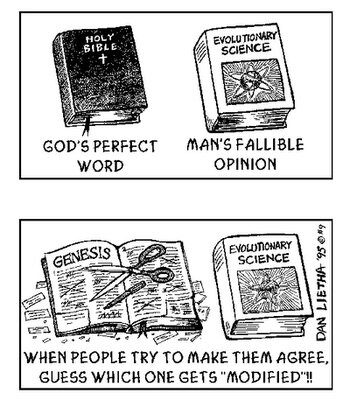
But if we reject God as Creator, that leaves us with man’s word. If objective truth exists, we can’t know what it is without relying on subjective human perceptions, feelings, and reasoning. But atheism tells us these things are products of chemicals reacting in brains that evolved by unguided processes for no transcendent purpose. And why should unguided, meaningless processes result in reliable, meaningful perceptions and thinking?
Evolutionary processes select for survival and reproductive advantages, not necessarily true thinking. In fact, some researchers argue that faulty reasoning and self-deception can offer evolutionary advantages.3 So as Charles Darwin once said,
But then with me the horrid doubt always arises whether the convictions of man’s mind, which has been developed from the mind of the lower animals, are of any value or at all trustworthy.4
The trouble is that we can’t search out whether human perceptions, feelings, and reasoning are reliable without relying on human perceptions, feelings, and reasoning. We end up in a vicious cycle of uncertainty, without an authoritative foundation for truth to exist and be knowable.5
Similar problems arise for the concept of logic. Immaterial laws of logic could not exist in a strictly material universe.6 And if the laws of logic were only agreed-upon human conventions or by-products of our brains, then those laws wouldn’t be universally true and unchanging.7 In other words, reality wouldn’t necessarily be logical everywhere and at all times. Unfortunately, knowledge and scientific reasoning depend on those concepts of logic and truth, which would be lacking a solid foundation.
Scientific reasoning also assumes we live in an orderly, predictable universe that follows natural laws. But as philosopher Danny Fredrick realizes, “The existence of natural laws . . . seems puzzling because it implies that mindless bits of matter behave in a consistent and co-ordinated way.”8 He ends up concluding that the existence of natural laws is best accounted for only by some kind of theism.
And what about moral laws? Secularists have proposed many creative frameworks for morality, including Kantianism, utilitarianism, contractarianism, intuitionism, and essentialism.9 But as this article unpacks, none of these systems end up being able to provide ultimate, meaningful justification for real, knowable, and enforceable moral standards. Correspondingly, atheist Michael Ruse concludes from his evolutionary perspective,
So how then do I justify my substantive ethical beliefs? I claim simply that there is no justification! I think the substantive ethics, claims like “love your neighbor as yourself,” are simply psychological beliefs put in place by natural selection in order to maintain and improve our reproductive fitness.10
Evolutionary arguments that assume morality, truth, and logic are foundationally real and meaningful must borrow them from outside of evolutionary naturalism. In other words, this worldview fails the test of internal consistency.
Test 2 next week.
by Patricia Engler on November 4, 2026