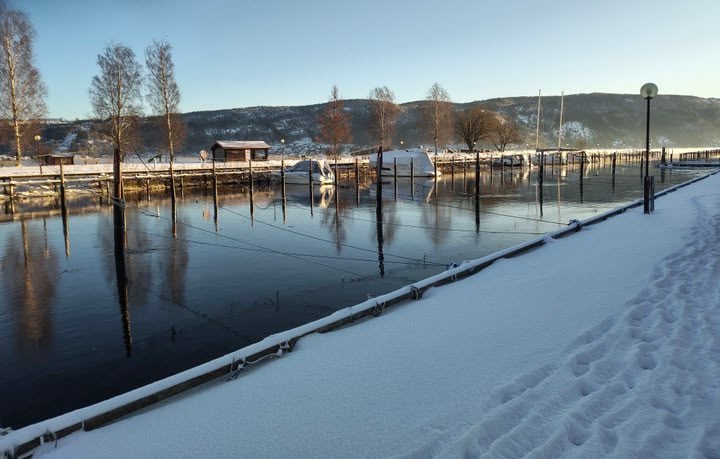
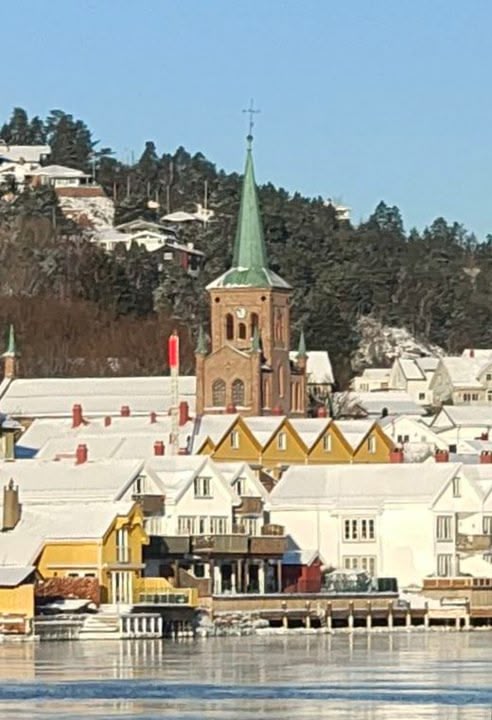
@Boeing It's the local Lutheran church in the middle of the village I live in. As far as I know such churches are not dedicated to saints, I'm not even sure that Lutherans believe in the idea.
@ninalanyon The church is moderately unusual in one respect and that is that it is oriented with the altar at the west end and the main door and tower at the east end. Most churches have the altar at the east end.
This church is relatively new, from sometime in the 1850s. But it is built on the site of a church from about 1200.
@Boeing The spire is clad with copper I think. The copper turns green on exposure to sulphuric acid in the atmosphere. The process takes several decades. The general form and construction of the spire is quite common here
@ninalanyon interesting, here orthodox churches and catholic face with their altar east. But there are exceptions, there is a huge church facing north. I don't know why. Is the copper transformation part of the initial design or it is a beautiful accident?
@Boeing I think that probably it has always been intended, even on buildings erected many centuries ago. After all you don't need to actually know how the chemistry works, you just observe that copper left exposed to the elements eventually turns green. You don't need to know that it's because of the copper sulphate layer that forms on the surface. People probably also noticed that once that layer was in place that further damage to the copper happened exceedingly slowly so it's a very good roofing material. Very expensive too of course so usually confined to important buildings like churches and even then to only parts of them.
Don't take my word for this though, I'm speculating about the historical details (not the chemistry).