@
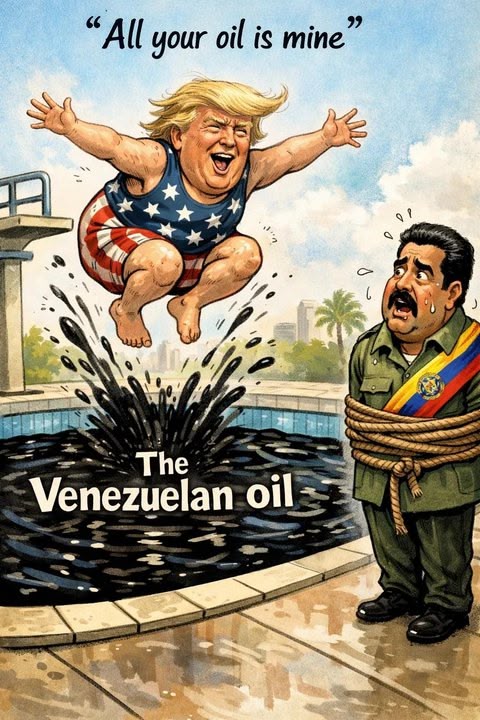
KiwiBird he said so much, that Venezuela stole US oil. The fact is that some oil companies, unfortunately most based in the US, made deals or took land in Venezuela and drilled wells to steal natural resources from Venezuela. That was sort of the standard in the days of big business controlling everything. Yes, they may have invested lots of their stock holders' money, but the fact remains that the companies benefitted by removing natural resources from the people of Venezuela.
Here is some information that I pulled very quickly and easily. Notice thiough it doe not show the return on investment for the US investors.
"US companies invested billions of dollars in Venezuela's oil industry over the 20th century, with estimates of over $5 billion invested before the 1976 nationalization alone. The precise total amount made and returned to the Venezuelan people is complex due to multiple nationalizations, ongoing legal battles, and the opaque nature of the state-owned oil company PDVSA's finances.
US Company Investment and Operations
Early Development: U.S. companies like Standard Oil (later Exxon), Gulf Oil, and Mobil were pioneers in developing Venezuela's oil industry in the early 20th century, investing heavily in infrastructure and exploration.
1976 Nationalization: The industry was nationalized in 1976, leading to the takeover of American subsidiaries. At the time, U.S. companies had invested more than $5 billion in the industry.
2007 Nationalization: After a period where foreign companies could return, former President Hugo Chávez initiated another nationalization process in 2007. ExxonMobil and ConocoPhillips refused to accept the new terms and left the country, with their assets seized.
Compensation: International arbitration courts later ordered Venezuela to pay ConocoPhillips over $10 billion and ExxonMobil over $1 billion in compensation, but Venezuela has only paid a fraction of these sums.
Current Status: Houston-based Chevron is the only major U.S. oil company currently operating in Venezuela, maintaining its presence under specific U.S. government licenses. Its profits do not directly benefit the Venezuelan government or PDVSA under the terms of the waiver.
Return of Revenue to the Venezuelan People
The extent to which oil profits were reinvested into public welfare is a subject of significant debate and political complexity.
State Control: All oil revenues flow through the state-owned company, PDVSA (Petróleos de Venezuela, S.A.), and the government ultimately determines how this income is used.
Revenue Decline and Mismanagement: While oil historically accounted for the vast majority of Venezuela's export revenues, production has dramatically declined due to mismanagement, corruption, and lack of investment. Oil export revenues plummeted from a peak of about $120 billion a year in 2012 to around $24 billion in 2023.
Lack of Transparency: The allocation of these funds is often opaque. For instance, PDVSA contributed $6.2 billion to government coffers in 2023, but there is little transparency on how much directly benefits the general populace versus being used for other state priorities or lost to corruption. The economic collapse in Venezuela has led to severe shortages of food and medicine, indicating that wealth distribution mechanisms have largely failed the people despite the country's vast oil reserves."
Searching for Return on Investment is very complicated , but it is clear that prior to the nationalization by Venezuela, foreign oil companies did very well:
The return on investment (ROI) for oil companies in Venezuela has varied drastically over time, but has generally been negative in recent decades due to nationalization, political instability, and mismanagement.
Key Insights
Historical Profitability (Pre-2000s): Foreign oil companies were highly profitable for much of the 20th century, particularly after the Hydrocarbon Laws of 1943 required 50% of profits to go to the state, and production peaked at 3.7 million barrels per day in 1970.
Nationalization and Decline (2000s-Present): Former President Hugo Chávez's government nationalized much of the oil sector in 2007, forcing foreign companies to accept minority stakes (less than 60%) in joint ventures with state-owned PDVSA, or leave the country. This resulted in a mass exodus of foreign investment and technical expertise, contributing to a massive decline in production to about 1 million barrels per day today.
Financial Losses & Legal Battles: Companies that were forced out, such as ExxonMobil and ConocoPhillips, pursued international arbitration and won billions of dollars in compensation awards for unlawful expropriation, though much of this debt remains unpaid. ConocoPhillips was awarded $8.37 billion plus interest in 2019, and ExxonMobil received a $1.6 billion award in 2014.
Current Situation: Currently, only a few foreign companies like Chevron still operate in Venezuela through joint ventures, primarily to recoup existing debt. Returns are limited, and experts indicate companies find higher returns investing in politically stable regions like the U.S.. Revitalizing the industry would require tens of billions of dollars in investment over at least a decade.