Asking
Only logged in members can reply and interact with the post.
Join SimilarWorlds for FREE »

Solar panels now produce more power than nuclear. Can they solve the middle east oil/war stranglehold too?


Photo above - Mary had a little lamb. And solar panels sharing the pasture, in an improved ecological outcome for everyone.


I’m still distressed when I see a hundred acres of continuous pasture or cornfield shaded out with solar panels. But that’s not where most of the new installations are being made. They now share space with sheep (50-50) in pastures and provide partial coverage on lakes and reservoirs to deter excessive algae growth – in addition to generating power.

The state of California recently flashed the bird at corporate electricity producers, and legalized “balcony solar panels” for renters. Who could have believed that politicians would take this long to screw over consumers, before finally relenting?

It's probably too soon to hold a funeral for additional nuclear installations. There are several companies betting the farm on “shipping container size” nuke plants, to be installed near rural towns, data centers, and factories. Sounds great until you start asking about how Hooterville is expected to provide a defense against terrorism and hacking directed against neighborhood nuke plant. ("Call 911 - the security cam just went blank" . . . ?)

Still, having solar panels surpass nuke power this year (10% of total power generation) seems like a good trend. A less favorable trend is watching giant turbine blades fall to earth daily due to manufacturing, installation, and engineering errors. If that happens in your sheep pasture there will be blood, probably.

As I write this morning, North Korea has apparently (again) stolen millions/billions in crypto. “Largest theft ever”. This can’t be good for Binance, Ethereum, Velshi etc. What happens when these live fast and die young mobile casinos finally establish decent security? Do state sponsored hackers turn to the American grid, and all those locally owned pasture/rooftop/reservoir installations? Better those than toward nuke plants, I guess.

I’m just sayin’ . . .


Solar Panels Are Now Producing So Much Power That They're Leaving Nuclear Plants in the Dust
Top | New | Old
samueltyler2 · 80-89, M
Recently we flew into Amsterdam. It seemed there were very few buildings without rooftop solar panels. We also saw may wind turbines.
Crazywaterspring · 61-69, M
@samueltyler2 The Dutch are very serious about being carbon neutral. Their target date is maybe 2030.
ArishMell · 70-79, M
I am afraid not, because solar and nuclear power-plants produce only electricity.

They do not produce the range of raw materials as well as fuels, available from petroleum.


You make a very serious point about security in your last paragraph.

I think everyone around the world (apart from China, North Korea, Russia and one or two others also responsible for most cyber-attacks), has sleepwalked into far too much dependence on the Internet.
whowasthatmaskedman · 70-79, M
The problem for commercial power generators is that solar panels are the thin end of the wedge. The next step is to make panels and other generating means a total replacement for the current grid, building homes and buildings that are self sustaining without connections. This sends the power generation industry the way of the buggy whip makers..This is already happening in individual cases. And as is the way with these things, the costs are coming down every year..😷
ArishMell · 70-79, M
@whowasthatmaskedman A country can't be made entirely"grid-less".

There are many users of electricity who would not be able to produce enough themselves. In the early days of mains electricity, towns had their own power-stations but it did not take everso long for everyone to realise that would be unsustainable.

Hence the concept of a relatively small number of big power-stations feeding a national network that supplies all users.

It may be possible to make a small house self-sufficient, but not a large factory, school, hospital, the railways, etc.; and the more you try to become self-sufficient with it the less efficient it becomes.

Besides, even your proposal would still need a huge electricity industry; making, installing and servicing the equipment.

There'd also be the question of resources: would there be enough material available for so many solar panels and batteries?
whowasthatmaskedman · 70-79, M
@ArishMell Not entirely No.. Industry and high density living pose difficulties that require a grid. But that grid can be much smaller than the "stop at every house"existing one and use less material and me less subject to breakdown and overload..😷
RachelLia2003 · 22-25, F
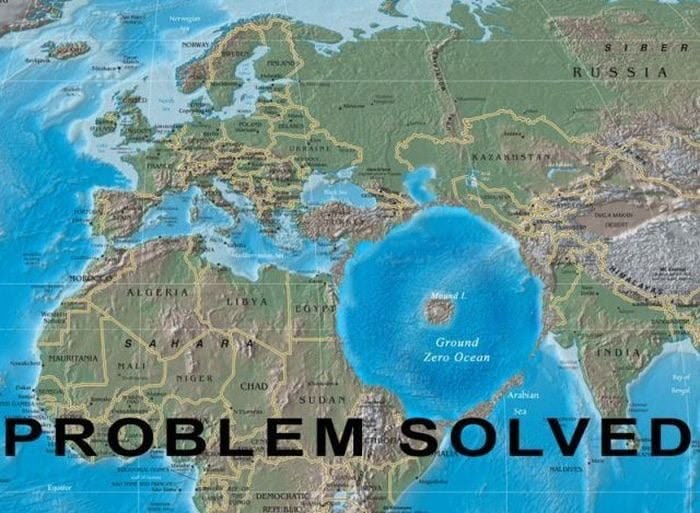
here is the solution für middle east

Crazywaterspring · 61-69, M
@RachelLia2003 Nudge it over to the west. The Zionist Republic loves to stir up wars and other problems.
RachelLia2003 · 22-25, F
@Crazywaterspring i want to extend the ring on the map but i dont want to offend more ppl😩 because ppl living in soft arse eu areas get offended more than ppl live in the ground zero ocean🫩
Thevy29 · 41-45, M
Perhaps, cutting back electronic gizmos maybe a better solution. Have only one TV in the house. Kick the kids outside till the street lights come on. Drink from taps instead of refrigerated purified water. Baseball bat/cricket bat instead of gaming consoles.
whowasthatmaskedman · 70-79, M
@Thevy29 Oh Look! A whole squadron of Flying Pigs!😂
ArishMell · 70-79, M
@Thevy29 Collectively we do waste vast quantities of electricity even if frugal individually.
wildbill83 · 41-45, M
no amount of solar, wind can ignore the fact that both are intermittent power sources that can only supplement main power grid, not replace it (it can provide additional power at peak loads). Only conventional power sources (coal, gas, hydro, nuclear, etc.) can provide consistent base loads

i.e. a 1gW solar farm only produces that amount during peak sunlight in perfect/clear weather when brand new (renewables degrade quickly compared to conventional sources, especially solar)

a 1gw nuclear produces that amount all day, 365 days a year, regardless of weather, and will last decades with little degradation.

 
Post Comment