Asking
Only logged in members can reply and interact with the post.
Join SimilarWorlds for FREE »

Goodbye electric VW ID Buzz. You died so young, and we wanted you so much.
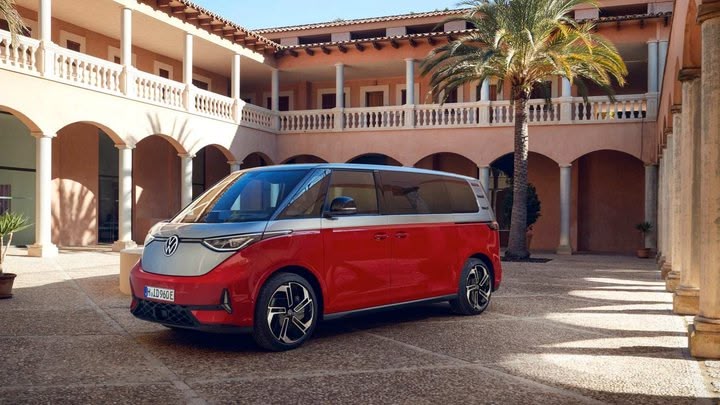


Photo above - VW's "ID Buzz" poses for a portrait outside of some rich guy's mansion. Production was cancelled this week because most people can't afford to buy it.

Okay, the first hint that things weren’t going well at VW was the ID Buzz unveiling in 2017 at the North American Auto Show. It took another 8 years for the 2025 model to begin arriving. Now it’s completely cancelled, after 1 year. (see MSN link below). In the meantime, VW had to pay a gazillion dollar fine to the EPA for deliberately faking it's diesel emission tests.

Although the headline says it costs $60,000, most of the early ID Buzz deliveries were in the $72-$75K range. Maybe higher if the dealer applied a markup to the sticker (“We only have the one in stock. Act now . . . it might be gone tomorrow . . . “)

It certainly IS a cute vehicle. Two tone paint, just like the $2,500 original decades ago. Gorgeous interior. Lotsa windows. But let's talk about the limited range, and long recharge times. Well, those are handicaps should have been expected. The other VW BEV (ID3) has the same problems. Well, we can’t expect EVERYONE to make great cars, right? And there was no point in VW waiting longer to bring the ID Buzz to America while trying to fix it's shortcomings. The ID Buzz wasn’t going to get any cheaper if VW waited, and minivans from competitors with more practicality and lower prices were showing up.

And there’s the missing $7,500 EV rebate. Did that hurt sales? Probably not, because the ID Buzz is totally manufactured and assembled in Europe, it NEVER qualified under Biden’s rules, let alone Trump’s. Which makes a $75,000 “well equipped” sticker all the more of a shock.

I’m rewatching “The Wire” as I write this. An episode where drug kingpin Stringer Bell is taking business courses at a community college. The professor engages Stringer in a dialogue about product quality, market saturation, and competitors. It’s clear that whoever at VW was managing the 8 yearlong ID Buzz project never took a community college course on these things.

I’m just sayin’ . . .


VW kills its $60K electric bus just 12 months after launch—2,600 vans ‘unsellable’ | Watch
This page is a permanent link to the reply below and its nested replies. See all post replies »
hippyjoe1955 · 70-79, M
Vehicles that use batteries as fuel tanks will be obsolete soon. Fun idea but in no way practical. Short range, long charge times, battery degeneration leading to huge expenses when the battery dies. Some insurance companies won't even cover them. Electric vehicles are a sign of government hubris not practical engineering.
SusanInFlorida · 31-35, F
@hippyjoe1955 solid state batteries are coming. eventually
GerOttman · 70-79, M
@SusanInFlorida need either buried charging lines in the road bed or quick change battery packs.
SusanInFlorida · 31-35, F
@GerOttman buried charging lines in roads will immediately cause nearby property values to spike. which could be a good thing if you have advance notice of where they will be installed, and start buying up adjacent land.
GerOttman · 70-79, M
@SusanInFlorida wouldn't need to be every road. just the big ones to keep the charge fresh. I like the quick change pack idea myself. Pull one out, drop it in the charger and slap in a fresh one. Would take less time than a fill up!
hippyjoe1955 · 70-79, M
@GerOttman So who is going to pay for the wires in the road and the electricity in the wires?
GerOttman · 70-79, M
@hippyjoe1955 it's metered like anything else
hippyjoe1955 · 70-79, M
@GerOttman So about the massive loss of electricity into the road...... Who is going to pay for that?
GerOttman · 70-79, M
@hippyjoe1955 what massive loss? who pays for anything?
hippyjoe1955 · 70-79, M
@GerOttman Just curious if you know anything about electricity? Not trying to be nasty but lets be honest here. Electricity wants to go to ground (earth) Once it is in the earth it dissipates and becomes nothing. That is why for many many years all electrical lines were on poles. The electricity couldn't get to ground. Now we have sufficiently insulated wires that we can run the wires under ground but that insulation prevents the electricity from doing any actual work say in a vehicle passing over top of the wire. If you remove the insulation to allow the electricity to reach the car the electricity would take a short cut and simply go to ground.
GerOttman · 70-79, M
@hippyjoe1955 I've worked in the electronics industry for about 40 years. its really the same tech that charges your phone wirelessly. just at a larger scale. And no, nothing like this currently exists. it's just an idea.
hippyjoe1955 · 70-79, M
@GerOttman Do you have any idea how much electricity is required to run a car? Spin the wheels and run the electronics maybe provide some climate control? Any idea at all? According to google it takes about 15 KWs to run one on a good day. How much electricity does your average phone charger transmit? about 15 watts. So to run a Tesla on a good day you would need about 1000 phone chargers. However there is a problem. You need a coil in the sending end (wire in the ground) and you need a coil in the receiving end. (car). So if you are going to charge as you go you will need a continuous coil that extends for hundreds? Thousands of miles? Sorry but the engineering just doesn't work on this.
GerOttman · 70-79, M
@hippyjoe1955 your math is probably close, I didn't say it was easy or 'currently' practical. It's doable from a technical standpoint. Like any advancement someone would have to do it first before anyone else can say "why didn't I think of that?"

the swapable battery pack is not really any less challenging. both would work in a general sense.
hippyjoe1955 · 70-79, M
@GerOttman I would think the swapped battery pack would be much superior to the wire in the road method. I think it would only take a bit of cooperation of the manufactures to come up with some standard batteries and some standard quick connects and batteries that don't belong to the owner of the vehicle. Call it a battery pool that covers both the cost of charging the battery and the cost of battery replacement every few years since batteries don't last very long. I suspect that would make the day to day running of an electric very very expensive which would then lead back to ICE vehicles.
GerOttman · 70-79, M
@hippyjoe1955 and then there is hydrogen... another time perhaps.
hippyjoe1955 · 70-79, M
@GerOttman Yeah hydrogen has many many problems including building tanks to hold it. It makes steel brittle as the hydrogen atoms simply go between the steel atoms and escape into the atmosphere. What nobody wants to address is how little damage and now much good the standard ICE vehicle is doing for plant life. Plants need CO2. Go to a greenhouse and watch as they generate CO2 and put it into the green house because CO2 is plant food.
SusanInFlorida · 31-35, F
@hippyjoe1955 a company has applied for a permit to build an indoor marijuana "grow farm" in our county (outside the city limits). Part of the permit involves the use of compressed C02 (carbon dioxide) to speed up the growth process.
hippyjoe1955 · 70-79, M
@SusanInFlorida Yes according to Dr Patrick Moore co-founder of Greenpeace the world needs more CO2 not less. The planet has stored vast quantities of it in coral and limestone and coal of the years of its existence which means it is running low. Plants need it as do animals which eat the plants.
