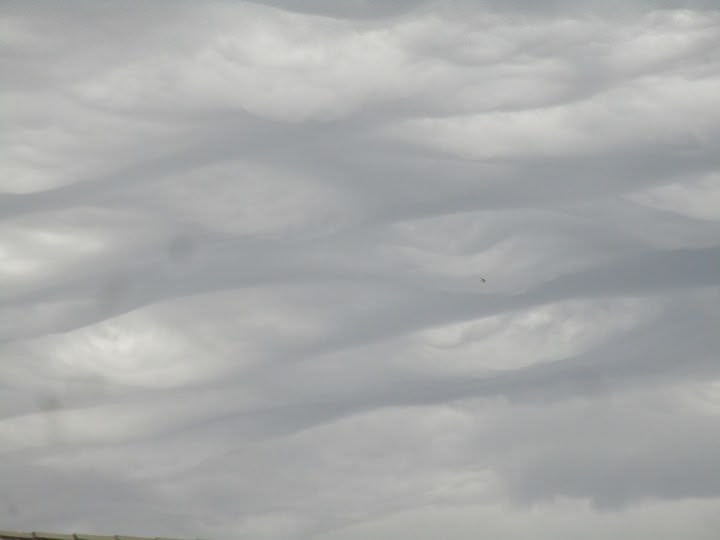
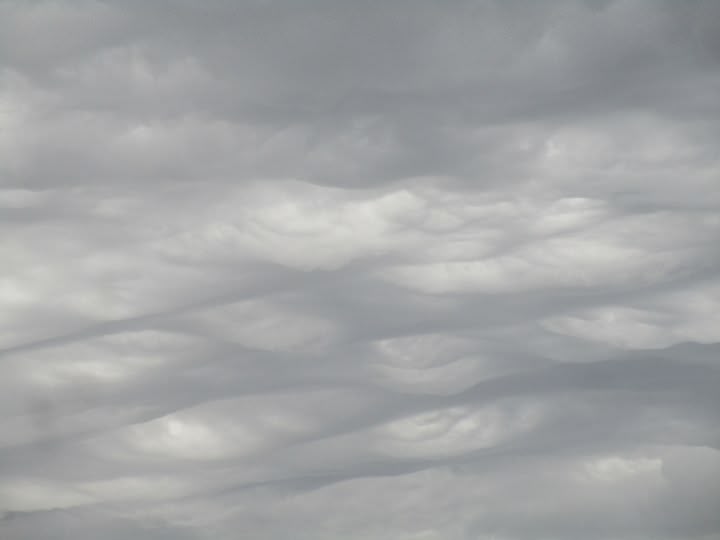
One sunny day at the My Lawley Cricket Ground, the game was a little tedious so I started cloud watching. Fascinating things clouds. They can appear from nowhere and just as quickly disappear to who knows where. We never look at clouds for more than a few seconds, on the whole. I thought I would show you what happens to many clouds if we look at them for a certain amount of time. Watch as this cloud disappears right before your eyes. [media=https://youtu.be/Ywr-m6ia4pU?si=bAhYKI69C31swoA-]
This is an even bigger cloud. Do you see all sorts of objects in the cloud shapes? I watch clouds are see them disappear before my eyes. I have even seen clouds appear out of thin air. :) [media=https://youtu.be/1Q2XcIXitpA?si=8RviTLv0HlcOqel2]
I look at clouds. There are a significant number of variations. I’m fascinated by them too.
Some come rolling in acting like no normal cloud, with a base of regular cloud stuff and a series of other darker clouds that look deliberate, stacked on top, like a display of marshmallows.
Yes; they come and go in all sorts of shapes and sizes.
I Iremember one hot Summer day watching little cumulus clouds form out of "nothing", drift a little way and fade into nothing again. I think they were over the coast a few miles away, and formed on thermals as the moist air above the sea came over the land.
@Gusman No, the water concentration has nothing to do with it.
When a bird flies into a cloud in theory (which it won't actually do in practice because it knows better), the bird will lose sight of the actual horizon, which is that line where the earth and sky meet in the distance.
Every bird that flies uses the earth's horizon to give itself reference to which direction "up" is. The horizon plus the earth plus the sky tells the bird which way 'up' is.
If a bird flew into a cloud and lost sight of the horizon, it would lose control of itself and would come tumbling out the bottom of the cloud and wouldn't regain control until it once again, made visual contact with the horizon, at which point the bird would 'right' itself and begin flying again.
The only bird in existence that will fly above the clouds is the Canada Goose.
Canada geese will not fly through a cloud, but will fly around a cloud or will fly through a hole in the cloud to find clear airspace somewhere above the cloud layer.
Flocks of Canada geese are routinely spotted by commercial pilots at altitudes reaching 12,000 feet during migration season in their attempt to migrate north or south without being hampered by a cloud layer enroute.
If the geese arrive over a resting destination and a thick cloud layer is below them, they will not descend through the cloud, but instead will literally enter a holding pattern in the clear air above the cloud until an opening in the cloud becomes evident, at which point they will descend down through the opening and land in a field to feed on grain, corn etc. Geese have been known to fly above the cloud in a holding pattern in excess of 24 hours straight.
Once on the ground, Canada geese will generally stay on the ground until the passage of a cold front which is followed immediately thereafter with clear skies in all cases. The passage of a warm front however, is typically followed by long periods of overcast skies and rain.
After the passage of a cold front, the Canada geese will then go airborne again and will fly in a 'V' formation to continue their journey.
Even if a pilot of a small airplane flew into a cloud WITHOUT instrument flying experience, he would become spatially disoriented within seconds of entering cloud because of his lack of visual reference with the earth's horizon. He would then lose control of his airplane within seconds which typically results in the aircraft coming out the bottom of the cloud in either an flat spin or a spiral dive.