[Psychology/sociology] Hierarchy of principles, values and morals.
I seem to be frequently posting in political posts about the hierarchy of:
Principles -> Values -> Morals.
This post serves as a reference link for those conversations.
While it is incomplete and may vary across different regions around the world. This AI generated list at least provides a starting point on what I mean.
Hierarchy of principles, values and morals.
Hierarchy of principles values and morals.
1.0 Principles
Principles are foundational truths or propositions that serve as the foundation for a system of belief or behavior. They provide guidance in decision-making and conduct. Here are some key principles:
1.1 Integrity: Adhering to moral and ethical standards. 1.2 Respect: Valuing others and considering their rights and feelings. 1.3 Justice: Ensuring fairness in treatment and decision-making. 1.4 Accountability: Taking responsibility for one’s actions and decisions. 1.5 Transparency: Being open and honest in communication. 1.6 Compassion: Showing empathy and concern for the welfare of others. 1.7 Courage: Acting in accordance with one's values, even in the face of adversity. 1.8 Human Dignity: Recognizing the intrinsic worth of every individual. 1.9 Sustainability: Making choices that protect the environment for future generations. 1.10 Equity: Ensuring fair treatment and opportunity for all.
2.0 Values
Values are deeply held beliefs that guide behavior and decision-making. They often reflect what individuals or societies deem important. Here are some common values:
2.1 Empathy: The ability to understand and share the feelings of another. 2.2 Honesty: Truthfulness in interactions and communications. 2.3 Loyalty: Commitment to friends, family, and organizations. 2.4 Family: Prioritizing relationships with family members. 2.5 Education: Valuing knowledge and learning. 2.6 Independence: Valuing self-reliance and personal freedom. 2.7 Community: Valuing relationships and contributions to society. 2.8 Creativity: Encouraging innovation and artistic expression. 2.9 Health: Prioritizing physical and mental well-being. 2.10 Hard Work: Valuing dedication and effort in achieving goals. 2.11 Freedom: Valuing the ability to act, speak, and think without hindrance.
3.0 Morals
Morals refer to the principles of right and wrong behavior; they often dictate how individuals ought to act. Here are some common morals:
3.1 Right and Wrong: Understanding the difference between ethical and unethical actions. 3.2 Fairness: Believing in just treatment for all individuals. 3.3 Honesty vs. Deceit: Valuing truthfulness over lying or cheating. 3.4 Respect for Others: Treating others with dignity and consideration. 3.5 Non-maleficence: Avoiding harm to others. 3.6 Empathy: Reflecting a moral obligation to understand and respond to the emotional experiences of others. 3.7 Beneficence: Promoting the welfare of others and helping when possible. 3.8 Justice: Advocating for fairness and equality in society. 3.9 Fidelity: Upholding promises and commitments. 3.10 Personal Morality: Upholding one's individual beliefs regarding ethical conduct in relationships. 3.11 Altruism: Acting selflessly for the benefit of others.
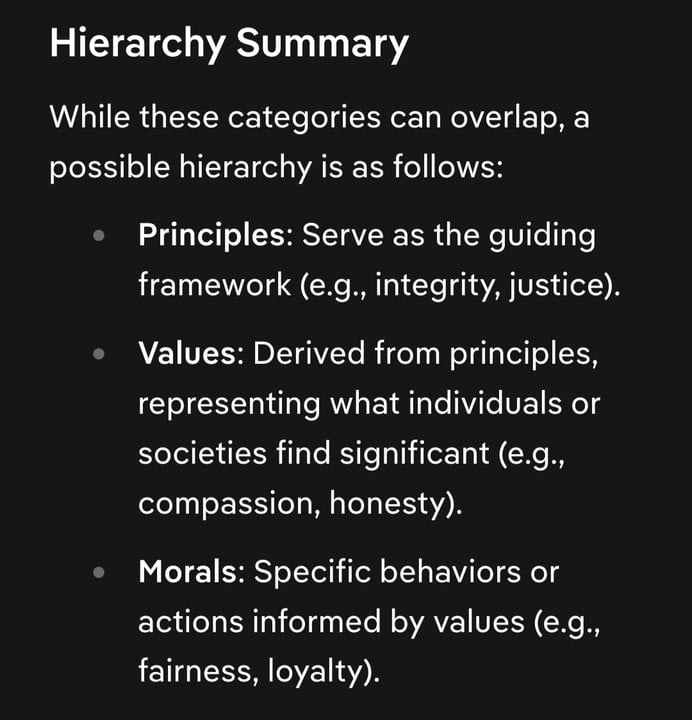
Hierarchy of Principles, Values, and Morals
While these categories can overlap, a possible hierarchy is as follows:
Principles: Serve as the guiding framework (e.g., integrity, justice). Values: Derived from principles, they represent what individuals or societies find significant (e.g., compassion, honesty). Morals: Specific behaviors or actions informed by values (e.g., fairness, loyalty).
BTW trolling will not be tolerated! I will delete such comments and replies.
It is also interesting how most would not dispute this yet will claim morality is universal and static when what follows from this is the exact opposite.
@PicturesOfABetterTomorrow I must admit I had some issues with the AI. Yet was able to resolve them through discussion and examples.
The problem with AI is it can only initially rely on it's initial training, often biased. If you give it examples, or other basic facts, it will change its own initial assessments.
An obvious basic fact is the actual date. It really does think it still 2023. And on every session without some type of different context, indicating a more recent timing, the AI will always assume it's 2023.
This becomes very problematic when referring to all current political situations.
Iranian Protests: Recent protests in Iran have centered around issues like personal freedoms, women's rights, and governmental accountability. This situation illustrates a significant clash between traditional values and emerging progressive ideals, highlighting the complexities of societal values in action.
Global Comparisons: While some regions may prioritize human rights and personal freedoms, others might enforce more conservative values. This distinction reflects how cultural contexts shape the interpretation and application of core principles like liberty and justice.
Impact of Regional Values: In Iran, the push for reform and greater personal freedoms signifies a desire for change rooted in a historical context. This contrasts sharply with how values are expressed in more liberal societies, like those in parts of Europe or North America.
Your point underscores the importance of using contemporary examples to illustrate the dynamics of values and principles. It’s a reminder that real-world events are crucial in understanding how these concepts play out in varied contexts.