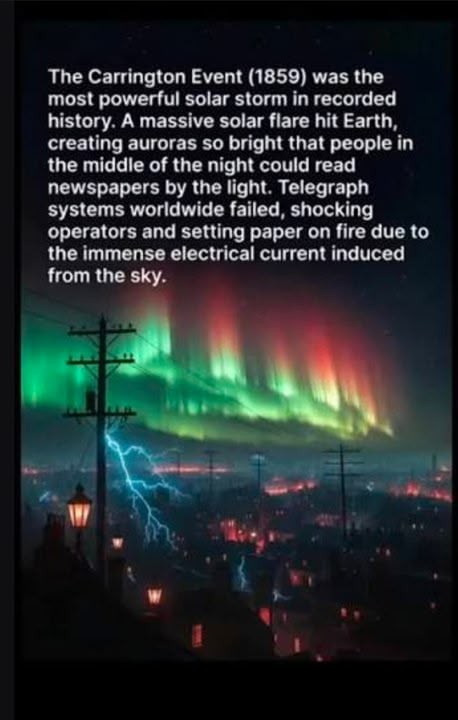
The Carrington Event of 1859 was the most intense geomagnetic storm in recorded history, caused by a massive solar flare and coronal mass ejection (CME) observed by British astronomer Richard Carrington. Striking Earth in roughly 17.6 hours, it caused global telegraph system failures, with sparks causing fires in offices, and produced brilliant auroras as far south as Hawaii, the Caribbean, and Mexico.
Solar Flare Observation: On September 1, 1859, Richard Carrington observed a dramatic burst of white light on the sun's surface, identifying the first-ever observed solar flare.
Massive Solar Storm: This event was associated with a huge coronal mass ejection, which traveled to Earth in just over 17 hours, much faster than the typical 2-3 days.
Global Impact on Technology: The geomagnetic storm induced massive currents in telegraph wires, allowing operators to send messages without power, causing operators to receive shocks, and setting paper on fire in stations across Europe and North America.
Unprecedented Auroras: Auroras were observed worldwide, including in tropical regions, allowing people to read newspapers at midnight due to the intense red light.
Modern Risk: Scientists emphasize that a similar, or stronger, Carrington-level event today could cripple power grids, global satellites, and communication networks. Probability: Research indicates a 10.3% chance of a similar storm occurring within the next decade.
@Bexsy Okay, I'll give it to you that your jokes are funny, but there are different degrees of funny. And I never said your jokes are not funny. The pasteurize joke was just less funny than your usual IMO.
Imagine what it would have been had it been 10-100 times stronger, like in 774, the Miyake Event. How many satellites would have fried, same with power stations.
@Northwest It could have been much worse. The Tunguska explosion of 1908 was possibly the result of a geomagnetic storm. That had the power and the strength of 100 atomic bombs. Luckily that occurred over an unpopulated area and it destroyed hundreds of acres of forests.
The Tunguska explosion of 1908 was possibly the result of a geomagnetic storm.
A geomagnetic storm is a disturbance in Earth's magnetosphere caused by the solar wind and charged particles crashing into our magnetic field. They heat the upper atmosphere, generate spectacular auroras, and can induce electrical currents that interfere with electronics and power grids.
Tunguska was the atmospheric explosion of a stony medium, 50-60 m, asteroid, at an altitude of 5-10 km leaving no impact crater. Magnitude 3-50 Megaton.