I remember stockpiling staple foods like dry beans & rice. I remember all the medical people I knew taking it very seriously. I remember various comments by tRump.
“Looks like by April, in theory, when it gets a little warmer, it miraculously goes away.” “very much under control,” “We’re going down, not up. We’re going very substantially down, not up.” “...when you have 15 people, and the 15 within a couple of days is going to be down to close to zero, that’s a pretty good job we’ve done.” “And it will go away. Just stay calm. It will go away.”
@FreddieUK A study of death certificates tells us that it wasn't simply a matter of mis-classifying other causes of death. mis-classification doesn't explain the huge increase in the number of US deaths.
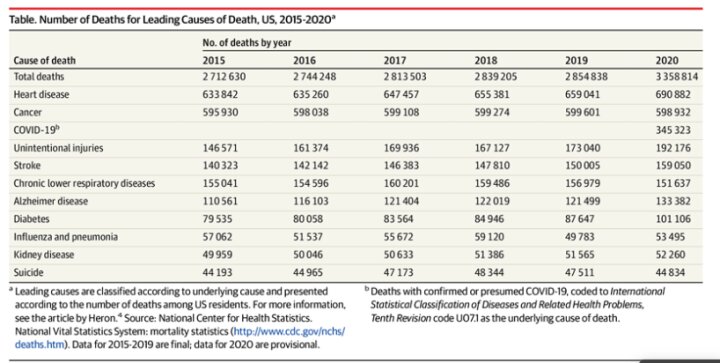
P.S. under this question I've also posted a more data-intensive table covering a six year period 2025-2020 comparing top ten causes of death based on death certificates.
@ElwoodBlues I think you may have misunderstood what I was saying to marine Bob. He said there were no flu cases. Neither of us said anything about deaths. I responded at the ordinary cases of flu that you normally have in the winter, will probably not diagnosed because people weren’t going to their GPs for routine appointments.
But if someone came down with flu-like symptoms, how would they know it was or wasn't COVID without going to a doctor or other health professional?
"You cannot tell the difference between flu and COVID-19 by the symptoms alone because many of the signs and symptoms are the same. Testing is needed to confirm a diagnosis. Having a medical professional administer a test that detects both flu and COVID-19 allows you to get diagnosed and treated for the specific virus you have more quickly."
But surely there must have been many that tested positive for flu when they went for their tests. But somehow, they were much below normal during the first year of COVID, then mysteriously went back to normal after that.
But somehow, they were much below normal during the first year of COVID
Yes, wearing masks and social distancing reduced flu transmission and infection. What @MarineBob said "no got the flu for a couple of years" isn't borne out by the data, but the masks & distancing explain the reduction.
The masks & distancing were so effective that one strain of influenza apparently went extinct during Covid.
... Back in 2020, the COVID virus managed to spread to every corner of the world despite all the isolation and masking. An unintended consequence of that strange, lonely year is a strain of flu known as B/Yamagata seems to have disappeared.
... Kevin R. McCarthy studies the coevolution of viruses at the University of Pittsburgh's Center for Vaccine Research. He says what happened with B/Yamagata was a big surprise. And if it is truly gone, this will be the first documented instance of a virus going extinct simply because people stayed away from each other. So social distancing can stamp out a virus, just not COVID.
@MarineBob @Thinkerbell @ElwoodBlues I'm going to put my emotions aside as best I can, but I expect that if I resort to name calling, some one of you will tell me to back the hell off, because this is a very triggering topic for me. I get extremely angry about it, as a lot of people know. So first I'm going to address Stinkerbelle's argument that due to the similar symptoms, it's harder to tell.
Let me tell you something, honey. From firsthand experience. I can tell. Okay? COVID is like no flu I've ever had in my life. It hits you like a freight train, and makes you not want to do anything. I've had the flu before, and I can power through it to get stuff done, and even go out and about to run errands. Not with that crap. It's the flu on steroids.
As for you, Bob, I see you're once again making positive assertions with no evidence. Sorry to tell you, but sarcasm isn't evidence.
"An unintended consequence of that strange, lonely year is a strain of flu known as B/Yamagata seems to have disappeared."
Very interesting... but then why did the flu rate go back to normal the very next year? Did people stop wearing masks and distancing? COVID hadn't gone away. Or did natural selection favor strains of flu that weren't stopped by masks and distancing? All within one year?
But then I read the article you linked, particularly the part that you omitted:
"Now, there were a couple of things working against B/Yamagata. For one,the strain of flu hasn't been around for decades, so there was population immunity.Also, it was in competition with another flu virus.
MCCARTHY: So the B/Yamagata strain co-circulates with sort of its twin, B/Victoria. And for the past few years, the Victoria lineage was winning the battle of global domination."
This means B/Yamagata was not a significant factor in causing flu immediately before, during or after 2020, so it looks as if B/Yamagata's supposed extinction is a red herring when it comes to explaining the one-year drop in flu cases.
So you were an outlier when it came to COVID symptoms. I've known people who tested positive for COVID with very mild symptoms. I've also known people with flu who could hardly get out of bed.
@Thinkerbell Don't get fixated on B/Yamagata alone. The linked article has influenza experts explaining that masking and distancing reduced flu transmission and infection.
but then why did the flu rate go back to normal the very next year? Did people stop wearing masks and distancing?
Pretty much. Covid vaccines became widely available in spring 2021. People who were vaccinated went back to a more normal lifestyle.
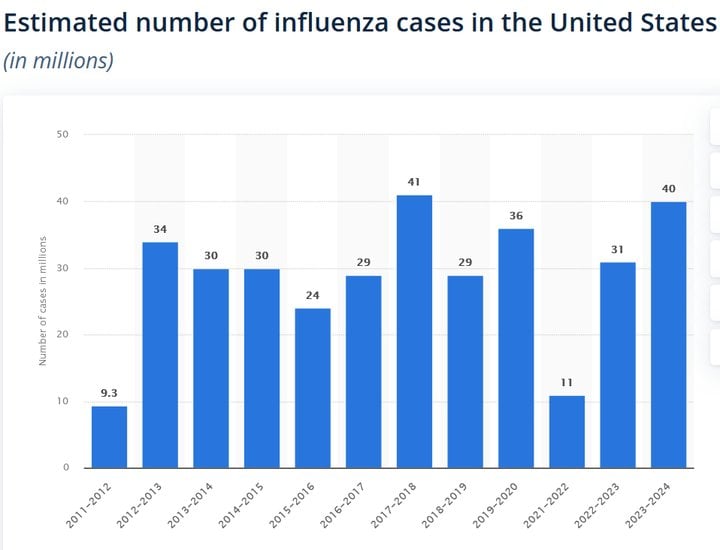
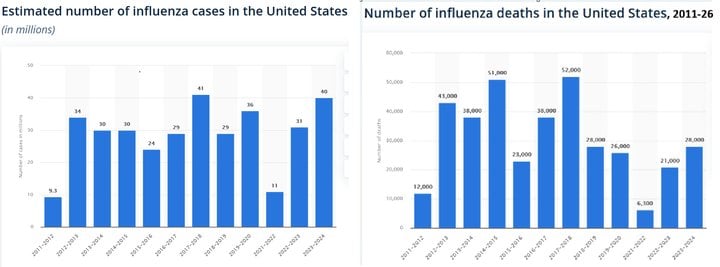
BTW, your data was estimated flu cases. Deaths are more closely examined; thus perhaps a better indicator of flu infection rate. It took a couple years for flu deaths to climb back up to pre-Covid levels.
So you were an outlier when it came to COVID symptoms. I've known people who tested positive for COVID with very mild symptoms. I've also known people with flu who could hardly get out of bed.
An outlier? Really? Because over a million Americans would disagree with you, if they weren't dead. But I suppose I should have guessed that you'd be one of those people who to lie on behalf of the virus. How much is the virus paying you?
Yes, they are outliers. The total number of COVID cases in the US has been about 103 million, of which there were about 1.1 million deaths, a mortality rate of about 1.09%.
Don't get too fixated on deaths alone; influenza can have death rates that can vary by factors of 2 or more from year to year, depending on the strain.
For example, the estimated number of cases was about the same for 2011-2012 and 2021-2022, but the number of deaths was about twice as high in 2011.
As your graph shows, 50,000 flu deaths is a bad flu year. Covid was on another level before vaccines became available.
Here in the table are US death numbers for the top ten causes of death for six years ending in 2020. Notice how there are 20% more deaths in 2020 than the average of the previous five years? Doing the math, that's 500,000 excess deaths in 2020. I n 2020, 345,000 of those 500,000 excess deaths were classified as Covid. That's SEVEN TIMES a bad flu year.
I personally knew only one person who (probably) died of COVID. I know no one who has been permanently disabled by it, or at least they haven't made it known to me.
@Thinkerbell There are medical records, however. Millions of people reported having permanent effects bad enough to prevent them from working the jobs they had before they got sick.
I never said COVID didn't cause many more deaths than flu
Yet you keep trying to compare Covid with the flu. As long as you're trying to imply they are similar, I'm going to keep underlining the crucial differences.
I personally knew only one
When I went to school, they taught us that the plural of 'anecdote' is not 'data.'
"Yet you keep trying to compare Covid with the flu."
Wrong again, Ellie. The only comparison I made had to do with symptoms, and I gave a source that confirmed you cannot distinguish COVID from flu by symptoms alone. One needs to be tested.
"When I went to school, they taught us that the plural of 'anecdote' is not 'data.' "
Don't you ever get tired of fudging, Ellie? 🙄
My personal anecdote was said in response to Lord Shadowfire's personal anecdote, and not posted as data, as you should very well have known. Context, Ellie, Context.
I also note that you omitted to chide LSF's anecdote, an omission made for obvious reasons. 😂 🤣 😂 🤣 😂 🤣
"And old Ellie never faltered, never once his nonsense altered, Always fudged and always paltered, on SW's rancid shore..."
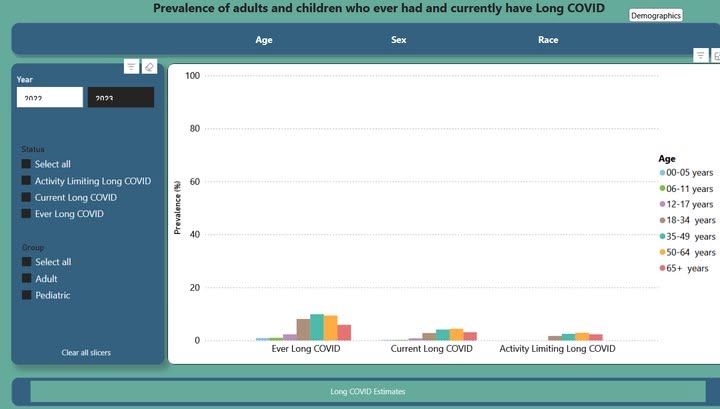
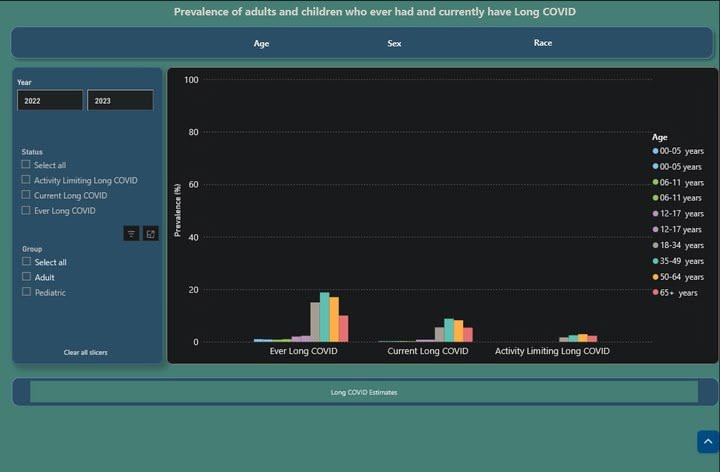
@Thinkerbell Gosh, I went to that same CDC site and got a completely different graph. I think you failed to click the right options. Sloppy work!!
This version of the chart you linked showed 20% rate of long Covid. NOT an outlier at 20%, not at all!
Pubmed includes a meta study covering 19 observational studies. It corroborates the 20% rate shown above.
Approximately 13–28% of patients experienced long-term persistent symptoms 2–12 months after diagnosis, including fever, sore throat, cough, muscle or body pain, loss of taste or smell, and diarrhoea, similar to those seen in the acute phase of COVID-19