Denmark has regained the US, Trump has fled to North Korea
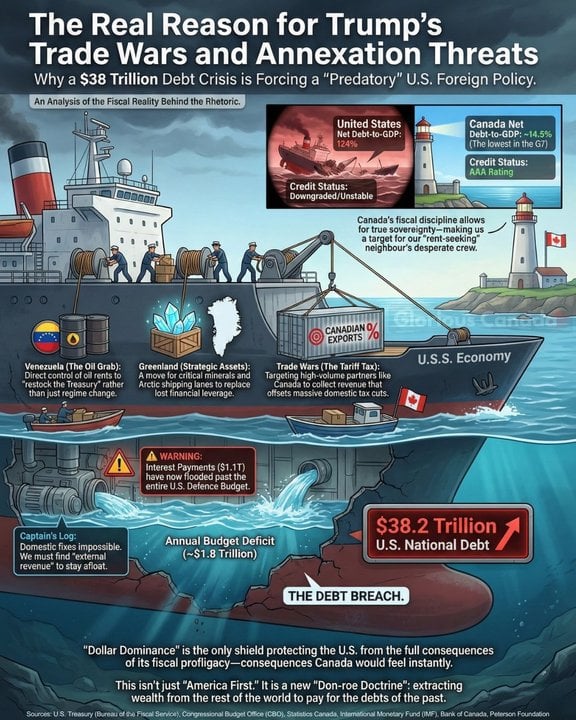
For decades, the United States projected power through ideology and military might, but in 2026, the primary driver of American foreign policy has shifted toward a strategy of rent-seeking (International Monetary Fund). As the U.S. national debt reaches a catastrophic $38.2 trillion (U.S. Treasury Bureau of the Fiscal Service), the White House is no longer just looking for global allies; it is hunting for revenue streams to prevent a total domestic fiscal collapse (Congressional Budget Office). The Math Problem That Can’t Be Ignored The foundation of this global shift is a brutal and undeniable calculation (International Monetary Fund). The United States is currently running an annual budget deficit of $1.8 trillion (Congressional Budget Office), which represents roughly 6.2% of its total GDP (Bureau of Economic Analysis). This is not "business as usual," as the net interest payments required to service this massive debt have climbed to roughly $1.1 trillion (U.S. Treasury). For the first time in history, these interest obligations have officially surpassed the entire U.S. defence budget (U.S. Department of Defense). Because the American political class has reconciled the desire for high government spending with low taxes through decades of borrowing, the country has hit an intractable tipping point (International Monetary Fund). With domestic tax hikes and spending cuts deemed politically impossible, the administration is now looking outward to find "external revenue" to keep the American programme afloat (Peterson Foundation). The Canadian Contrast: Stability as a Target While the U.S. struggles with a gross debt-to-GDP ratio of 124% and a downgraded credit status (International Monetary Fund), Canada remains a global outlier of fiscal discipline (Statistics Canada). - G7 Leadership: Canada maintains the lowest net debt-to-GDP ratio in the G7, currently sitting at approximately 14.5% (International Monetary Fund). - AAA Sovereignty: While the U.S. credit rating faces increasing pressure, Canada continues to maintain a AAA rating from major agencies, which preserves its national sovereignty (S&P Global). - The Revenue Target: This fiscal stability, however, has ironically turned Canada into a target for its neighbour (World Trade Organization). - Trade Extraction: Because Canada is a high-volume trade partner with manageable debt, the U.S. views Canadian exports as a lucrative "tax base" that can be tapped through aggressive tariffs to offset its own domestic shortfall (U.S. Department of Commerce). The Three Pillars of the "Don-roe Doctrine" The 2026 "Don-roe Doctrine" is fundamentally about resource extraction rather than regional security (U.S. Department of State). Each major move by the administration is a calculated attempt to restock a depleted U.S. Treasury: 1. Venezuela (The Oil Grab): The seizure of Venezuelan oil rents—estimated at 50 to 60 million barrels of crude—is a direct move to capture energy wealth for the U.S. Treasury rather than local development (U.S. Energy Information Administration). 2. Greenland (Strategic Assets): Annexation threats are driven by Greenland’s massive deposits of rare earth minerals and its control over emerging Arctic shipping routes (U.S. Geological Survey). These serve as non-financial forms of leverage designed to maintain U.S. power as "Dollar Dominance" faces global skepticism (Federal Reserve). 3. Trade Wars (The Tariff Tax): Tariffs have transitioned from trade protection tools to primary revenue tools (U.S. Customs and Border Protection). By targeting partners like Canada, the U.S. is attempting to extract the funds necessary to cover its interest obligations without asking American voters for more money (Congressional Budget Office). The Final Verdict The only shield currently protecting the U.S. from the full consequences of its fiscal profligacy is the global status of the U.S. Dollar (Federal Reserve Bank of New York). However, the world is now witnessing a superpower transitioning into a opportunistic foreign policy (World Bank). This is a coordinated exploitation of smaller powers by a larger power to pay for the debts of the past (United Nations Conference on Trade and Development).
If the USA were just another country, it would be bankrupt and face severe fiscal demands from the IMF. Does anyone remember the so-called “Structural Adjustment” programs of the past? That is what is urgently needed for the USA