EV public chargers now cost more per mile than a gas pump?
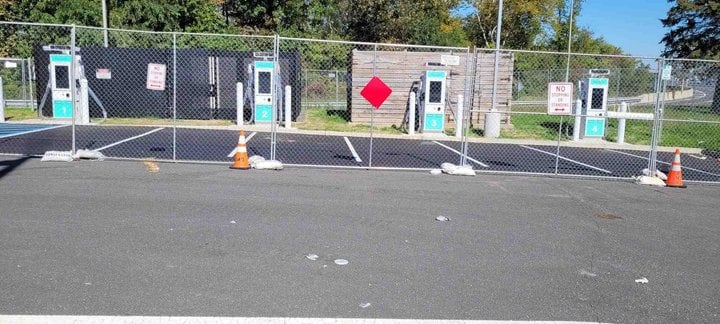
Photo above - now open to the public! DC fast charging stations at the Molly Pitcher Service area (NJ Turnpike, Cranbury exit). But is the 58 cents per KwH rate fair?
Full disclosure: I don’t own an EV. I drive a Civic hybrid (49 mpg per EPA). I have a hybrid because I live in an apartment, and don’t have access to a charger at residential electricity rates. According to the latest data, anyone who uses a public charger is officially a financial idiot. (See EVSHIFT link, below).
I guess we one should have expected public chargers to quickly become a ripoff. The previous administration showered $7.5 billion in subsidies on charging network companies. This began after the 2021 Bipartisan Infrastructure law passed, so no matter which political party you swear by, everyone is part of the problem.
That $7.5 billion bought us about 200,000 level 2 ports, and 70,000 DC fast charging ports (as of April 12, 2026). That comes out to $27,272 per port. About 10X what it costs to put a Level 2 charger in your garage (<$3,000) - if you could afford to buy a house. I’m guessing that most of bloat in this $7.5 billion giveaway relates directly to the DC fast chargers, which allow you to refuel in under 30 minutes, instead of cooling your heels for an hour and a half or more at some sketchy location off the interstate.
How much does public charging cost, now that the introductory period is over? Level 2 remains somewhat affordable at 30 cents per KwH (national average). That’s only double residential electric rates, so it doesn’t immediately make your head explode. DC fast charging is now $0.45 to $065 per KwH. Let's assume the average is 55 cents. More than triple what your local electric company is allowed to get away with for keeping your refrigerator and lights on.
The EV public charger scheme was never intended to provide affordable charging. Those subsidies were to eliminate range anxiety, the first emotion you feel after you collect your $7,500 EV tax rebate and drive it off the lot.
Once subsidies ended, reality returned. The installation of new (unsubsidized) public chargers has fallen to virtually zero (see link below). Some states are actually reporting a shrinkage in the number public EV stations, although this may be due to the reluctance of owner/operators to replace those $500 copper cables which are so popular with scrap metal thieves. There’s an additional cost of $1,000-$3,000 in cable replacement labor, and no guarantee that Reginald “Bubs” Cousins (The Wire) won’t be back again 2 days later with his hacksaw. Security cams don’t help, as we saw with the Nancy Guthrie abduction.
If you drive a Tesla Model Y (Americas most ubiquitous EV) you’re getting about 4 miles per KwH. When you plug into a public charger at 55 cents per KwH, that’s 14 cents per mile. (check my math). You might see the problem. Even at $4.00 a gallon for unleaded regular, my Civic hybrid costs 8 cents a mile to drive. A gas-powered Ford 150 at 25 mpg is about the same cost per mile as that publicly charged Tesla Y.
The EV math got worse a LOT faster than anyone anticipated, once the government stopped using subsidies to mask the real cost. Greedy EV charging station network owners aren’t helping.
Perhaps the best solution is to return to the original concept – put a level 2 charger in your own garage and pray that rates don’t go above today’s 17 cents per KwH. And that nobody builds a massive data center in your town, sending rates to the moon.
I’m just sayin’ . . .
https://www.evshift.com/439452/ev-charging-used-to-be-free-then-it-was-cheaper-than-gas-now-some-fast-chargers-cost-more-per-mile-than-a-gas-pump/
https://usevchargingstations.info/blog/april-12-2026-ev-charging-station-updates/