Asking
Only logged in members can reply and interact with the post.
Join SimilarWorlds for FREE »

Bollinger motors dies after 10 years, without delivering a single vehicle. The good news: Michigan taxpayers only lost $3 million subsidizing it.


Photo above - which of these EV trucks cancelled production this month? Trick question - both Bollinger AND Ford did . . . .

Were you an angel investor who put money into Bollinger motors? I tried to get a list, and the only names I could come up with were “Robert Bollinger” ($148MM), Mullen Automotive (<$10MM) and “Michigan Governor Whitmer" ($3MM), without consulting the state's taxpayers. There may be other investors, but they declined to have their identities revealed on the internet.

You’re all at zero now.

Bollinger sent an email this week to the 60 employees who were suing for unpaid wages. Essentially: “Sorry, we went bankrupt. Again. Good luck and have a nice life.” Apparently no emails were sent to Governor Whitmer, Michigan's taxpayers, or the Detroit Free Press.

I take no joy in announcing the death of another fantasy-based EV carmaker. Trump’s abandonment of EV subsidies will undoubtedly be blamed for Bollinger's self destructdion, but let’s face reality here. The company had 10 years to bring it’s EV truck to market. Zero were sold to actual consumers. Apparently 30 were loaned/leased to some company years ago. Good luck getting spare parts for those now.

The Bollinger B2’s fatal flaw – other than being named after an outrageously overpriced Air Force bomber? It was outrageously overpriced itself, at $120,000. And also there were no showrooms, no mall kiosks to take a test drive, or websites to get in line for later delivery.

Ford ended i'ts F150 platinum EV truck production a few weeks ago, in case you hadn’t heard. Announced on November 6th. This follows a fire at Ford aluminum plant. A restaurant near my home burned down too. Arson investigators are still at work there. How do you set aluminum on fire anyway? That stuff has a melting point of 1,220 degrees! An unattended candle or pile of oily rags won’t get the job done.

Ford used to claim that 150,000 F150 Lighting trucks have been sold. Don’t you believe it. Actual production numbers for all 4 years barely cracked 100,000 units, and tens of thousands of those are still sitting on dealer lots and at factory storage facilities.

So why did the F150 lightning die? At one point Ford was even giving away a “free” home charging unit (level 2) if you agreed to buy or lease their truck. But the sticker price started at about $80,000, and it had crappy towing/range capability unless you spend tens of thousands more on extended batteries and other upgrades. Ford lives in a bubble and apparently never realized that most F50’s are parked outside, because they are too long, wide, and tall to fit in a garage. So the “free” chargers are kind of useless unless you run 240 volt-80 amp service from your basement to a standalone outdoor kiosk which shelters protect your charger from rain and snow. A mini-garage for your charger.

Tesla Cybertruck . . . I'm looking at you. Your base model starting price is $82,236. Do you have some sort of announcement on future production?

I'm just sayin' . . .


Whitmer’s Michigan: EV start-up Bollinger Motors 'to officially close the doors' despite $3 million from taxpayers - The Midwesterner

Bollinger Motors - Wikipedia

Ford F-150 Lightning Sales Numbers, Figures, Results

Ford reportedly considers ending production of F-150 Lightning EV
Top | New | Old
@AthrillatheHunt says
in the end we will find EV batteries do way more damage to the planet than CO2 emissions
Really??? The main difference between an EV and an ICE is the battery.

A Tesla Model 3 battery contains about 40Kg of lithium; the Model Y is around 75Kg. This battery lasts the lifetime of the car -- 120,000 miles.

A typical American car gets 25mpg; goes 12,000 miles per year; 480 gallons/year or 2976 lbs/year. With the same 10 year service life, the care will burn close to 30,000 lbs of gas in its lifetime. Also, 42-gallon barrel of crude oil yields approximately 19 to 20 gallons of gasoline, so over the lifetime of the car, over 60,000 pounds of crude need to be pumped and refined to operate the car.

Are you honestly trying to claim that extracting and refining 75Kg of lithium (165 lbs) is worse for the planet than extracting and refining 60,000 pounds of crude oil, then burning half?? You're saying that lithium recovery is pound for pound 340X worse for the planet than oil recovery??


UPDATE


If you're wondering what happens to the battery after the car is junked, lithium is 95% recyclable, according to Redwood Materials who has contracts with Toyota, Ford, GM, VW, and several other car makers.

If you're wondering about the fuel used to make electricity to charge electric cars, utility powerplants are about twice as efficient as typical internal combustion engines driving on roads.
@SusanInFlorida Industrial aluminum is recycled at a 90% rate according to https://www.aluminum.org/Recycling. Unlike used cans, used cars are not discarded in the landscape. Similarly, 92% of steel is recycled in North America each year https://stispfa.org/library-resources/steel-sustainability/.

Thus it's reasonable to treat used lithium traction batteries as industrial and recycled at 90%+, similar rates to industrial steel and aluminum.
SusanInFlorida · 31-35, F
@ElwoodBlues hilariously confusing array of charts, dealing with theoretical outcomes 5-25 years in the future.

bottom line - your chart shows the now defunct "nissan leaf" as the most fuel efficient car in america.

thank you, elwood!
@SusanInFlorida says
hilariously confusing array of charts,
Yes, it's aimed at the college level. Apologies; I didn't realize that was such a challenge to you🤣😂

BTW, Nissan is releasing a new Leaf with more charging options and longer range; some call it "progress."

The essential point, which I will restate for you here, is that over the lifetime of the vehicles, the electric car has a much lower overall cost and much smaller carbon footprint than the comparable gas car.
@SusanInFlorida says
this is true if you ignore the fact that coal is dirtier than fuel oil,
WRONG!

Using the actual mix of electricity generation sources in the US (62% fossil), this MIT lifetime vehicle study found electric vehicles far cleaner as well as cheaper to operate.
https://pubs.acs.org/doi/full/10.1021/acs.est.6b00177

Here's a study that breaks down the costs in more detail
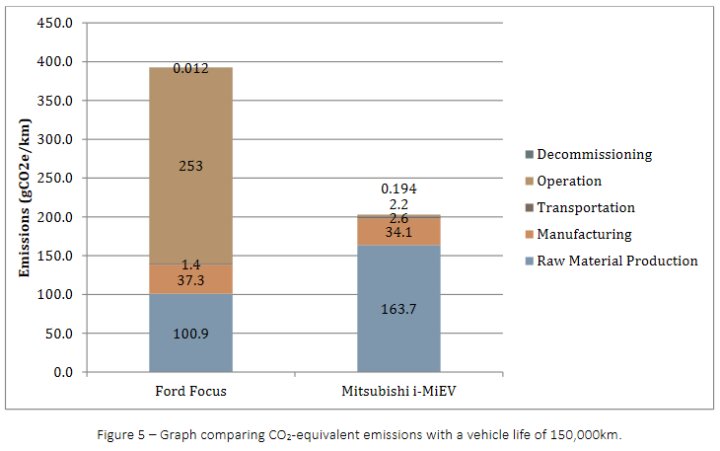
Lifecycle CO2 costs (these include extracting & transporting oil)

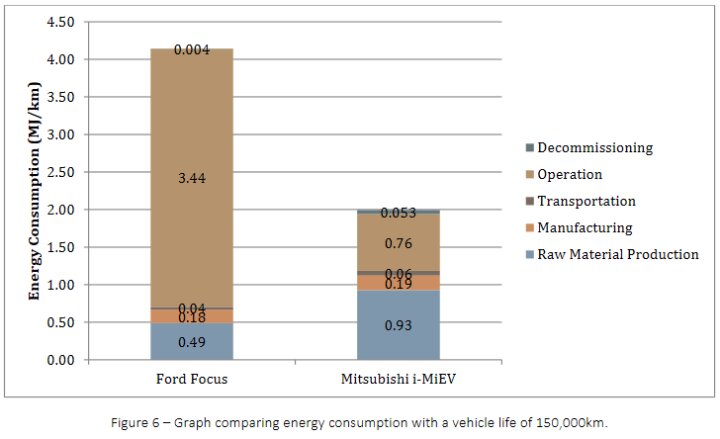
Lifecycle energy costs
Source: https://sustain.ubc.ca/sites/default/files/2018-63%20Lifecycle%20Analysis%20of%20Electric%20Vehicles_Kukreja.pdf

These graphs are for Vancouver CA in 2018, so energy costs are similar to the US; however energy is represented in megajoules - there are 3.6 MJ in a KWH, and 1 MJ = .37 horsepower hours. It assumes 150,000Km of travel over the life of the car, about 93,000 miles.

Electric cars have a FAR lower lifetime CO2 footprint and a FAR lower lifetime energy footprint. Since energy correlates closely to dollars, it means electric cars have a far lower total cost of ownership.
GerOttman · 70-79, M
I had a SPAC that went EV back in the day! Pffttt...

Good times, good times..

Still watching Rivan though!
This comment is hidden. Show Comment
SW-User
What made you hate EVs so much? Are you that desperate for us to wreck the planet?
GerOttman · 70-79, M
@SW-User somehow I had a feeling that it was all Trumps fault... It just makes sense!
SW-User
@GerOttman glad you’ve woken up.
GerOttman · 70-79, M
@SW-User

Yeahhhhhh.....
meJess · F
lol Bollinger motors, so we know what they spent the money on.


Post Comment