





TexChik · F
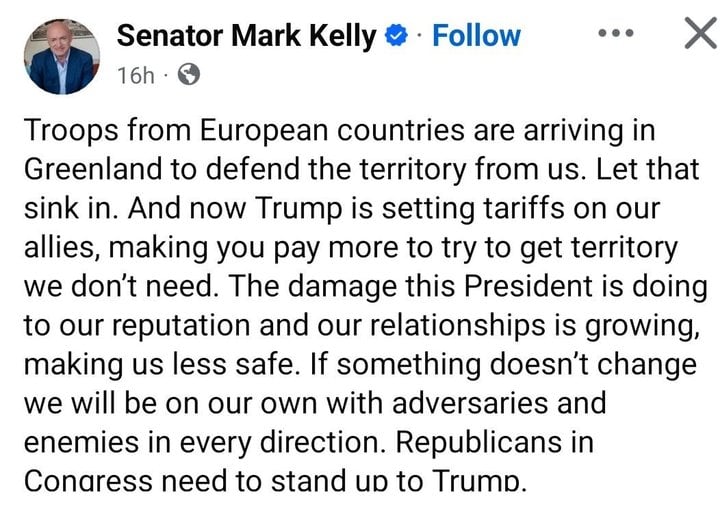
Only for the TDS crowd! America puts Anerican lives at risk and spends American dollars defending it, much more than any other NATO alliance country.
To claim sovereignty in Greenkand the Danes must maintain a population there, have built infrastructure there, and maintain it. They don’t.
Until Trump wanted it Greenland was a block of ice that Russia and China were exploiting.
When NATO understands that without the US, there will be no NATO or protection from Russia and China.they will realize, in that moment, they F'd up
To claim sovereignty in Greenkand the Danes must maintain a population there, have built infrastructure there, and maintain it. They don’t.
Until Trump wanted it Greenland was a block of ice that Russia and China were exploiting.
When NATO understands that without the US, there will be no NATO or protection from Russia and China.they will realize, in that moment, they F'd up

View 11 more replies »

ArishMell · 70-79, M
@SunshineGirl On which goods or services, for what purpose, though?
That seems an odd choice: I'd have thought it far more likely the EU would impose tariffs on all the United States, or none. Not specific ones, though of course a blanket tax may reduce exports from states who are the only suppliers - and put up the prices in the importing countries.
Tariffs are not imposed on countries in those countries, of course, but on imports from them; and paid by the eventual customers in the importing country.
I know politicians and some journalists keep saying "... imposed on [country name]" but I wish they would not do so.
That seems an odd choice: I'd have thought it far more likely the EU would impose tariffs on all the United States, or none. Not specific ones, though of course a blanket tax may reduce exports from states who are the only suppliers - and put up the prices in the importing countries.
Tariffs are not imposed on countries in those countries, of course, but on imports from them; and paid by the eventual customers in the importing country.
I know politicians and some journalists keep saying "... imposed on [country name]" but I wish they would not do so.

TexChik · F
@SunshineGirl Doesnt matter

FreddieUK · 70-79, M
@ArishMell The two seem very much aligned at the moment, as he claims that his international actions are there to protect the US national interests. They seem to be many over there who would beg to differ about the internal imperatives and we certainly can't understand the reasoning behind taking a piece of sovereign land for which you already has permission to place troops.
ArishMell · 70-79, M
@FreddieUK It is baffling, and Trump has changed gear again. He is now claiming "world" security.
His stated reason is that if the USA does not take Greenland then China and/or Russia will. Whether that is so or is simply Mr. Trump's opinion, he effectively puts the USA in the same position as he alleges of those two bellicose countries.
I see no need for any of those three to seize Greenland anyway, for their own military defence. I think any future war is more likely to be covert including using the Internet to subvert the politics and cripple the public utilities, than simple fire-power.
In that regard the USA is as much in danger as any other country - and ironically her cyber-attackers would be helped by the near world-wide domination of the Internet by huge US corporations.
In extremis we can all only hope that the Pentagon's own computers can no longer be hacked by someone like an autistic teenager in London, as happened I think about twenty years ago. I don't know the outcome but the US Government should have given him a medal, not demanded extradition for trial and likely life imprisonment!
Strategically, I think the USA might have more to fear by looking North-West rather than North-East. Alaska with its oil (and other minerals?), and the narrow Bering Strait with a small US-owned island in the middle, is far closer than Greenland to Russia and China. There are actually two islands, the larger being Russian territory.
The best protection so far perhaps is that although the NE tip of Siberia is only about 70 miles from Alaska at nearest, it is very remote, wild and empty. It may be earmarked for development though. (See for example the Interbering website for background and rationale to its grandiosely reviving an old proposal for a railway tunnel linking the two territories.)
Anyway, if Russia attacked Alaska or the NW seaboard of the American mainland, obviously the USA would expect her NATO allies, especially Canada, to help defend it.
.....
So if there is no strategic rationale to the USA taking the sovereign territory of a NATO ally, perhaps we come back to the potential of Greenland holding valuable ores whose accessibility will increase with climate-change removing the ice cover. Back in 2016, Mr. Trump waffled about wanting to buy Greenland, at the same time as trying to deny climate-change and attempts to minimise it. Surely I can't have been the only one who saw the link?
....
[Good thing I re-read that penultimate sentence. I'd typed "...Mt. Trump...", so corrected it . On the other hand......
His stated reason is that if the USA does not take Greenland then China and/or Russia will. Whether that is so or is simply Mr. Trump's opinion, he effectively puts the USA in the same position as he alleges of those two bellicose countries.
I see no need for any of those three to seize Greenland anyway, for their own military defence. I think any future war is more likely to be covert including using the Internet to subvert the politics and cripple the public utilities, than simple fire-power.
In that regard the USA is as much in danger as any other country - and ironically her cyber-attackers would be helped by the near world-wide domination of the Internet by huge US corporations.
In extremis we can all only hope that the Pentagon's own computers can no longer be hacked by someone like an autistic teenager in London, as happened I think about twenty years ago. I don't know the outcome but the US Government should have given him a medal, not demanded extradition for trial and likely life imprisonment!
Strategically, I think the USA might have more to fear by looking North-West rather than North-East. Alaska with its oil (and other minerals?), and the narrow Bering Strait with a small US-owned island in the middle, is far closer than Greenland to Russia and China. There are actually two islands, the larger being Russian territory.
The best protection so far perhaps is that although the NE tip of Siberia is only about 70 miles from Alaska at nearest, it is very remote, wild and empty. It may be earmarked for development though. (See for example the Interbering website for background and rationale to its grandiosely reviving an old proposal for a railway tunnel linking the two territories.)
Anyway, if Russia attacked Alaska or the NW seaboard of the American mainland, obviously the USA would expect her NATO allies, especially Canada, to help defend it.
.....
So if there is no strategic rationale to the USA taking the sovereign territory of a NATO ally, perhaps we come back to the potential of Greenland holding valuable ores whose accessibility will increase with climate-change removing the ice cover. Back in 2016, Mr. Trump waffled about wanting to buy Greenland, at the same time as trying to deny climate-change and attempts to minimise it. Surely I can't have been the only one who saw the link?
....
[Good thing I re-read that penultimate sentence. I'd typed "...Mt. Trump...", so corrected it . On the other hand......

22Michelle · 70-79, T
@peterlee There's more than two.

