978Edward the Martyr, King of England and the eldest son of King Edgar, was murdered at Corfe Castle. . The murder is thought to have been ordered by his stepmother Aelfryth, mother of Ethelred the Unready who was eager to see her son crowned.
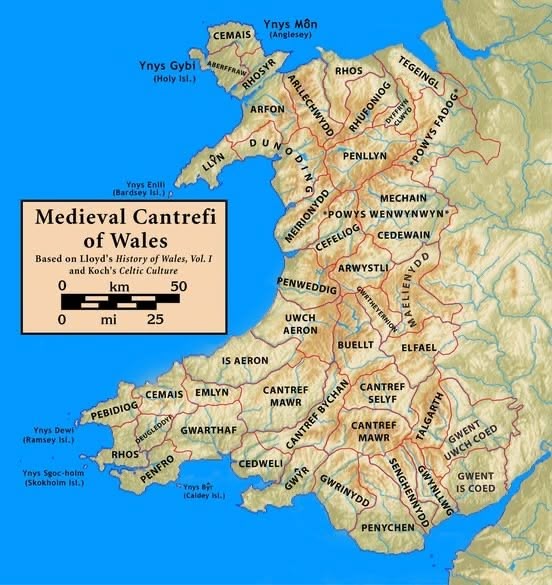
.... Llywelyn Bren surrendered at Ystradfellte on March 18th 1316 after leading a revolt opposing the Anglo-Norman persecution of the people of Glamorgan. In 1267 Llywelyn's father, Gruffudd ap Rhys, Lord of Senghenydd was dispossessed of his lordship by the powerful Anglo-Norman lord Gilbert de Clare, who began the construction of Caerphilly Castle in the following year. The death of Gilbert de Clare's son and heir at the Battle of Bannockburn in 1314 left a power vacuum in the region and in 1315 Edward II appointed an administrator, who proceeded to persecute the people of Glamorgan. In response Llywelyn appealed to Edward. When his appeal was rebuffed and he himself was charged with treason, Llywelyn laid siege to Caerphilly Castle on 28th January 1316 and burnt the town. The revolt then quickly spread across South Wales, forcing Edward to launch a two-pronged attack on Llywelyn from Cardiff and Hereford.
Llywelyn at first retreated, but realising that his position was now hopeless, he surrendered at Ystradfellte on March 18th and was imprisoned in the Tower of London. His lands were seized by the crown, and Hugh Despenser, reputedly King Edward's lover, was given the Lordship of Glamorgan. In 1318, in order to seize his estates, Despenser had Llywelyn executed without trial at Cardiff Castle and had the parts of his body exhibited in various part of the county before burial in the Grey Friars at Cardiff.
1834Six farm labourers from Tolpuddle, Dorset were sentenced to be transported to Australia for seven years for forming the first trade union and introducing collective bargaining for better wages. There was such an outcry that they were pardoned two years after sentencing and allowed to return to England. The annual Tolpuddle Martyrs' festival is held in the village of Tolpuddle in the third weekend of July. Each year a wreath is laid at the grave of James Hammett, one of the martyrs. .... 1891The London to Paris telephone link came into operation.
....1965: Cosmonaut Aleksei Leonov becomes the first person to walk in space when he leaves his spacecraft Voskhod 2 for 12 minutes.
....Music1967: It's announced that that former Spence Davis Group member Steve Winwood is planning a new group with Jim Capaldi, Chris Wood and Dave Mason – the new band is to be named Traffic.
1976 – A science fantasy drama film starring David Bowie called 'The Man Who Fell to Earth', premiered in the theaters in London.
The conviction of the Tolpuddle Martyrs, as they came to be known, was not for forming a trade-union although that is way it is often portrayed.
They had not formed any sort of association. Their offence was of simply an oath of mutual support, but even that was regarded as very serious. The powers-that-be of the time were genuinely afraid of what they though might be revolutionary tendences, unable to see that their repression of such would if anything encourage them.
Mutual support is of course a central trades-union tenet but I'm not sure if unions as such even existed in the 1830s. The incident, and some of the results of the massive Industrial Revolution, certainly encouraged unions to form as the 19C progressed.
I think James Hammett was the only one who came home. Another emigrated to Canada.
Their restored cottages in Tolpuddle village are now a memorial museum.
''''''''
By the way I am a union member, though now of its Retired Members' branch.
=====
I could practice my Welsh pronounciation with that map! Probably far from accurate and even further from learning the language, but at least I know 'LL' from 'L' and 'DD' from 'D'.
I see two of the Mediaeval names are book-ended by asterisks. Presumably marking some distinct characteristic or contemporary political significance?
I remember Ystradfellte as a peaceful little village in lovely countryside - never even suspecting what significant events it had seen centuries ago!
@Thinkerbell The Dutch language is closely connected to the Anglosaxon... it's more about being counseled badly... Onraad in the Dutch is about danger being near... Un-raed, 'redeless' or 'Unready', it all means 'no counsel', or that the person was unwise... Ethelred failed to win or retain the allegiance of many of his subjects. In 1002, he ordered the massacre of all Danes in England to eliminate potential treachery
Yes, we joked about Ethelred in history class... and all the Danegeld he (i.e., the taxpayers) paid to keep the foreign Danes from invading. Didn't work too well... they always came back for more.
And yes, Dutch is closely related to Anglo-Saxon, although now it's mostly German with funny spelling. 🤭