THE TRUE ORIGINS OF THE SUPPERBOWL, AND HOW IT CROSSED THE ATLANTIC
Long before Americans ever heard of a “Super Bowl,” Scotland had already perfected a far superior sport, a game that in time became known simply as The Supperbowl.
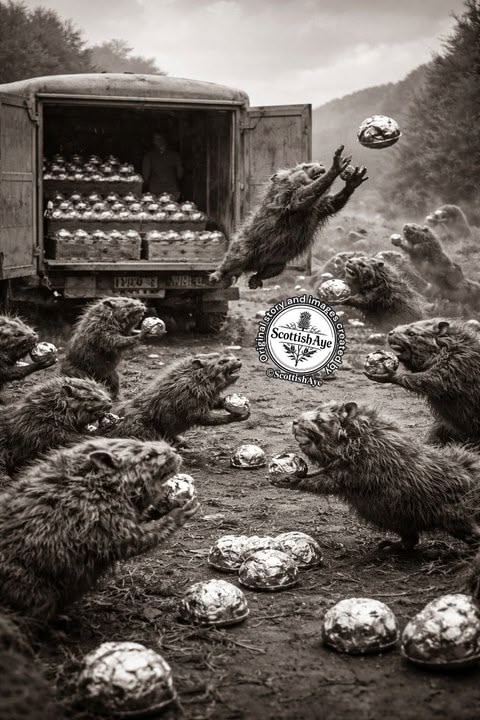
The story begins in the winter of 1947, some twenty years before the very first Supperbowl was officially recorded, when an ill fated experimental snack delivery lorry broke down on the road outside Stonehaven.
The truck wasn’t carrying ordinary snacks... inside were prototype chocolate and marshmallow biscuits, a secret test batch that would not be officially released to the public until 1956 under the now famous name “teacakes.”
Within minutes, two rival clans of haggis arrived at the scene, the tough, hill hardened Highland Haggis rolling down from the glens, and the sharper, faster Lowland Haggis sprinting up from the fields, both determined to claim the same mysterious, shiny foiled treats for themselves.
Rather than descending into total chaos, the two groups of haggis began circling each other around the stranded lorry, chattering angrily and slapping their paws on the road, until one particularly bold Lowland haggis picked up one of the prototype teacakes and hurled it across the tarmac sparking an unexpected contest that quickly felt less like a robbery and more like the birth of something bigger.
At this stage it wasn’t a sport, and there was no marked out field or formal rules, just pure haggis chaos. Both clans began launching and hurling the prototype teacakes back to their own side in frantic attempts to claim the most for themselves, which quickly escalated into full scale rivalry.
Within minutes, haggis were tackling haggis, leaping through the air for epic foil shimmering catches, and crashing into one another in a wild battle for dominance over the stranded lorry and its precious cargo.
By the time the bewildered lorry driver finally reappeared with help, the chaos had settled and the experimental teacake lorry had been thoroughly ransacked.
Yet instead of simply disappearing back into the hills, both clans of haggis lingered at the roadside, clearly aware that something remarkable had just happened.
What began as a desperate food scramble soon became a yearly tradition, and over time humans stepped in to formalise it, introducing clear rules, recognised teams, and organised matches.
The wild skirmish of 1947 gradually evolved into the structured game that would truly become The Supperbowl. Coincidentally, when the teacakes were finally released commercially in 1956, locals joked that they had already been “field-tested by haggis.”
As decades passed and Supperbowl traditions spread, adventurous Scots began travelling over the pond to America, carrying stories of teacake battles and haggis rivalries with them.
But once there, they hit a major problem, teacakes were almost impossible to find. Rather than abandon their beloved game, they improvised, picking up the locally available leather ball already being kicked around on American college fields.
Once established in their new home, these Scots staged informal Supperbowl style matches in fields, parks, and university grounds, still throwing their “imaginary teacakes” in fast, spiralling arcs.
Americans loved the spectacle, the high catches, heavy tackles, and territorial end zones, and gradually blended these ideas with their own previous games.
Over time, the teacakes were replaced entirely by the leather ball, the haggis were left behind, and the rules were tightened and out of that mix grew what we now call American football.
And so, while America built giant stadiums, celebrity halftime shows, and a global TV spectacle around its version of the game, Scotland quietly kept the original tradition alive.
Back in the U.S., because food was no longer used and no supper was actually had, the adapted game became known as the Super Bowl as a playful homage to its Scottish ancestor, even as it took on a life of its own across the Atlantic.
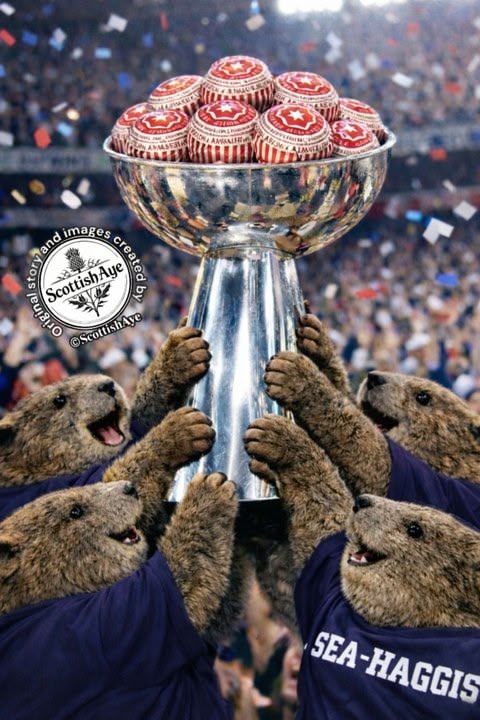
Each year, long after those first prototype teacake raids in 1947, Supperbowl continued to grow into its own national institution, still rooted in haggis rivalry, still centred on food, and still unmistakably Scottish in spirit. That’s why, as millions tuned in to Super Bowl 68, the real drama was unfolding at home in Haggden Park, where the Stonehaven Sea-Haggis lifted the Supperbowl 88 trophy, proof that no matter how far the sport travelled, its heart always stayed in Scotland