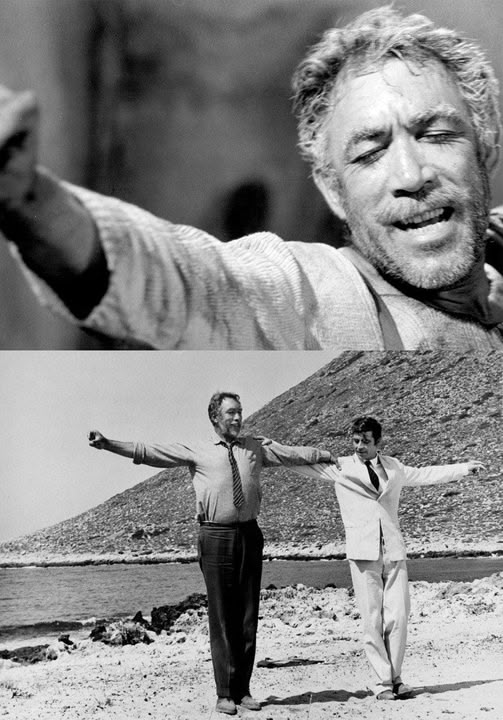
Possible remedy against all those awful self-help books
He advised living entirely in the present moment, embracing passion, and finding joy in simplicity rather than overthinking. Key advice included taking risks, acting rather than just thinking, accepting that "life is trouble," and finding strength in adversity. He encouraged ignoring societal, rigid rules in favor of embracing one's own "folly" and freedom. Sounds familiar?
Zorba the Greek is a novel written once by Nikos Kazantzakis, first published in 1946. It's the tale of a young Greek intellectual who ventures to escape his bookish life with the aid of the boisterous and mysterious Alexis Zorba. The novel was adapted into the very successful 1964 movie of the same name directed by Michael Cacoyannis, as well as a stage musical and a BBC radio play.
In Kazantzakis’s novel Zorba was this larger-than-life character who was passionate, fearless and always lived in the moment, for the moment. He was illiterate and yet ingenious and profoundly more philosophical in his daily teachings than any book or self-help guru could be. He was truly the force of nature, and these are the 7 lessons that were for the young man to learn:
1) Life is the ultimate teacher;
2) Be foolish (in measured way);
3) Death is one certainty of life, so embrace it (in the correct manner, of course);
4) Adversity leads to Growth (of character if not in wealth);
5) Be here now, live in the present;
6) Embrace Simplicity;
7) Freedom is human kind’s natural state.
[media=https://youtu.be/BS0w3Wkric8]
This page is a permanent link to the reply below and its nested replies. See all post replies »
1. Is similar to the Stoic philosophy of Epictetus, who believed we don’t truly learn from words alone, but from how reality responds to our choices. And psychologists like B. F. Skinner built entire theories around the idea that behavior is shaped more by consequences than by instruction;
2. Reminds me of something Albert Einstein once valued deeply — staying “childlike” in curiosity without losing adult responsibility. And in philosophy, Socrates embraced knowing he didn’t know — a kind of intentional foolishness that kept him searching, but not careless;
3. Carries the spirit of memento mori — the practice embraced by Stoics like Marcus Aurelius, who reflected on death not to fear it, but to live more deliberately. And it echoes the poetic awareness of Rainer Maria Rilke, who saw mortality as something that deepens life rather than darkens it;
4. Echoes the mindfulness teachings popularized by Thich Nhat Hanh, who often said the present moment is the only place life truly exists. And even Eckhart Tolle built an entire philosophy around the idea that the “now” is the only reality we ever actually experience;
5. Carries the spirit of deliberate simplicity — like the experiment in essential living by Henry David Thoreau at Walden Pond, and the inner stillness emphasized by Laozi in the Tao Te Ching. Both pointed toward reducing noise so something truer can surface;
7. Echoes the Stoic idea, again in Epictetus, that we are often imprisoned more by our judgments than by circumstances. And it aligns with the existential lens of Jean-Paul Sartre, who argued that we are condemned to be free — yet we frequently hide from that freedom behind excuses and self-imposed limits.