Corruption in Ukraine since the country became an independent state in 1991 is a societal issue rooted in the dissolution of the Soviet Union that year. Following independence, Ukrainian politicians from across the political spectrum, criminal bosses, and Ukrainian oligarchs exploited corruption within the National Police of Ukraine, the country's political parties, and industry to gain power. While Ukraine is still considered one of the more corrupt countries in Europe, it has made steady progress in improving its standing since 2015.
The modern period of corruption in Ukraine can be traced back to when it formed part of the Soviet Union, prior to 1991. During the 1980s, individuals linked to Soviet organised crime became integrated into the Soviet ruling elite. The American academic Louise Shelley, writing in 1998, commented that corruption in Ukraine followed similar patterns to organized crime and political parties across the post-Soviet space.
For two decades following the establishment of Ukraine as an independent state in 1991, the country experienced a period of violent corruption.
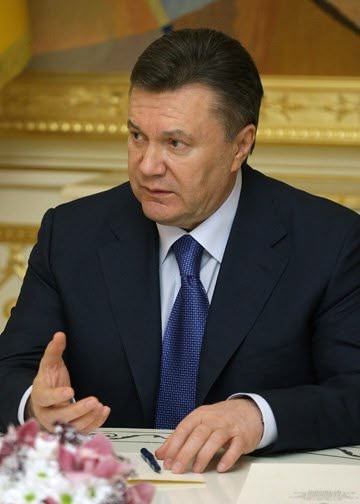
Viktor Yanukovych in April 2010 During this period, corruption in industry and tourism was particularly acute in Donetsk Oblast. In 2005, mass graves containing businesspersons, judges, lawyers, and investigators were discovered in the region. A former governor, Viktor Yanukovych, and his Party of Regions were among those accused of maintaining close ties to organised crime. Despite this, Yanukovych won the 2010 Ukrainian presidential election.
According to the United States Agency for International Development (USAID) in 2006, the main causes of corruption in Ukraine included a compromised justice system, a centralised and non-transparent government, close ties between business and political elites and Russia, and a weakened civil society. Corruption has been a frequent topic of Ukrainian media coverage.
A 2013 survey of Ukrainians found the country's most corrupt officials were believed to be the judiciary, the police, public servants, the health service, and parliament. Yanukovych was overthrown during the Maidan Uprising, which began in 2013 after his government—viewed by many of the protestors as corrupt—refused to sign a trade agreement with the European Union. Yanukovych's pro-Russian tendencies caused Ukrainian nationalists to link corruption in Ukraine with the country's relationship with Russia. In the aftermath of the uprising, law enforcement reforms were introduced to reduce waste, public procurement procedures were changed, and some state-owned industries were dissolved, but critics argued that the progress made in tackling corruption was too limited.
In 2008, TI estimated that 30–50 percent of Ukrainians had experienced government corruption. Juhani Grossmann, when working in 2009 for the ACTION project (Promoting Active Citizen Engagement in Combating Corruption in Ukraine), which was funded by the USAID, claimed that "Ukrainians pay roughly ₴3.5 billion, or more than US$400 million, in bribes annually." The previous year, he claimed that the figure was US$700 million.
In 2011, Yanukovych announced that corruption was costing his government an estimated US$2.5 billion each year, and that corrupt practices in public procurement alone resulted in 10–15% of the state budget (approximately US$7.4 billion) ending up "in the pockets of officials". According to the economist Ararat Osipian, Ukraine failed to sustain its economic growth trends in the 2000s due to endemic corruption. Corrupt practices marked Yanukovich's period as president; it contributed to his removal from office in 2014, and left the Ukrainian Ground Forces ill-equipped to counter Russia's invasion of Crimea that year.
In 2016, the International Monetary Fund (IMF) stated that a reduction in corruption was a key condition for continued international support for Ukraine. Some Western analysts argued that large foreign loans were not encouraging reform, but instead were enabling the extraction of funds from the country through corrupt practices. The then U.S. Assistant Secretary of State, Victoria Nuland, called for the prosecution of corrupt officials, stating: "It's time to start locking up people who have ripped off the Ukrainian population for too long and it is time to eradicate the cancer of corruption."
A 2025 Gallup opinion poll found that 85% of Ukrainians believed corruption was widespread throughout their government, a figure that had hardly varied since 2007.
In the 2000s, bribes were used in Ukraine to ensure that public services were delivered, with many Ukrainians considering their payment to be customary and expected. Some of the largest recorded bribes exceeded US$1 million.
In a 2001 survey conducted by the German market research company GfK, 43% of respondents stated that they had never personally paid a bribe.
According to a Management Systems International survey conducted in 2008, the highest levels of corruption were identified in vehicle inspection services (58%), the police (54%), health care (54%), the courts (49%), and in higher education (44%). In another 2008 survey, 21% of those questioned answered that they—or someone living in their household—had paid a bribe during the previous year. Surveys conducted between 2000 and 2010 showed that a majority of Ukrainians self-reported engaging in corrupt transactions with government authorities.
In the Global Corruption Barometer 2013 produced by Transparency International (TI), Ukrainians reported that the institutions to which they most commonly paid bribes during the preceding two years were the police (49% of responders), medical and health services (41%), and the education system (33%).
In the years following Ukrainian independence, electoral fraud was widespread, mainly through the administrative resource available to some candidates. According to the British political analyst Taras Kuzio, the fraud accounted to more than five percent of the total vote.
Pavlo Lazarenko, who was the prime minister of Ukraine from 1996 to 1997, allegedly embezzled between US$114 million and 200 million, After the initial round of voting in the 2004 presidential election, the Supreme Court of Ukraine ruled that the scale of the electoral fraud made it impossible to determine the election results, and it ordered a revote. Instances of vote rigging have since declined, although politicians continued to allege election fraud, and some political parties persisted in using tactics to secure votes, and the Ukrainian electorate remained sceptical of the integrity of the electoral process.
In the 2000s, United States diplomats claimed that the privatization of several Ukrainian state enterprises was rigged by politicians in favour of their political allies. In the early 2010s Ukrainian media, particularly the Ukrayinska Pravda, regularly unveiled millionaire lifestyles of Ukrainian politicians and public servants, utterly at odds with their declared official incomes. In 2010, it was reported that Ukrainian politicians regularly accused each other of corruption while claiming to fight it themselves. According to information revealed by means of the 2010 United States diplomatic cables leak, US officials described Ukraine under presidents Leonid Kuchma and Viktor Yushchenko as a kleptocracy.
Minister of Internal Affairs Vitaliy Zakharchenko stated in 2012 that since 2010, about 400 politicians had faced criminal charges in connection with corruption; most of them from the Party of Regions, followed by Bloc Yulia Tymoshenko and Our Ukraine–People's Self-Defense Bloc members. Since 2011, the President, Chairman of the Verkhovna Rada, Prime Minister, Prosecutor General, ministers and other Ukrainian top officials have been liable for prosecution for corruption. Since 2010, the Ukrainian press brought up thousands of examples of criminal cases in which state officials, as well as politicians and businessmen linked to the then-ruling Party of Regions, were shown leniency unprecedented for the general population of suspects. After going undercover in the Reforms for the Future parliamentary faction in early 2012, the Rada deputy Roman Zabzaliuk claimed this faction "bought" its members, paying US$500,000 [for a 'defection' from other parliamentary groups, and then paying a salary of $20,000–25,000 a month. In contrast, according to Reforms for the Future, Zabzalyuk had pretended he was "suffering a very serious disease" and the group had managed to raise some $100,000 for Zabzalyuk to undergo surgery in Israel.
A 2015 survey showed that 72% of adults blamed "corruption of power" for the lack of progress in reform. According to historian Andrew Wilson, as of 2016, progress in reducing corruption was poor. A 2016 requirement for members of the Ukrainian parliament (deputies) to declare their wealth led to a declared cumulative wealth of about $460 million for the 413 deputies. Reacting to public criticism, deputies cancelled a salary rise that would have doubled their monthly salary. This measure was part of an Anti-Corruption Package passed into law in 2014, which was a requirement of international financial support for Ukraine and a prerequisite to eligibility for visa-free travel within the European Union.
In the early 21st century, several Ukrainian mayors were suspected of using their posts to serve their own business interests. In 2009, regional corruption was discovered in connection with land allocation.
In 2013, Serhiy Odarych, former mayor of Cherkasy, was suspected of causing a ₴600,000 loss to the city budget.
In the early 2010s, Ukrainian politicians and analysts described the country's justice system as "rotten to the core", highlighting the political pressure put on judges. Ukraine's court system was widely regarded as corrupt; independent lawyers and human rights activists have complained that judges are pressurised to hand down a particular verdict. A Ukrainian Justice Ministry survey in 2009 revealed that 10% of respondents trusted the nation's court system, and fewer than 30% believed that it was possible to get a fair trial. Judicial independence exists in principle, but judges were subjected to pressure from political and business interests. In the 2010s, Ukrainian judges were arrested while taking bribes; and during the early part of the decade, it was noticeable that officials and their children (or mazhory) received favourable sentences compared with common citizens.
In 2012, Volodymyr Rokytskyi, Deputy Head of Ukraine's Security Service, was photographed in public wearing a US$32,000 luxury wristwatch—a price equally his yearly official income—at a joint Ukrainian-American event dedicated to fighting illegal drugs. When a 2017 Reuters article quoted the deputy Volodymyr Groysman as saying that "the weakest link in our fight against corruption is the Ukrainian court"; the article gave an example of 30 judges who received salaries ranging from US$10,000–13,000 and who owned Porsches.
The Kyiv Post reported in 2018 that several candidates for a post in the new High Anti-Corruption Court of Ukraine were themselves suspected of, or were associated with, corruption.[L AutoMaidan, Dejure, and the Anti-corruption Action Center all criticised decisions made in June 2023 by the Ethics Council relating to appointments onto the High Council of Justice. The decisions including the nomination of judges tainted by corruption, and the unfair exclusion of Larysa Golnyk, an anti-corruption whistleblower judge.
In May 2023, on the orders of the National Anti-Corruption Bureau of Ukraine (NABU) and the Specialized Anti-Corruption Prosecutor's Office (SAPO), the President of the Supreme Court of Ukraine Vsevolod Kniaziev was detained while allegedly receiving a bribe. NABU and SAPO reported on their social media accounts about allegations of corruption in the country's Supreme Court of Ukraine. Anti-Corruption officials said that, "NABU and SAP have uncovered massive corruption in the Supreme Court, specifically plans to profit unfairly from the Supreme Court leadership and judges."
A 1995 national poll initiated by the Ukrainian government showed that 42% of the survey's respondents viewed corruption as "a shameful phenomenon that has no objective grounds", while 36% viewed it as "a component of social traditions".
In the 2010s, the Ukrainian economist Oleh Havrylyshyn compared Ukrainian corruption to global trends, using data from TI. His research estimated that corruption levels in Ukraine were comparable to those in Sub-Saharan Africa, identifying Uganda as the country's closest counterpart.
In 2012, Ernst & Young ranked Ukraine among the three most corrupt nations out of 43 surveyed. In 2015, The Guardian labelled Ukraine as "the most corrupt nation in Europe". By 2017, an Ernst & Young poll of experts ranked Ukraine ninth-most corrupt out of 53 surveyed nations.
In TI's 2024 Corruption Perceptions Index (CPI), Ukraine was ranked 105th out of 180 countries, with a score of 35. Commenting on the data, TI noted that Ukraine's score had improved steadily for 11 years, but that the high number of corruption cases that were detected and prosecuted was an indication that significant work remains to be done. TI's CPI report for 2025 includes Ukraine as one of the countries whose 2025 score has increased from between one of the lowest to one that is middle ranking, as a result of "long-term efforts from political leaders and regulators". The report, whilst commenting on successful convictions following corruption investigations, noted that structural reforms still needed to be put into place.