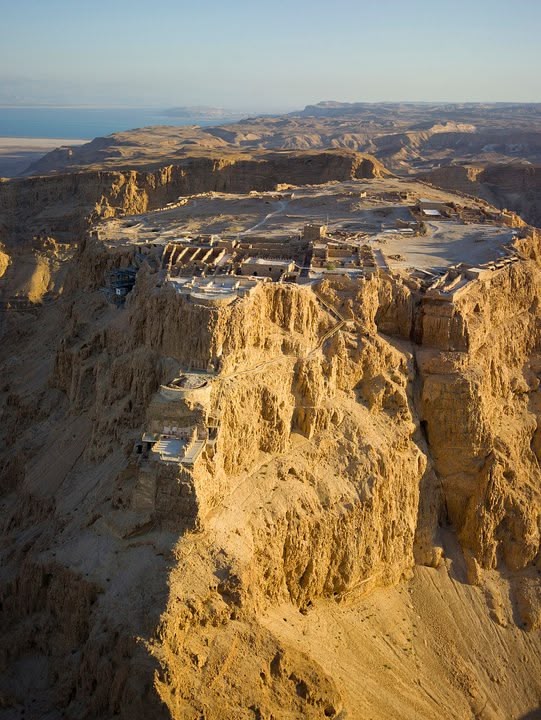
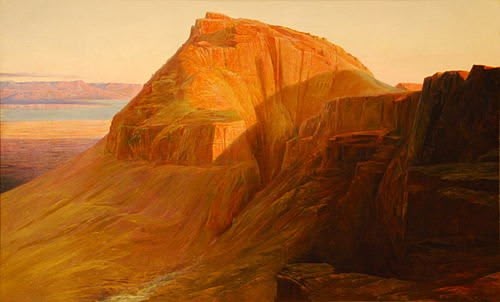
Tomorrow, Tim and I are going to visit Masada. Masada (Hebrew: מְצָדָה məṣādā, 'fortress'; Arabic: جبل مسعدة, romanized: jabal musayda, lit.'mount museida') is a mountain-top fortress complex in the Judaean Desert, overlooking the western shore of the Dead Sea in southeastern Israel. The fort, built in the first century BC, was constructed atop a natural plateau rising over 400 m (1,300 ft) above the surrounding terrain, 20 km (12 mi) east of modern Arad.
The most significant remains at the site date to the reign of Herod the Great, King of Judaea c.37–4 BC, who transformed Masada into a fortified desert refuge early in his rule. He enclosed the summit with a casemate wall and towers, and constructed storerooms, an advanced water system, and bathhouses, along with two elaborate palaces: one on the western side and another built across three terraces on the northern cliff. These palaces remain among the finest examples of Herodian architecture.
Masada is most renowned for its role during the First Jewish–Roman War (66–73 AD), when it became the final holdout of Jewish rebels following the destruction of Jerusalem. A group known as the Sicarii, a radical faction led by Eleazar ben Ya'ir, defended the site against the Roman Tenth Legion under Lucius Flavius Silva. The Romans laid siege by building a circumvallation wall and a massive ramp. According to Josephus, when the walls were breached in 73/74 AD, the Romans found nearly 1,000 inhabitants had died by mass suicide—a claim that remains debated among historians. In modern times, the story of Masada was interpreted as a symbol of heroism that became influential in early Israeli national identity.
Excavations led by archaeologist Yigael Yadin in the 1960s uncovered remarkably preserved remains, including Herod's palaces, storerooms with food remnants, ritual baths, a synagogue, Jewish scrolls, columbaria, and pottery shards bearing names, one inscribed "ben Ya'ir," possibly linked to the final days of the defenders, and a small Byzantine church. The surrounding Roman siege works and bases remain visible and are among the most intact examples of Roman military engineering. Today, Masada is a UNESCO World Heritage Site due to those siege works, and one of Israel's most popular tourist The most significant remains at the site date to the reign of Herod the Great, King of Judaea c.37–4 BC, who transformed Masada into a fortified desert refuge early in his rule. He enclosed the summit with a casemate wall and towers, and constructed storerooms, an advanced water system, and bathhouses, along with two elaborate palaces: one on the western side and another built across three terraces on the northern cliff. These palaces remain among the finest examples of Herodian architecture.
The cliff of Masada is, geologically speaking, a horst. As the plateau abruptly ends in cliffs steeply falling about 400 m (1,300 ft) to the east and about 90 m (300 ft) to the west, the natural approaches to the fortress are very difficult to navigate. The top of the mesa-like plateau is flat and rhomboid-shaped, about 550 m (1,800 ft) by 270 m (890 ft). Herod built a 4 m (13 ft) high casemate wall around the plateau totaling 1,300 m (4,300 ft) in length, reinforced by many towers. The fortress contained storehouses, barracks, an armory, a palace, and a series of cisterns (capacity around 40,000 m3; 1.4 million cu ft) that were refilled by rainwater – with the runoff collected from a single day's rain allegedly able to sustain over 1,000 people for 2 to 3 years. Three narrow, winding paths led from below up to fortified gates.
Almost all historical information about Masada comes from the first-century Jewish Roman historian Josephus. Masada is also mentioned in the Judean Desert Documents.
Josephus writes that the site was first fortified by Hasmonean ruler Alexander Jannaeus in the first century BC. However, so far no Hasmonean-period building remains could be identified during archaeological excavations.
Josephus further writes that Herod the Great captured it in the power struggle that followed the death of his father Antipater in 43 BC. It survived the siege of the last Hasmonean king Antigonus II Mattathias, who ruled with Parthian support.
According to Josephus, between 37 and 31 BC, Herod the Great built a large fortress on the plateau as a refuge for himself in the event of a revolt and erected two palaces with an endless food supply.
In 66 CE, a group of Jewish rebels, the Sicarii, overcame the Roman garrison of Masada with the aid of a ruse. According to Josephus, the Sicarii were an extremist Jewish splinter group antagonistic to a larger grouping of Jews referred to as the Zealots, who carried the main burden of the rebellion. Josephus said that the Sicarii raided nearby Jewish villages including Ein Gedi, where they massacred 700 women and children.
In 73 AD, the Roman governor of Judaea, Lucius Flavius Silva, headed the Roman legion X Fretensis and laid siege to Masada. Another source gives the year of the siege of Masada as 73 or 74 CE. The Roman legion surrounded Masada, building a circumvallation wall and then a siege ramp against the western face of the plateau. According to Dan Gill, geological investigations in the early 1990s confirmed earlier observations that the 114 m (375 ft) high assault ramp consisted mostly of a natural spur of bedrock.
The ramp was complete in the spring of 73, after probably two to three months of siege, allowing the Romans to breach the wall of the fortress with a battering ram on April 16. The Romans employed the X Legion and a number of auxiliary units and Jewish prisoners of war, totaling some 15,000, of whom an estimated 8,000 to 9,000 were fighting men, in crushing Jewish resistance at Masada.
A giant siege tower with a battering ram was constructed and moved laboriously up the completed ramp. According to Josephus, when Roman troops entered the fortress, they discovered that its defenders had set all the buildings but the food storerooms ablaze and committed mass suicide or killed each other, 960 men, women, and children in total. Josephus wrote of two stirring speeches that the Sicari leader had made to convince his men to kill themselves. Only two women and five children were found alive.
Josephus presumably based his narration upon the field commentaries of the Roman commanders that were accessible to him.
There are discrepancies between archaeological findings and Josephus' writings. Josephus mentions only one of the two palaces that have been excavated, refers only to one fire, though many buildings show fire damage, and claims that 960 people were killed, though the remains of at most 28 bodies have been found. Some of the other details that Josephus gives were correct – for instance, he describes the baths that were built there, the fact that the floors in some of the buildings 'were paved with stones of several colours', and that many pits were cut into the living rock to serve as cisterns. Yadin found some partially intact mosaic floors which meet that description.
Masada was last occupied during the Byzantine period, when a small church was established at the site. The church was part of a monastic settlement identified with the monastery of Marda known from hagiographical literature. This identification is generally accepted by researchers. The Aramaic common noun marda, "fortress", corresponds in meaning to the Greek name of another desert monastery of the time, Kastellion, and is used to describe that site in the vita (biography) of St Sabbas, but it is used as a proper name only for the monastery at Masada, as can be seen from the vita of St Euthymius.
The archaeological site is situated in the Masada National Park, and the park requires an entrance fee (even if by hiking). There are two hiking paths, both very steep:
The Snake Trail leaves from the eastern side at the Masada Museum (access via the Dead Sea Highway) and gains around 301 m (988 ft) in elevation. The Roman Ramp trail is also very steep, but has less elevation gain, and is accessed from the western side of the mountain (with access by car from the Arad road). Hikers frequently start an hour before sunrise, when the park opens, to avoid the mid-day heat, which can exceed 43 °C (109 °F) in the summer. In fact, the hiking paths are often closed during the day in the summer because of the heat. Visitors are encouraged to bring drinking water for the hike up, as water is available only at the top.
Alternatively, for a higher fee, visitors can take a cable car (the Masada cableway, opens at 8 am) to the top of the mesa.
A visitors' center and the museum are at the base of the cable car.
A light-and-sound show is presented on some summer nights on the western side of the mountain (access by car from the Arad road or by foot, down the mountain via the Roman Ramp path).