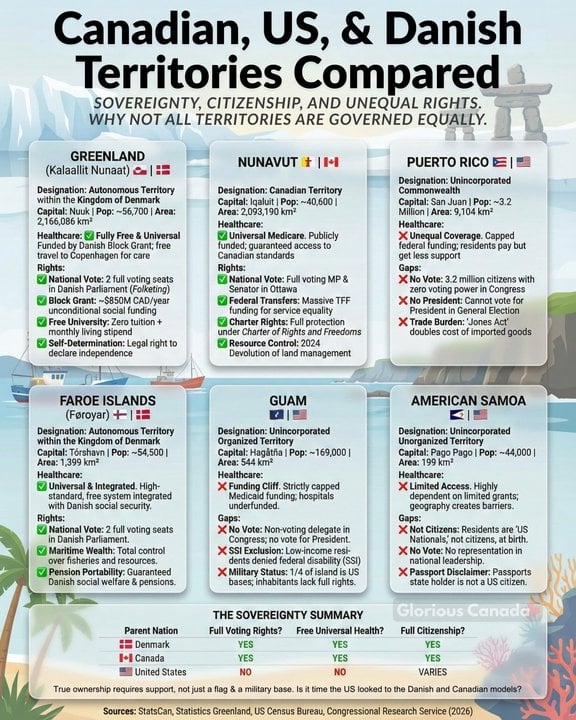
It’s a classic image from the Cold War: the United States, flush with cash and post-war ambition, looking north and trying to buy Greenland. We laugh about it now—the idea of just "buying" a massive, icy landmass and the 56,000 souls who live there. But when you actually look at the maps and the money, a much darker question emerges: What would actually happen to those people if the deal went through? To understand that, you have to look at the Geography of Support. Right now, Greenland exists within the Kingdom of Denmark. It’s a relationship built on something called "The Unity of the Realm." It’s not perfect—no post-colonial relationship is—but it’s built on a fundamental promise of equality. Even though Nuuk is 3,500 kilometres from Copenhagen, a Greenlander is, for all intents and purposes, a full-blooded Dane. They have two voting seats in the Danish Parliament. They have a "Block Grant"—an unconditional, multi-hundred-million-dollar infusion of cash every single year that ensures their hospitals are first-world and their schools are free. If a student in a remote fjord wants to become a doctor, they fly to Denmark, tuition is zero, and the government hands them a monthly stipend to live on. This is the Danish Model: High-cost, high-support, and full democratic dignity. Then, you look at Canada. We do something similar. We realized a long time ago that you can’t have "Northern Sovereignty" on the cheap. If you want people to live in Nunavut or the Yukon, you have to bridge the gap. We use Territorial Formula Financing to make sure that a heart surgeon in Iqaluit is paid for the same way one is in Toronto. A Canadian in the Arctic isn't a "territorial subject"; they are a voter, a citizen, and a full participant in the federation. But then... you look at the American model. And this is where the map starts to break. The United States has this category of land called "Unincorporated Territories." It sounds like a boring legal term, but for the 3.5 million people living in places like Puerto Rico, Guam, and American Samoa, it’s a ceiling on their existence. Take Puerto Rico. There are more U.S. citizens living there than in twenty different U.S. states. They pay into the system. They serve in the military at incredibly high rates. But they have zero voting power in Congress. They have no say in who their President is. And the support? It’s hit-or-miss. In the U.S. mainland, if you’re poor or disabled, there’s a floor called SSI (Supplemental Security Income). In the territories? The U.S. Supreme Court has literally ruled that the government doesn't have to give it to you. In Guam, a quarter of the island is a military base—the "Tip of the Spear"—yet the people there face "Medicaid Cliffs" where healthcare funding just... stops. This is the American Model: Strategic value first, citizens second. So, when we talk about Greenland, or the Faroe Islands, or Nunavut, we aren't just talking about borders. We’re talking about a choice between two very different versions of the world. In the Danish and Canadian versions, the "parent" country recognizes that distance shouldn't diminish your rights. In the American version, the farther you are from the centre of power, the more your citizenship begins to fade. If Greenland had been "bought" in the 1940s or the 2010s, it wouldn't be the 51st state. It would almost certainly be another "unincorporated territory." The block grants would vanish. The voting seats in Parliament would be traded for a non-voting delegate in D.C. The free university stipends would be replaced by American-style student debt. Sovereignty isn't just about whose flag or military base is on the map. It’s about who has your back when the cost of living in the middle of the ocean gets too high. And right now, the North is showing the world that equality isn't just a mainland luxury—it's the only way a Kingdom, or a Country, actually stays together.Greenland Canada is a logistical nightmare (that's why it's retained it's sovereignty sofar), and then there is King Winter, the defenders protective saint.Americans probably put a kill switch in all the F35. So that if you attack them, you're going down as well. down
This page is a permanent link to the reply below and its nested replies. See all post replies »
I've wondered if something related to that is behind Presaident Trump's demand to take over Greenland.
Installing military radar should not be a problem as this is a fellow-NATO country, needing suitable agreements but not the territory itself.
The possibility of valuable ore deposits is the greater motive but still does not justify seizing the country as in the 18C days of the British Raj. (I am a Briton saying that, too!).
Suppose the minerals do exist:
It is for the Greenlanders and Danes to decide what to do about their property - including possibly nationalising them as Norway did with her oil and natural-gas. They could even do that in advance - "If they are found..." as Danish, to keep them out of foreign hands.
Without local mining skill, they would probably invite bids for mining rights, from the USA and other nations; but will want to benefit from the products.
So the winning companies, of any nationality, would need obey Danish and Greenland planning, enviromental, employment and tax regulations, with disputes resolved under Danish law, possibly in Copenhagen; the entirety ensuring international and national law, and Greenland herself, are treated properly.
Just as if the same companies wanted to operate in Denmark, France, the UK, Australia, Canada or anywhere else foreign to themselves.
So I think Trump wants to annexe the land, whether by force or other means, so US-only companies can exploit any mineral deposits for the USA only, under US Federal law probably a lot less strict than the Danish law might be; without needing care about the residents and their land.
Further, it is not hard to imagine the "State" governors being the mining corporations and established USAAF, with the residents having little or no say - as well as losing all those benefits you describe.
..
There is a fear, and I think expressed by President Trump, that if the USA does not seize Greenland, China or Russia might. I do not know if there is any evidence for that although those two states are sniffing round the Arctic for their own reasons. Perhaps they hope as Trump may do, that climate-change will make the seas and islands around the top of Canada ice-free.
Militarily, I think the USA might have more to fear attacks arriving from the West rather than North-East; but grabbing Greenland will not necessarily bring America greater protection. Modern long-range weapons need not by only ballistic missiles, either, but covert ones via the Internet by subversion or denial and those could be more destructive in total.
I think we all know the answer to that little footnote question your quote asks: "Yes, it is time, but the USA refuses any such models on purely ideological grounds."
@ArishMell USA closed 16 military bases in Greenland , radioactive waste , oil , etc.. at some point 17.000 personal. They already have radar station. If ice melts NY will be under water. In mining you need to make profit.