


This page is a permanent link to the reply below and its nested replies. See all post replies »

ArishMell · 70-79, M
Interesting to compare that with the UK's equivalent.
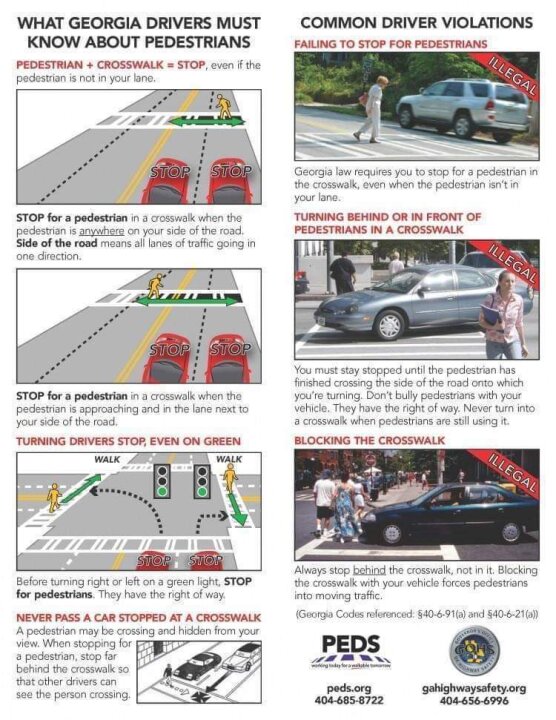
Here the driving regulations and Highway Code on the subject are very similar to Georgia's (though we call them "pedestrian crossings"), but we also have marked No Parking areas on both sides of the crossing, each about two cars in length. It allows better visibility if the parking is allowed along the street otherwise.
We do have two main types of crossing.
One is similar to those in the photographs, with a slightly different pattern, but marked at both ends by black-and-white banded poles topped by a large, flashing orange lamps.. They are called 'Belisha Beacons' after the Minister of Transport who had them introduced some time in the mid-20C.
The other uses traffic-lights operated by a press-button on the lamp pole, and at a height reachable by a fairly young child, or someone on a wheelchair or mobility-scooter. The lights don't stop the traffic immediately but after a short delay set either by time or vehicle count.
'
Some crossings here have a central refuge, effectively splitting it into two separate crossings. With those, the driver can proceed if behind the pedestrian who has already reached at least the refuge - provided no-one is trying to cross! So the motorist would be driving legally in the middle photo if there is an island between his car and the woman walking towards us.
Pedestrian crossings in town centres are often combined with important traffic-light controlled junctions. One such in my town has a large refuge fenced with staggered openings so you can't walk straight across and blunder into traffic legally crossing from the opposite direction.
It is not illegal as a pedestrian to use a light-controlled crossing without using the lights, IF safe to do so; but when driving it is very annoying to see someone press the button some distance away then cross immediately if still clear to do that, so he or she is safely clear yards away while you are held up needlessly. On the other hand, when I am a pedestrian, if there are only one or two vehicles approaching, I often let them pass then walk across despite my red light, so I am not delaying the drivers for the sake of a few seconds waiting by me. Sometimes it even saves me time too, thanks to the appreciable delay between button-pressing and lights changing.
'
The one class of British road where pedestrians have no right-of-way at all is the Motorway, apart from using the hard shoulder where that has not been turned into an extra running lane, to reach an emergency telephone. The advice if you break down or fall ill at the wheel, is to pull off as far as possible, and for all occupants to exit the car and wait behind the road-side barrier. The motorway is also barred to cyclists, horses, agricultural and one or two other classes of vehicle. Those need use the other roads, almost all available to almost all legal road-users.
Here the driving regulations and Highway Code on the subject are very similar to Georgia's (though we call them "pedestrian crossings"), but we also have marked No Parking areas on both sides of the crossing, each about two cars in length. It allows better visibility if the parking is allowed along the street otherwise.
We do have two main types of crossing.
One is similar to those in the photographs, with a slightly different pattern, but marked at both ends by black-and-white banded poles topped by a large, flashing orange lamps.. They are called 'Belisha Beacons' after the Minister of Transport who had them introduced some time in the mid-20C.
The other uses traffic-lights operated by a press-button on the lamp pole, and at a height reachable by a fairly young child, or someone on a wheelchair or mobility-scooter. The lights don't stop the traffic immediately but after a short delay set either by time or vehicle count.
'
Some crossings here have a central refuge, effectively splitting it into two separate crossings. With those, the driver can proceed if behind the pedestrian who has already reached at least the refuge - provided no-one is trying to cross! So the motorist would be driving legally in the middle photo if there is an island between his car and the woman walking towards us.
Pedestrian crossings in town centres are often combined with important traffic-light controlled junctions. One such in my town has a large refuge fenced with staggered openings so you can't walk straight across and blunder into traffic legally crossing from the opposite direction.
It is not illegal as a pedestrian to use a light-controlled crossing without using the lights, IF safe to do so; but when driving it is very annoying to see someone press the button some distance away then cross immediately if still clear to do that, so he or she is safely clear yards away while you are held up needlessly. On the other hand, when I am a pedestrian, if there are only one or two vehicles approaching, I often let them pass then walk across despite my red light, so I am not delaying the drivers for the sake of a few seconds waiting by me. Sometimes it even saves me time too, thanks to the appreciable delay between button-pressing and lights changing.
'
The one class of British road where pedestrians have no right-of-way at all is the Motorway, apart from using the hard shoulder where that has not been turned into an extra running lane, to reach an emergency telephone. The advice if you break down or fall ill at the wheel, is to pull off as far as possible, and for all occupants to exit the car and wait behind the road-side barrier. The motorway is also barred to cyclists, horses, agricultural and one or two other classes of vehicle. Those need use the other roads, almost all available to almost all legal road-users.