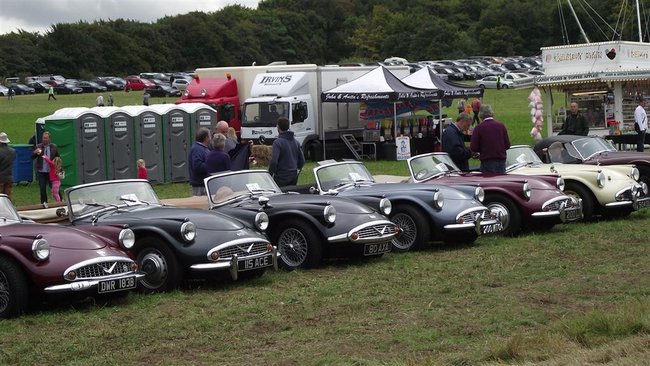
In the mid-1950s, Daimler was one of Britain's oldest motoring names. By then, it was owned by BSA (Birmingham Small Arms) and producing a range of rather sedate luxury cars. They had for a long time enjoyed the favour of the British royal family, but these latter had been showing a preference for Rolls-Royce. Add to this the odd internal scandal, and Daimler (who got the name from the acquisition of patent rights from Gottlieb Daimler's company in Germany back in the 1890s) were in the doldrums. But they'd been eyeing up the sports car market, particularly that in the USA which was turning out to be a money-spinner for the likes of Jaguar and Triumph. And they thought they'd have a go.
Edward Turner, who'd established a reputation for himself designing engines like the Ariel Square Four and Triumph Speed Twin, was, by the late Fifties, in charge of the automotive activities of BSA. He came up with a nice state-of-the-art V8, with a small displacement of 2.5 litres but with hemispherical combustion chambers, giving good performance and efficiency. This was to be heart of the new car. By 1959 the fibreglass-bodied car was ready and Daimler launched it at the New York show that year as the Daimler 'Dart'.
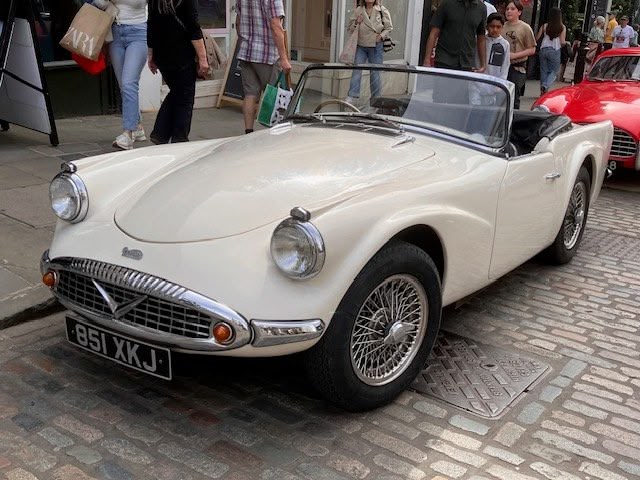
Oops! Apparently Chrysler Corporation had already reserved the rights to the 'Dart' name for their Dodge division. The styling of the new car was bold - with large, dominant headlights (the car was only 152cm (5 feet) wide, which made the lights look huge). The curved nose of the car sloped down between them to an oval grille, onto which had been grafted the traditional Daimler 'crinkles'. Then, the SP250 (the car took on its internal project number as its model name by default) was unoficially dubbed 'the ugliest car in the show'. Oops! again!
A 1960 SP250 ('A' Spec). 'Proper' front bumpers were not standard at this stage
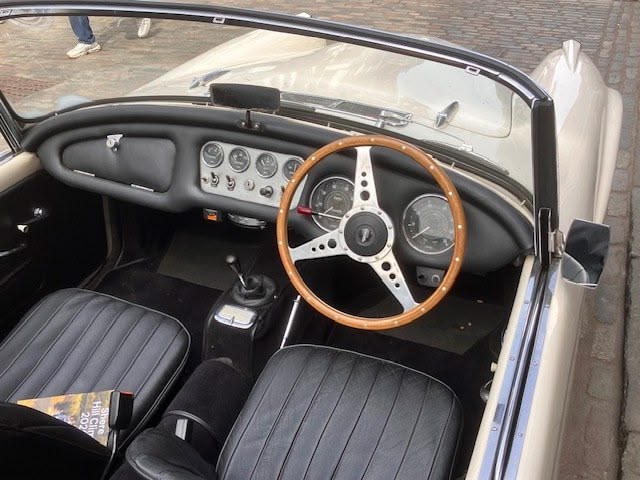
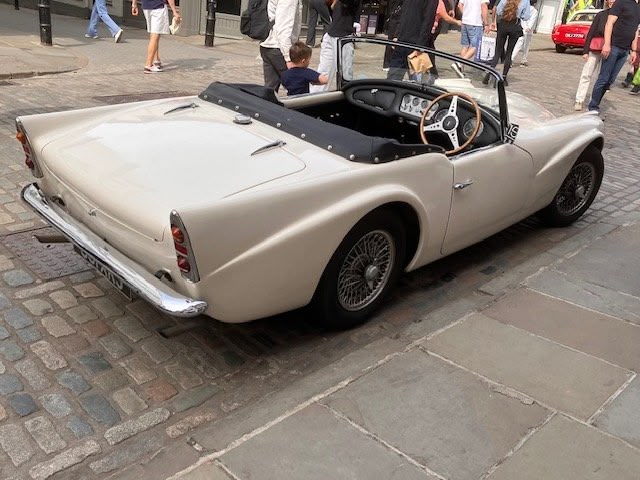
Aesthetics are highly subjective, but when something divides opinion like this car did, it's not a good sign. Cars cost a lot of money and no one wants to drive something that they'd be embarrassed to be seen in. Personally I don't think it's ugly - quirky would be my take on it. And I think some aspects of the design, like the interior and that finned rear end with its monogrammed tail-light clusters - are quite appealing. But I don't think the appearance of the car helped it. Nor did the lack of rigidity of the frame, which was basically a carry-over from the Triumph TR3. Early examples of the SP250 occasionally had doors pop open while under way, which must have been rather disconcerting!
Interior and rear views of the 1960 car. The steering wheel isn't standard - from the factory, it would have had an indicator switch on the steering wheel hub...
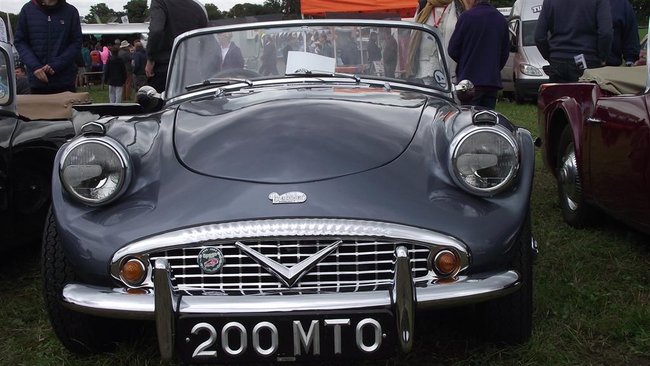
In 1960, Jaguar acquired Daimler, thus combining one of Britain's oldest makes with one of its youngest and most dynamic. Jaguar also had a healthy sports car presence, with the XK150, an elegant, powerful vehicle with a charismatic six-cylinder engine. And on top of that, it had the 'E'-type (XKE) in the pipeline. Jaguar sorted out the immediate problems with the SP250, with more rigid frames on so-called ''B' spec' cars from early 1961, and further refinements, including a standard heater (gosh!) were added on ''C'-spec' cars a couple of years later.
1961 ('B'-spec) example with full front bumper
Daimler had expected to sell thousands of examples of the SP250, but the figures by 1964 - 2,654 cars over several years - told their own story. Daimler's venture into sports cars had flopped. Jaguar had been thinking of producing a more refined and updated version of the SP250 with development starting as early as 1961, and codenamed SP252, but it was not to be. Production economics dictated that any future development work - further refinements, larger engines and all the rest - would be dedicated to the 'E'-type. And so it was - the 'E' continued until 1975, by which time the engine had grown to a huge (by British standards) 5.3 litres. The SP250 was the last Daimler to be developed before the tie-up with Jaguar, which led to the badge increasingly being used on Jaguar-bodied cars, and ending up, really, as just an additional trim level.
I can't help liking this car though. It's not pretty, but it's rather attractive, It's got personality. It doesn't just get on my nerves like something like a Citroen Ami or a Pontiac Aztek. And there's no denying that the SP250 went well - its 140bhp took it to 60mph in under 9 seconds and over 120mph flat out. Numerous police forces used them, most famously the Metropolitan Police, whose Wolseley 6/110s and Ford Zephyrs couldn't catch speeding motorcyclists. If you like them, you'll be pleased to know that the survival rate is huge - around 50%, with over 1,000 vehicles still in existence, with a youngest age of 62 years. Turns out a lot of people do like them!
I'd guess the tail fins were there to attract American motorists when their car styles included such oddities, and reached nadirs of absurdity in a few US-built cars.
Was it the Ford Zephyr that had a steeply negative-slope rear window, and odd bits of chromed trim - also borrowed from 1950s-early '60s US fashion?
@supersnipe Thank you for that. I think some of those companies were already under US ownership that likely influenced the styling.
Ford of course was always American anyway, although it built its first UK factory somewhere around 100 years or more ago.
One European manufacturer I can't imagine would ever have adopted Americana, is Citroen! It seemed to follow lines no other car designer would touch, but individuality is dying rapidly in today's world of opaque layer-on-layer ownership, "badge engineering" and push for commercial uniformity.
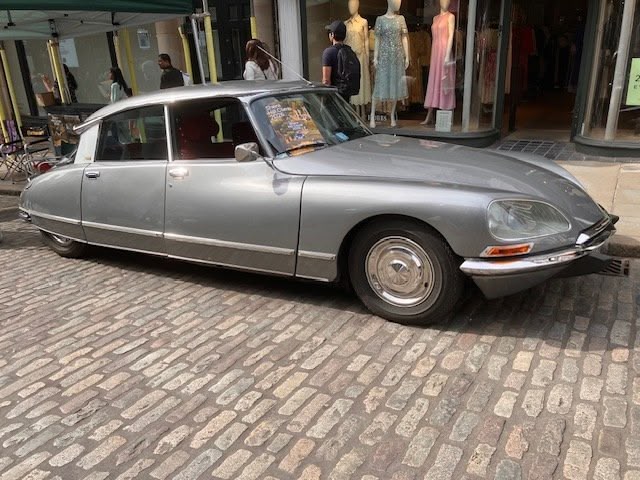
Citroen always liked to be different! I took this pic of a DS at the same show where I saw the Daimler. This is a later example (DS23 Pallas) which differed from the 1955 original but was still very recognisable.
@supersnipe With those curious 2CV and small vans with corrugated sides, at the other extreme of Citroen's range!
The inverted double-V symbol reflects the original M. Citroen, a gear manufacturer, having devised and patented a machine for cutting accurate "herring-bone" profile gears.
@gandalf1957 Pre-selectors were a big thing with Daimlers for many years. They hadn't used an ordinary manual for a long time but they wanted a straightforward four-speed floor shift for the SP250. So another rummage in fellow Coventrian Triumph's parts bin turned up the TR3 gearbox, which they basically copied and put it in this car.
There was an automatic option, too. This played well with the police who then didn't have to worry about clutch wear on their cars which were on the road for dozens of hours every week. It also suited the American market where automatics were quite common.