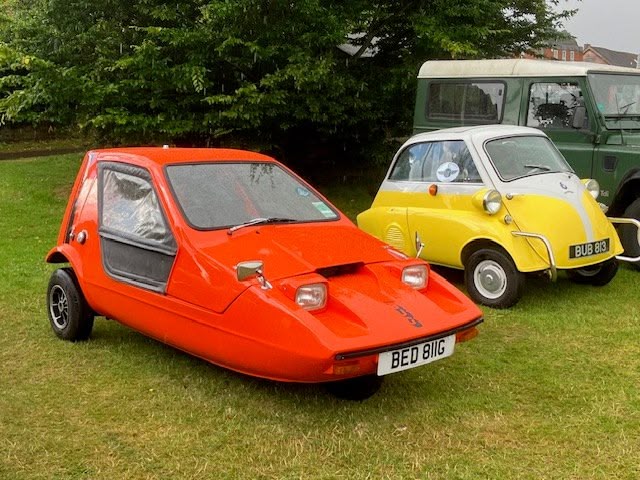
It was smaller than a BMC Mini, and they're small. It had three wheels, and announced its arrival with a raspy exhaust note and like almost all of its ilk, bright orange livery. And it was a curious shape - like a wedge of Red Leicester cheese scooting down the road. One of my fellow students at technical college where I was doing 'A' levels had one of these little beasties, and it was like a trademark. Anyone who had one would be indelibly associated with it. It wasn't something for people who wanted to go unnoticed. Plenty of Austins, Fords and Vauxhalls for those folk!
A 'Bug' at a show a few years ago. The other car is an Isetta, built by BMW. Both could be driven on a motorcycle licence, which explains the three-wheel format for microcars in the UK
The story of the 'Bug' goes back to the mid-1960s when Reliant Motors, a Midlands-based manufacturer of family three-wheeled runabouts (we had such things in those days), studied the idea of a sporty, novelty-type vehicle based on the then-current 'Regal' three-wheeler, to be called the 'Reliant Rogue'. The idea was shelved due to reservations about its congruity with the no-nonsense 'Reliant' image. They may have been about a lot of things but they weren't about fun. Fast forward to 1970, and Reliant, having taken over its rival three-wheeler maker Bond, had a rethink. Ogle Design, with whom Reliant had a long working relationship, were called upon to freshen up the mid-60s project, and it was released under the Bond name, initially manufatured at the Bond factory in Preston but soon moved to Reliant's Tamworth facitity.
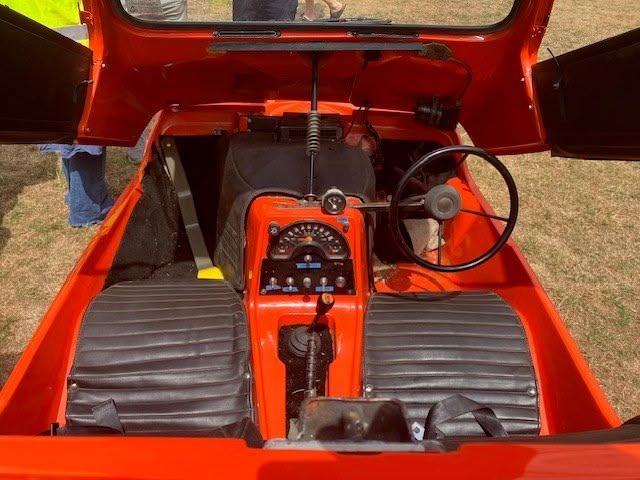
The clamshell body opens up to give access to the seats.
The running gear was pretty much the same as the Reliant Regal, but mounted on a new frame which Reliant would later repurpose for the mainstream Robin four-seater which was to appear a few years hence. That meant 701cc and a base output of 29bhp, rising to 31bhp for the top trim. This later went to 748cc and 32bhp. Not much, but with a kerb weight of less than 400kg, this gave you around 75bhp per tonne. Not earth-shattering, but we were a world away from Bond's original 1950s 'austerity' two-stroke microcars - and quick enough to be entertaining. The handling wasn't 'too bad', the acceleration was lively and the top speed was nearly 80mph (130km/h). And of course it didn't drink fuel. The 93 decibel howl produced by the engine at motorway speeds was tiring, but then, this wasn't a vehicle for those who wanted a quiet life.
The 'Bug' didn't go unnoticed by the Press either. The Automobile Association's 'Drive' magazine reported on the car, saying that it was 'aimed at younger drivers', but that of the people who turned up for the launch 'the youngest was 26 and the rest were staving off middle age'. Their rueful conclusion was that 'perhaps youth appeal doesn't come with a £600 price tag'. And that was the problem. For £600, or not much more, buyers could have something (most obviously a BMC Mini) which did a rather better job of actually being a car. The 'Bug' only had two seats. It's luggage compatment wasn't much more than a glorified glovebox. But perhaps the biggest killer of sales (something over 2,000 over a four-year run) was the clamshell canopy and the contorsions needed to get into the vehicle. You lay down inside a 'Bug', rather than getting into it.
The Bug's lack of sales success must have been a disappointment to Reliant. But I am returning to it here because I love it when motor manufacturers do something a bit different. The world is a more interesting place fbecause of the SAABs, Citroens, Panhards and other examples of car makers 'thinking outside the box'. In an automotive world ruled by calculation, it's refreshing to see something completely different. These little cars might not have been all that practical, but nothing on sale for £600 in 1970 had more personality.
This page is a permanent link to the reply below and its nested replies. See all post replies »