
Cousin Typing?

[media=https://vocaroo.com/19oHl31HFuZE]
...
{
"is_ranking_enabled": true,
"user_text": "\"what color you are\"\n\nTreatment for heroin addiction does, however.",
"headline": "Mom Shares Late Daughter\u2019s Poem About Heroin Addiction",
"url": "https://www.yahoo.com/beauty/mom-shares-late-daughters-poem-heroin-addiction-210729832.html",
"timestamp": "Mon Nov 11 21:59:03 UTC 2019"
},
{
"is_ranking_enabled": true,
"user_text": "Of course, all the empathy and sympathy poured out for a blonde white female. And if the woman was black.....nothing except criticism.",
"headline": "Mom Shares Late Daughter\u2019s Poem About Heroin Addiction",
"url": "https://www.yahoo.com/lifestyle/mom-shares-late-daughters-poem-heroin-addiction-210729832.html",
"timestamp": "Mon Nov 11 21:58:14 UTC 2019"
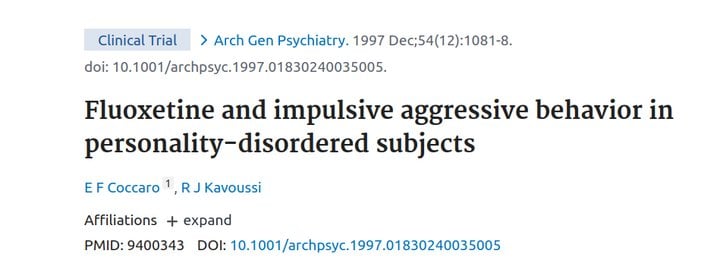
Background: Evidence of an inverse relationship between central serotonergic (serotonin [5-hydroxytryptamine]) system function and impulsive aggressive behavior has been accumulating for more than 2 decades. If so, pharmacological enhancement of serotonin activity should be expected to reduce impulsive aggressive behavior in subjects in whom this behavior is prominent.
Methods: A double-blind, placebo-controlled trial of the selective serotonin-uptake inhibitor fluoxetine hydrochloride was conducted in 40 nonmajor-depressed, nonbipolar or schizophrenic, DSM-III-R personality-disordered individuals with current histories of impulsive aggressive behavior and irritability. Measures included the Overt Aggression Scale-Modified for Outpatients, Clinical Global Impression Rating of Improvement, and several secondary measures of aggression, depression, and anxiety.
Results: Fluoxetine, but not placebo, treatment resulted in a sustained reduction in scores on the Irritability and Aggression subscales of the Overt Aggression Scale-Modified for Outpatients that was first apparent during months 2 and 3 of treatment, respectively. Fluoxetine was superior to placebo in the proportion of "responders" on the Clinical Global Impression Rating of Improvement: first at the end of month 1, and then finally demonstrating a sustained drug-placebo difference from the end of month 2 through the end of month 3 of treatment. These results were not influenced by secondary measures of depression, anxiety, or alcohol use.
Conclusion: Fluoxetine treatment has an antiaggressive effect on impulsive aggressive individuals with DSM-III-R personality disorder.
