Asking
Only logged in members can reply and interact with the post.
Join SimilarWorlds for FREE »

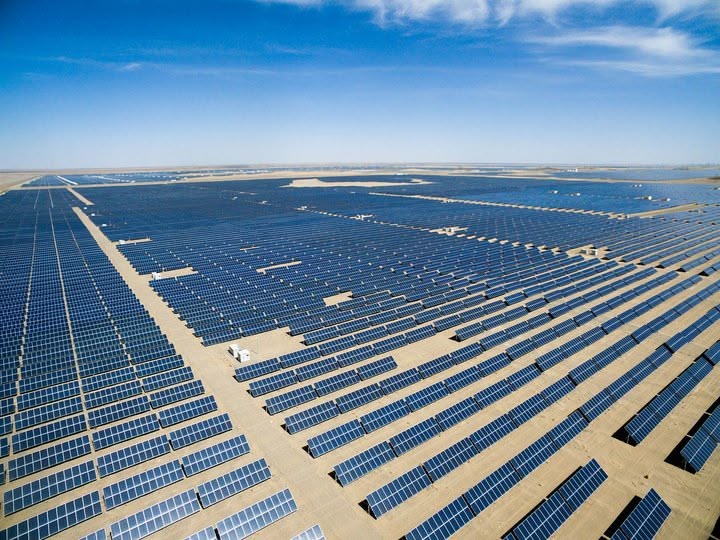
Is this really true? Elon Musk believes a solar farm 100 miles by 100 miles could power the entire USA?
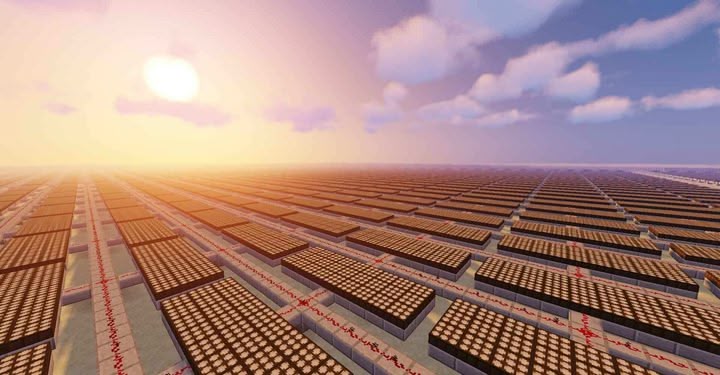


Photo above - our solar powered future, as rendered in Minecraft. Elon Musk's dream of a 10,000 square mile solar farm probably dwarfs this . . .

A solar farm 100 miles by 100 miles powers the entire nation. That’s what Elon Musk said. (see link below). To put this in perspective though, Musk has made a lot of eye-popping claims over the years: He’s going to Mars. He will find $1 trillion in government waste while heading up DOGE. That Tesla cars are “full self-driving” (the Department of Transportation is still suing him over that one. A Tesla can have difficulty navigating its way out of a crowded parking lot.)

But still, the premise of a silicon/cadmium/copper quilt 100 miles by100 miles which fixes everything is alluring no? (Set aside your concerns about copper thefts for now). A giant solar farm is especially attractive if you own a solar panel company, like Musk’s Solar City. The quilt might become less attractive when you realize that 95% of solar panels in America are manufactured in the People’s Republic of China. A nation which refuses to release its 100,000 Uighur minorities from “re-education camps,” and is constantly menacing Taiwan with aircraft and gunboats.

100 miles by 100 miles is larger than it seems. That’s actually 10,000 square miles. Okay, take a deep breath. The entire USA is a whopping 3.X million square miles. But most of this owned by the federal government. So if Musk gets his wish either the government could be impoverished or private landowners could become billionaires, or possibly both at the same time. That’s how government land acquisition works. It’s why the gamblers' express bullet train from California to Vegas is too expensive to complete - $100 million per mile.

10,000 square miles is bigger than Los Angeles, Houston, Dallas, Fort Worth, New York City, Chicago, New Orleans, Denver, Miami, Atlanta, and Frostbite Falls, Minnesota combined. I’m sure the 10,000 miles would be carved out of some desert or prairie, and not anywhere close to where we live. But remote locations will trigger the need for more power lines. America has 600,000 miles high voltage lines. If you want to reach places like Hawaii and Alaska, the story probably gets worse.

Personally, I’m okay with paving over 10,000 miles of useless desert, if this would actually fix anything. But it probably won’t. America already uses 4 trillion KwH of electricity annually. There are dozens of new data centers planned. One announced this week will use more electricity than the entire state of Utah. And then there’s the government’s efforts to outlaw gasoline cars, diesel trucks, gas furnaces and kitchen appliances . . . still a work in progress.

If you doubt any of this is true, just remember that China uses 10 trillion KwH of electricity a year – more than double the USA. Because China has 10 times as many electric vehicles.

I’m just sayin’ . . .

Elon Musk Says It Would Only Take 100 Miles By 100 Miles Of Solar Panels To Power The Entire U.S. —The Sun Is 'Really Reliable. It Comes Up Every Day'

https://finance.yahoo.com/sectors/energy/articles/elon-musk-says-only-100-140103053.html
Top | New | Old
BlueVeins · 26-30
Realistically a lot of that solar would just be on rooftops.
SusanInFlorida · 31-35, F
@BlueVeins i'm waiting for the adoption of windows which are also solar panels. for skyscrapers that could be a big thing.
BlueVeins · 26-30
@SusanInFlorida Wouldn't that fuck up the interiors by blocking the natural light?
SusanInFlorida · 31-35, F
@BlueVeins that was my thought at first too. then i saw pictures. almost all skyscraper window-walls are at least 30% "shaded", and that was the effective blockage of the solar windows too. of course, solar windows don't operate at the same 20-25% efficiency as old school panels, but still - it's the entire frigging building, top to bottom, generating electricity.
The Elon estimate is based on 20% efficiency solar panels in a high sunshine area such as the southwest. Current panels on sale from manufacturers like Maxeon and Ieko are approaching 25%, so the 10,000 square mile estimate can be confirmed from multiple sources and is good.

Two key points:

(1) the panels don't all have to be in the same place; they can be widely distributed. They can be spread all around the country, connected to many different grids. More square miles are needed in places with more clouds and rain; Vermont has half the "solar potential" of Arizona, but the savings in transmission lines may still make VT a viable place for some panels.

(2) Battery storage is needed for nighttime. However, industrial scale batteries are completely different from lithium batteries in use now. Sodium ion batteries are workable; iron-sulfur batteries may be even better. Batteries can also be widely distributed; in fact the more widely decentralized the batteries, the less additional load on big transmission lines.
SusanInFlorida · 31-35, F
@ElwoodBlues agree that it's unlike all 10,000 square miles will be in one place.

but like wind turbines, there would be public resistance to driving through pristine countryside and seeing half mile solar farms scattered about everywhere like snowflakes from the sky.
Ontheroad · M
I'm a huge proponent of solar energy, but that many panels all concentrated in one area could lead to dramatic ecological damage, weather pattern changes, etc.

I like the idea, but a smart grid connected to a widely spread system equaling his imagined array would be better.
SusanInFlorida · 31-35, F
@Ontheroad i completely agree with the weather/ecosystem impacts.

the same as paving over vast swaths of wild areas for cities and interstates and airports
SusanInFlorida · 31-35, F
@ElwoodBlues is this a tesla powerwall battery? how much did it cost? what's the capacity?
Ontheroad · M
@SusanInFlorida yeah, we really screwed that one up... badly.
DeWayfarer · 61-69, M
The guy is incapable of doing any such thing. Yet this is already happening in Saudi Arabia....


Current size versus future projected size.

Using 5–10 acres per MW (common utility-scale ranges) for the 2.6 GW (2,600 MW) Al Shuaibah plant:

Low estimate (5 acres/MW): 2,600 × 5 = 13,000 acres = 20.31 sq mi
Midpoint (7.5 acres/MW): 2,600 × 7.5 = 19,500 acres = 30.47 sq mi
High estimate (10 acres/MW): 2,600 × 10 = 26,000 acres = 40.63 sq mi

Projected future size for Saudi Arabia’s renewable target of 130 GW by 2030:

Low (5 acres/MW): 130,000 MW × 5 = 650,000 acres = 1,015.63 sq mi
Mid (7.5 acres/MW): 130,000 × 7.5 = 975,000 acres = 1,523.44 sq mi
High (10 acres/MW): 130,000 × 10 = 1,300,000 acres = 2,031.25 sq mi

Now think about that!

Why would a filthy oil rich nation, with a fraction of the USA population, even attempt what already has been done and still wants to vastly expand it to upto 2 thousand square miles by 2030?

This is not just about electric vehicles!
The world is going to expand into automated robots and AI! That requires electricity! And super vast amounts of it.
DeWayfarer · 61-69, M
@ArishMell You said the key word there! Digitally! Now think what's happening in finances. Think computers, AI's and NFT's.

Saudi Arabia is the first country to recognize an AI as a citizen! Sophia is the name of it. AI requires electricity! And vast amounts of it.

It's becoming all pervasive. And other countries don't have the same ethics as Western countries. AI doesn't have to care about ethics either. Think Musk's Grok!
SusanInFlorida · 31-35, F
@DeWayfarer this is probably easier to pull off in "kingdom", where a single family makes all the decisions on everything. and gets a piece of the action right off the top
DeWayfarer · 61-69, M
@SusanInFlorida Oh you would be right on the type of government. Not necessarily a monarchy or fiefdom though.
This comment is hidden. Show Comment
1490wayb · 56-60, M
hope it remains on the drawing board. i prefer them on individual homes and NO bloody transmission lines

 
Post Comment