Fun
Only logged in members can reply and interact with the post.
Join SimilarWorlds for FREE »

You can't make this stuff up...

The under funded, under educated, but never under fed, Chicago Teachers Union and an example of why it's members need to go back to the 4th grade!

Yup... those are liberals!

This page is a permanent link to the reply below and its nested replies. See all post replies »
Bumbles · 56-60, M
The tax code is so advantageous to the wealthy. I also work with unions and know how unreasonable they are.
pdockal · 56-60, M
@Bumbles

How are they unreasonable ?????
Bumbles · 56-60, M
@pdockal They ignore employee misconduct, incompetence, economic realities, the need for supervisors to communicate with staff, the need for operational changes, any limits on leaves of absence, and abuses of sick leave. They defend the indefensible.

I’m guessing you are a represented firefighter. I haven’t worked with a union representing them. I have worked with SEIU, Teamsters, CNA, others. Perhaps your union is not like those unions, but in my 25 years of experience unions only vary in degree, not kind.
pdockal · 56-60, M
@Bumbles

Sure they do
Worked with meaning you not in a union and can't stand the union
Bumbles · 56-60, M
@pdockal I can stand them fine, just describing their general behavior. I work for companies who have a unionized workforce.
pdockal · 56-60, M
@Bumbles

Of course you do
Your a union hater/ buster
CougarLisa · 36-40, F
@Bumbles I agree about unions, they are very corrupt, yet can... I repeat, can offer works some recourse. How is the tax code advantageous to people with higher incomes? Or those who have saved/invested?
Bumbles · 56-60, M
@CougarLisa. The tax code favors the wealthy primarily through lower tax rates on capital gains vs. wages, deferral of taxes on unrealized gains (allowing borrowing against assets instead), and loopholes in estate/inheritance taxes that protect large fortunes across generations, plus specific deductions and deductions for business owners and investors that disproportionately benefit high earners. These advantages allow the rich to pay a lower effective tax rate, often less than middle-class workers, and accumulate passive wealth concentrated in fewer and fewer people.
Bumbles · 56-60, M
@pdockal I don’t spend any energy on it, just describing how unions act. They are not the righteous organizations they pretend to be. I definitely don’t bust unions, lol.
pdockal · 56-60, M
@Bumbles

your describing how they act towards union haters
I can describe the total opposite & how they make my life so much better & protect me from unscrupulous business owners & their management teams who would take advantage of me if I dodnt have the protections negotiated on my behalf in place.
Because of UNIONS you have weekends & a 40hour work week
Because of unions you arent working as a child (child labor)
Because of unions the workplace is safer
Because of unions men, women etc get the same pay
I could go on but I doubt youll listen/comprehend or even care ... youll just try to spin it
CougarLisa · 36-40, F
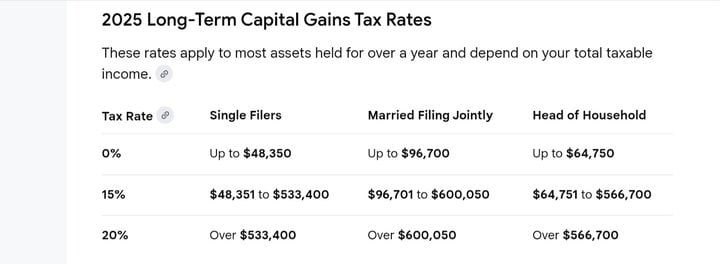
@Bumbles a great deal of what you are saying is simply not true! As an example please see the Capital Gains Tax table below. It clearly demonstrates that smaller investors are favored over larger investors.
This comment is hidden. Show Comment
Bumbles · 56-60, M
@CougarLisa If you’ll hear me out, the issue isn’t different rates, per se. Those exist for income, too. It’s that wealthy people make much more of their income as capital gains, and so can take advantage of their lower rate. So, rather than 37% (income) a much greater proportion of their income is taxed at 20% (capital gains).

This is why they may be taxed a lower rate overall than middle class folks who make most of their money via income not capital gains.
CougarLisa · 36-40, F
@Bumbles I don't have an issue with civil discourse from intelligent people, so I will hear you out. I understand what you are saying about income vs investment returns (capital gains). But we shouldn't muddy the waters on the subject of one or the other. They are two separate taxable forms of return. One is for physical work, the other is for the work your money is doing. It's unfair to look at someone who has worked hard and not wasted their money, or worked hard to achieve more and say; the return you make on the income you have already payed taxes on and invested should be taxed at the rate income is taxed because you've done so well at investing. The rates are the rates and that's what we have to works with.

Personally, I do not think anyone should be paying taxes on money they have been wise with and already been taxed on! You make money, you pay a tax. What you do with that money is no one business. If I get no return on it by spending it all, (and pay sales tax in doing so) that's on me! If I can make 10% or 1,000% return on it in a legal manner, that's my luck or wise planning. Why should anyone be punished for success, or achievement? The flip side to this is, of course, no tax breaks for losses; which I think is only fair under this scenario.

I personally have used "dividend harvesting" to offset my returns at tax time. In a perfect world, this too would be on me and not qualify me for a deduction. But the system we have is not simple! It's overly complex in a manner that bleeds money out of everyone! Needless to say, this has the largest impact on those struggling to save and survive. It also provides a whole industry with a purpose and billions of dollars in income... do you pay someone to do your taxes??? That's my point here!

Lower income people pay less tax on income, smaller investors pay less tax on their returns. In both cases, the lowest tier applies no tax at all! In theory, someone who lives a very modest life can have a nice sized nest egg and never pay a penny in tax on it!

Moreover, what you pay on your investment returns is influenced by income. Here, again, lower income people with small investment holdings have an advantage. It is the opposite for lower income people with large investments because it influences the overall tax they pay inspite of the lower income bracket.

Bumbles · 56-60, M
@CougarLisa Thank you for your explanation. I think we have a philosophically different idea about passive income, inherited wealth, and wealth concentration. So it goes…