
How much will it cost to replace your EV battery? And did you know that high power, fast charging is a near death experience for it?
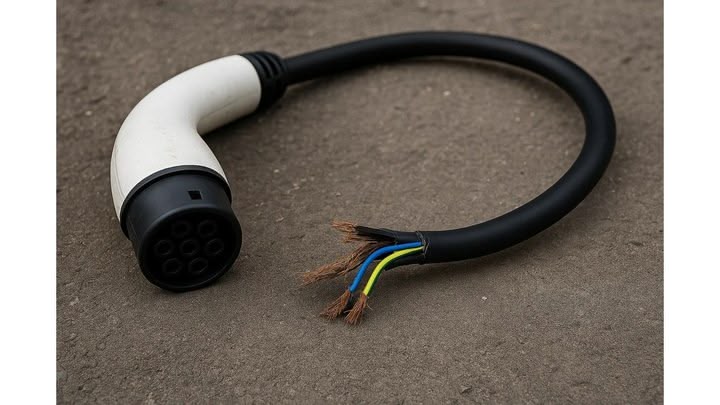
Photo above – Is someone short on cash? The copper in this EV charging cable is worth $23. Check Amazon for replacement cables beginning at $79 and up.
First, I was upset that the Biden Administration only installed 37 public EV chargers after spending $7.5 billion as of the 2024 election. Then I was upset that Trump cancelled all the remaining federal charging stations. But now I’m confused. The latest report says that high-power, fast EV charging is the surest way to kill your battery. (see link below).
I doubt this is going to turn into another asbestos-style fiasco, where smart alecky lawyers sue the government. Asbestos was originally a legal product certified safe to use by government agencies. Until it wasn't. The Department of Transportation could be on the hook for of millions of replacement EV batteries. The way lawyers think you can never tell. Wait 'til they find out what alcohol, tobacco, and firearms can do.
People should already have figured out that gazillion watt EV charging is risky. Cars were already igniting with low power garage style chargers. And sometimes when they weren’t even plugged in*. (“Park your Chevy Bolt outside until further notice. This is your first and final warning. General Motors and its subsidiaries bear no responsibility for what happens if you continue to recklessly park in your own garage.”)*
The list of ways you can kill your EV battery is apparently endless. In addition to charging too fast, charging too long is a risk (“don’t leave your EV plugged into the charger while on vacation”). Do not park near salt water – the ocean spray in the air might cause a fire. Or put it on a container ship. And entire cargo of Mercedes EVs went to the bottom after catching fire. Do not operate vehicle when the battery seems not. Operating vehicles in temperatures below freezing dramatically shortens range. Looking at it cross eyed makes it unhappy.
I totally get why people don’t buy home chargers. Half of everyone doesn’t even own a home. Most people who DO have a garage don’t park in it. They use it as a shed for lawn mowers, snow blowers, garbage cans, a chest freezer, spare tires. And home chargers can be expensive – when you call for installation, Joe the plumber/electrician asks “how much were you lookin’ to spend?”
It might SEEM like an ideal solution to hook your EV up to some convenience store gizmo which claims it can recharge you in 15 minutes or less. And which costs 3X as much per KwH as home electric rates. But all silver linings have a cloud. You can pay more at the point of charging, and more again when it's time to replace your battery, it seems.
I’m just sayin’ . . .
https://www.msn.com/en-xl/news/other/high-power-fast-charging-is-the-leading-cause-of-ev-battery-degradation-report/ar-AA1UaLiU?ocid=BingNewsSerp
https://www.politifact.com/factchecks/2024/dec/05/michael-rulli/biden-law-gave-states-75-billion-for-ev-charging-3/
High-power fast charging is the leading cause of EV battery degradation: report
PolitiFact | Biden law gave states $7.5 billion for EV charging; 37 stations and 226 ports built, more to come


