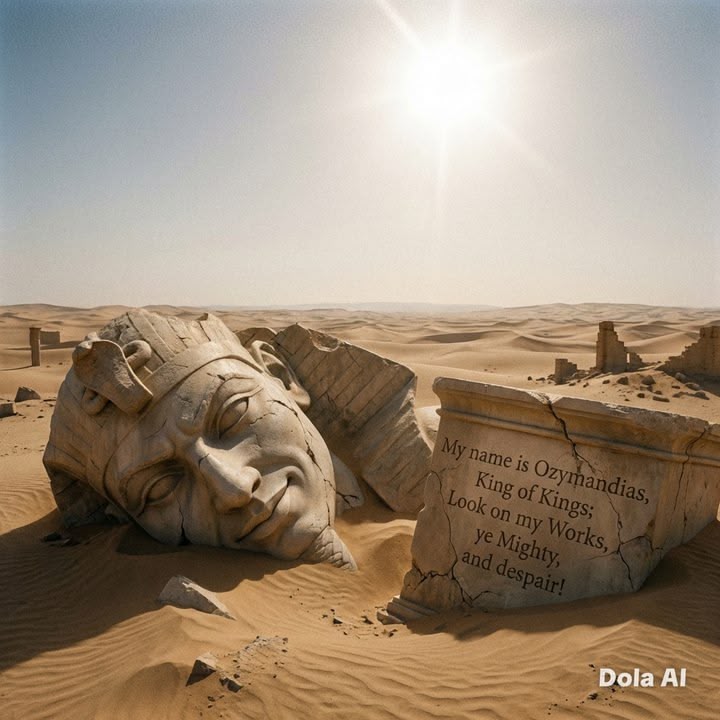
Forgotten poets of a bygone age - Ozymandias by Horace Smith
You probably think you are going to hear about a traveller to an antique land, but Shelley isn’t of course a forgotten poet. Horace Smith on the other hand is. Smith 1779 - 1849 was an English poet, novelist, and humourist associated with the later Romantic era.
He worked as a prosperous stockbroker and insurance broker for much of his life, which provided financial stability. In 1818, he famously participated in a sonnet-writing competition with his friend Percy Bysshe Shelley on the theme of Ozymandias inspired by ancient Egyptian ruins described by the classical Greek historian Diodorus Siculus. Shelley’s version became iconic, while Horace’s “Ozymandias” offered a similar meditation on the transience of power and empire, with a more apocalyptic future vision.
Here it us:
In Egypt's sandy silence, all alone, Stands a gigantic Leg, which far off throws The only shadow that the Desert knows:— "I am great OZYMANDIAS," saith the stone, "The King of Kings; this mighty City shows The wonders of my hand."— The City's gone,— Naught but the Leg remaining to disclose The site of this forgotten Babylon.
We wonder — and some Hunter may express Wonder like ours, when thro' the wilderness Where London stood, holding the Wolf in chace, He meets some fragment huge, and stops to guess What powerful but unrecorded race Once dwelt in that annihilated place.
In the same vein, a prose poem by Clark Ashton Smith, American poet, writer, and artist...
The Memnons of the Night Clark Ashton Smith
Ringed with a bronze horizon, which, at a point immensely remote, seems welded with the blue brilliance of a sky of steel, they oppose the black splendour of their porphyritic forms to the sun's insuperable gaze. Reared in the morning twilight of primeval time, by a race whose towering tombs and cities are one with the dust of their builders in the slow lapse of the desert, they abide to face the terrible latter dawns, that move abroad in a starkness of fire, consuming the veils of night on the vast and Sphinx-like desolations. Level with the light, their tenebrific brows preserve a pride as of Titan kings. In their lidless implacable eyes of staring stone, is the petrified despair of those who have gazed too long on the infinite.
Mute as the mountains from whose iron matrix they were hewn, their mouths have never acknowledged the sovereignty of the suns, that pass in triumphal flame from horizon unto horizon of the prostrate land. Only at eve, when the west is a brazen furnace, and the far-off mountains smoulder like ruddy gold in the depth of the heated heavens — only at eve, when the east grows infinite and vague, and the shadows of the waste are one with the increasing shadow of night then, and then only, from their sullen throats of stone, a music rings to the bronze horizon — a strong, a sombre music, strange and sonorous, like the singing of black stars, or a litany of gods that invoke oblivion; a music that thrills the desert to its heart of adamant, and trembles in the granite of forgotten tombs, till the last echoes of its jubilation, terrible as the trumpets of doom, are one with the trumpets of infinity.
@emmasfriend ‘Chace’ is an archaic spelling of ‘chase’ even archaic in Smith’s time. I think it is a deliberate archaism to give the poem a romantic flavour. ‘Wolf’ being capitalised must stand for something symbolic. Does the ‘Wolf’ represent Britain or the British Empire - I don’t know.