Poets of a Bygone Age - Christina Rossetti

Morning and evening
Maids heard the goblins cry:
“Come buy our orchard fruits,
Come buy, come buy:…
The opening lines of Goblin Market. Now mainly remembered for ‘In the Deep Midwinter’ this is Christina Rossetti’s most intriguing poem.
You can read the whole poem here:
https://www.poetryfoundation.org/poems/44996/goblin-market
Born Christina Georgina Rossetti on December 5, 1830, in London, she was the youngest of four exceptionally talented siblings in an artistic Italian immigrant family. Her father, Gabriele Rossetti, was a poet, Dante scholar, and political exile; her mother, Frances Polidori, came from half-Italian heritage (and was the sister of John Polidori, Lord Byron’s physician and friend). Her brothers included the Pre-Raphaelite poet and painter Dante Gabriel Rossetti and critic William Michael Rossetti; her sister Maria also became a writer.
A devout High Church Anglican, Rossetti twice declined marriage proposals on religious grounds (once to the pre-raphaelite painter James Collinson because he converted to Catholicism).
Her breakthrough came with Goblin Market. Two sisters meet the goblin men who tempt them with succulent fruits. Lizzie resists, but Laura succumbs to the temptation. Having fallen into temptation she can no longer live without the fruit but can no longer see the goblins to get more. In order to save her Laura must sacrifice herself and withstand the temptation. She succeeds in both and throughout her sacrifice Laura is redeemed.
It is generally interpreted as a Christian religious allegory of temptation, fall, sacrifice, and redemption. Rossetti herself described it as a children’s poem, but its sensual imagery and symbolic depth invite deeper readings. The goblins representing predatory men tempting women into sexual excess.
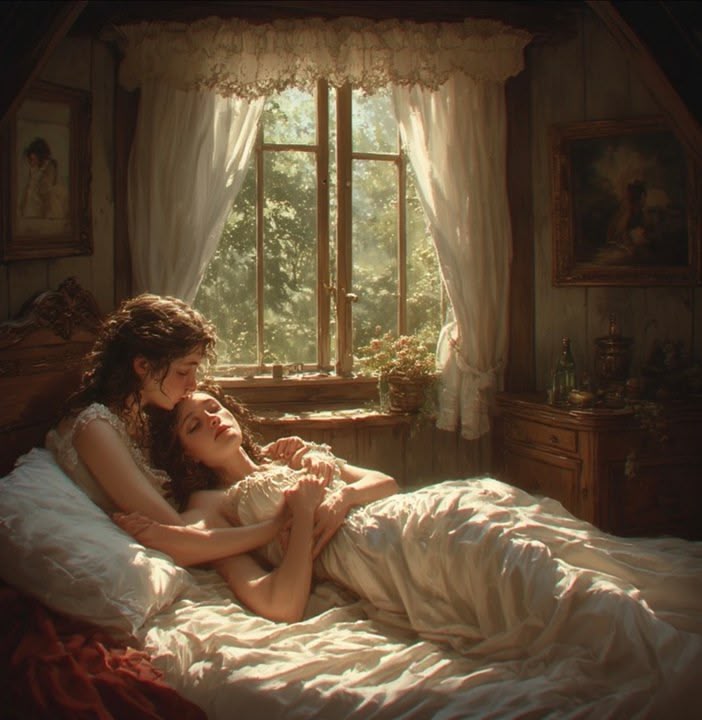
There is continual erotic and homoerotic language. Perhaps Rossetti’s refusal to marry was more than just on religious grounds. Although the girls are described as ‘sisters’, they share a bed, and are described as lying “cheek to cheek and breast to breast / Locked together in one nest,” evoking close, bodily entanglement that goes beyond typical Victorian sibling affection. The poem notes them “kissing” on multiple occasions, with affectionate, lingering descriptions.
In the climactic redemption scene: After Lizzie endures assault by the goblins to obtain the antidote-like fruit juices, she returns home and urges Laura:
Hug me, kiss me, suck my juices
Squeez’d from goblin fruits for you,
Laura responds by “kiss’d and kiss’d and kiss’d her” with a “hungry mouth,” then “suck’d until her lips were sore” (echoing her earlier obsessive consumption of the goblin fruit). The repetition of “suck,” “kiss,” “eat,” “drink,” and “love me” mirrors Eucharistic language (Christ’s body and blood) but is laden with erotic overtones—sensual sucking, juices on skin, ecstatic revival through oral contact. This moment of intimate, bodily exchange revives Laura, transforming what was once destructive desire into mutual pleasure.