Book to share - May 2026
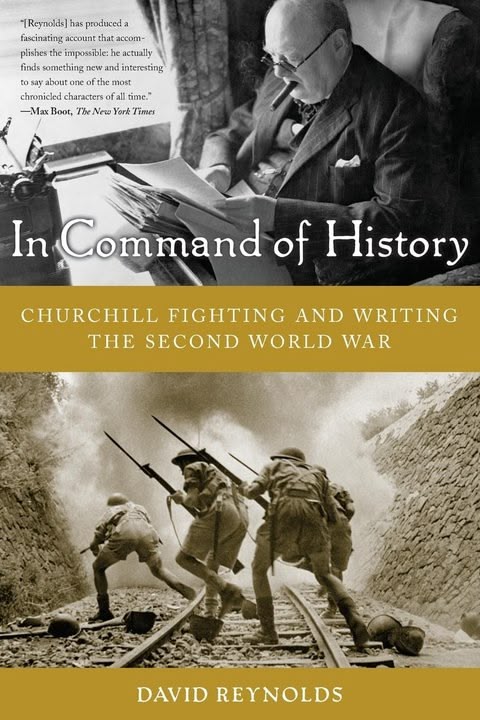
Winston Churchill fought the World War II twice over-first as Prime Minister during the war, and then later as the war's premier historian. From 1948-54, he published six volumes of memoirs. They secured his reputation and shaped our understanding of the conflict to this day.
Drawing on the drafts of Churchill's manuscript as well as his correspondence from the period, David Reynolds masterfully reveals Churchill the author. Reynolds shows how the memoirs were censored by the British government to conceal state secrets, and how Churchill himself censored them to avoid offending current world leaders.
This book illuminates an unjustly neglected period of Churchill's life-the Second Wilderness Years of 1945-51, when Churchill wrote himself into history, politicked himself back into the prime-ministership, and delivered some of the most important speeches of his career.
A lot of the myth remains that would be found in anything by either Andrew Roberts or Victor Davis Hanson. However, if we were to read a book on how Shakespeare wrote Hamlet, it would stand to reason that we have either seen the play or read the work. That makes indeed more sense. We need to read what Churchill wrote first of all.
Reynolds does a complete and thorough dissertation of how, when and why Churchill wrote this Nobel Prize winning series of books on the Second World War. Many of the past reviewers stated that it wasn't really Churchill's writing but that of a band of ghost writers, what we nowadays call simply writing syndicate or ghost writers.
Did Churchill write all the text? No. Was this work his authorship? You can bet it was. As Reynolds' stated, it's like a Master Chef supervising the entire culinary creation. He showed how Churchill became the conductor of a veritable team of researchers and writers: Bill Deakin, Henry Pownall, Lord Ismay, Norman Brook, and Denis Kelly.
Reynolds follows Churchill's "The Second World War" volume by volume, according to a regular plan: the context of its writing, an analysis of Churchill and his assistants' handling of the historical content, and the volume's reception in Great Britain, but also in North America, since the series was broadcast on both sides of the Atlantic from the outset.
The book arrives at a nuanced portrait of Churchill, one that respects the man and his grandeur: Churchill was often impulsive and unfair to his generals and admirals. He could have prevented Mers-el-Kébir and Dresden, bears a heavy responsibility for the fall of Singapore, but he stood firm against Hitler in May 1940.
Reynolds brilliantly demonstrates how the writing of "The Second World War" was influenced by the successive phases of the Cold War, from the Fulton speech to the Korean War and the relative détente that followed Stalin's death. David Reynolds's book is therefore a great one.
The critics would claim that not every Churchill myth has been boned out. Perhaps. One example is the Battle of Britain in 1940. The battle is fixed into our popular consciousness, the valiant `Few' against the Luftwaffe swarms. It was Churchill's phrasing, and this pithy epithet continues to define how the battle is perceived to this very day.
Other historians such as Richard Overy tell a different story: the balance of planes and pilots made it a better-matched contest than was realised at the time. The few faced the fewer. Plus the planning done by Air Chief Marshal Hugh Dowding preformed much better than even radar.
Reynolds's most fascinating insights is that Churchill's memoirs were an "unofficially official" history, promoted by and encouraged by Whitehall as a way to get Britain's version across. Senior Civil Servants played an important role in the memoirs, allowing the publication of a mass of documents and even writing some of the text.
Churchill's History is thus biased in several ways. He tends to make himself much more far sighted in retrospect. His account in "The Gathering Storm", of his war against appeasement, makes him seem a much stauncher opponent of appeasement much earlier then he really had been.
Similarly, following the Fall of France, Churchill had privately had doubts about the possibility of final victory. But his histories follow his public persona and emphasis his belligerency. Churchill excuses even the Norway invasion, and generally casts himself in a positive light. Read also the diaries of Field Marschal Alan Brooke for more!