May Day - originally a Roman festival which began on 28th April and lasted several days to mark the commencement of summer. In England, middle and lower classes would gather flowers - ‘go a maying’ - and the prettiest village maid was crowned Queen of the May, celebrated with dancing around the maypole.
On 1st May 1308 Albert Habsburg I Duke Austria (age 52) was murdered by his nephew John "Parricide" Habsburg (age 18) who he had deprived of his inheritance when Albert Habsburg I Duke Austria forced John's eleven year old father Rudolf Habsburg II Duke Austria to waive his rights to the Habsburg duchies of Austria and Styria as part of the Treaty of Rheinfelden.
One of the most significant events in English history that took place on May 1 was the dramatic fall of Anne Boleyn, the second wife of King Henry VIII. On this day, Anne’s arrest on charges of adultery, incest, and high treason was officially recognized by the king. Her execution would come only days later, on May 19, 1536.
Another key event on May 1 was the arrest of several prominent Royalist figures during the English Civil War. After King Charles I was executed in 1649, his supporters still sought to maintain the monarchy, resulting in continuing tensions across the kingdom. On May 1, the Parliamentarians executed a series of raids to capture these Royalists, resulting in further divisions in British society during this turbulent period.
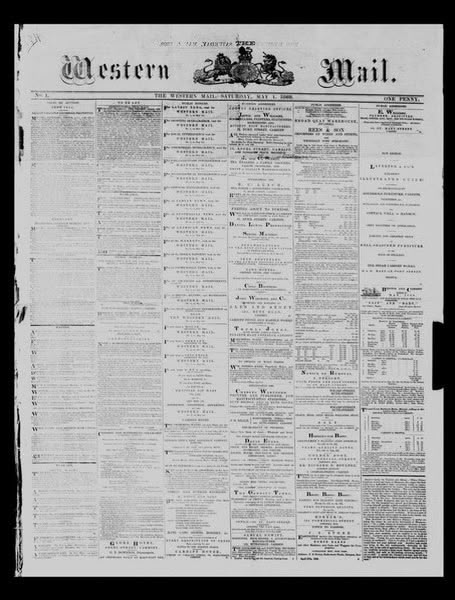
The first ever edition of the Western Mail was printed on May 1 1869. The Western Mail was founded in Cardiff by John Crichton-Stuart, 3rd Marquess of Bute. It describes itself as 'the national newspaper of Wales' although it has a very limited circulation in North Wales.
On May 1, 1924, the British Empire Exhibition opened at Wembley Stadium in London. This event was designed to celebrate the achievements of the British Empire and promote its economic and cultural power. The exhibition was held during a time of political and economic change, following the First World War, and it sought to reinforce Britain’s place as the central power within the Empire.
1966: The Beatles perform what would be their last British concert appearance at the New Music Express Annual Poll-Winners All-Star Concert.
Radio
1942: World War II: The Dutch resistance station Radio Orange calls on Jewish citizens to defy Nazi orders to wear a yellow star of David badge.
1970: The radio-ship King David, the home of the ill-fated Capital Radio, makes its first test transmission. It uses an experimental 'hoop' aerial suspended from its main mast.