1408The Battle of Bramham Moor in which King Henry IV defeated the rebellious Percy family. The death of Percy removed the threat of rebellion in the North of England and allowed Henry to focus more fully on Wales.
On February 19, 1600, the Peruvian stratovolcano Huaynaputina erupted, creating the most catastrophic volcanic explosion in South America's recorded history. The eruption caused significant climate anomalies and affected the Southern Hemisphere's weather patterns for years.
Fast forward to the 18th century, February 19, 1747, marked a somber and historic event: the execution of Simon Fraser, the 11th Lord Lovat. This moment took place after Lord Lovat's involvement in the Jacobite Rebellion of 1745, which sought to restore the Stuart monarchy to the British throne. The rebellion was ultimately unsuccessful, leading to the defeat of the Jacobite forces at the Battle of Culloden in 1746.Lord Lovat, who had initially switched allegiances during the conflict, was captured by the British government. Despite his attempt to portray himself as a loyal servant of King George II, his past actions during the rebellion led to his arrest and eventual trial for treason.On February 19, Lord Lovat was executed by beheading, a dramatic and symbolic end to a turbulent chapter in British history. His execution served as a warning to other potential Jacobite sympathizers, solidifying the British government's control over Scotland and the end of the Jacobite cause.
On 19th February 1766, Thomas Kymer was granted an Act of Parliament allowing him to construct the Kidwelly and Llanelli Canal. The Kidwelly and Llanelli Canal with an adjoining tramroad was, built to carry anthracite coal from Little Gwendraeth River, near Kidwelly to the coast for onward transportation. It originally linked pits at Pwll y Llygod, near Trimsaran, to a dock near Kidwelly, but as the entrance to the dock was subject to silting, an extension of the canal to Llanelli was authorised in 1812.
Friday, February 19, 1836. : British Parliament officially proclaims the colony of South Australia and formally defines its boundaries.
1878: Thomas Alva Edison patents his phonograph. Sound is recorded onto a tinfoil sheet wrapped around a revolving cylinder.
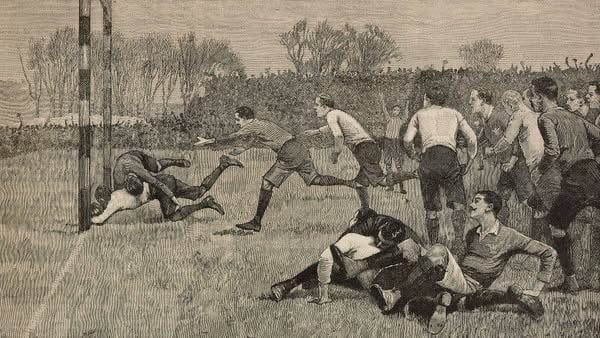
On 19th February 1881, Wales played their first ever rugby international, against England at Blackheath's Richardson's Field.
The game is noted for its chaotic organisation and it didn't help that the RFU insisted that the match was played on the same day that Swansea were playing Llanelli in a semi-final cup-tie thus depriving Wales of several players. The players had never played together before and one player, Major Richard Summers from Haverfordwest was selected on the performances for his school. As no formal invitations to play were sent out, two of those expected to play didn't turn up and two bystanders, with tenuous Welsh links were roped in,so the final team that took to the pitch consisted of 8 Welshmen, 4 Englishmen, 2 Irishmen and the captain, James Bevan, an Australian.
The Welsh connection to Kellogg's Corn Flakes; Kellogg's was founded as the Battle Creek Toasted Corn Flake Company on February 19th 1906, by Will Keith Kellogg and on one of her overseas trips in 1922, Nansi Richards, the internationally acclaimed Welsh harpist, visited the home of Will Kellogg, who was looking for a marketing idea for his cornflakes.
It is said that Nansi suggested a pun on the name Kellogg and the Welsh word ceiliog, meaning cockerel. Will Kellogg liked the idea and Cornelius Rooster was born and has appeared on packs of Kellogg's Corn Flakes ever since.
1972 Paul McCartney releases "Give Ireland Back to the Irish", his commentary about the Britain-Ireland conflict. The song was immediately banned by the BBC, but the notoriety the song received from the banning only increased its popularity and the record soared into the UK Top 20. [media=https://youtu.be/P_O3cCs9qmM]
1977
Leo Sayer had his only UK #1 single with "When I Need You". The chorus of the song is identical to part of the Leonard Cohen tune "Famous Blue Raincoat" and after a lawsuit was launched, Cohen received compensation. [media=https://youtu.be/ohk3DP5fMCg]