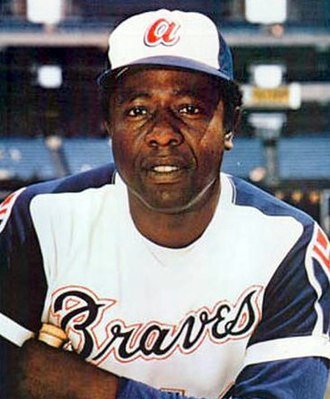
Henry Louis Aaron (February 5, 1934 – January 22, 2021), nicknamed "Hammer" or "Hammerin' Hank", was an American professional baseball right fielder who played 23 seasons in Major League Baseball (MLB), from 1954 through 1976. Considered one of the greatest baseball players in history, he spent 21 seasons with the Milwaukee/Atlanta Braves in the National League (NL) and two seasons with the Milwaukee Brewers in the American League (AL). At the time of his retirement, Aaron held most of the game's key career power-hitting records. He broke the long-standing MLB record for home runs held by Babe Ruth and remained the career leader for 33 years. He hit 24 or more home runs every year from 1955 through 1973 and is one of only two players to hit 30 or more home runs in a season at least fifteen times.[1]
Aaron holds the MLB records for the most career runs batted in (RBIs) (2,297), extra base hits (1,477), and total bases (6,856). The total base record is remarkable in context: at the time of his retirement, he had travelled over 12 miles farther on the base paths than any other player in MLB history.[2] Aaron is also third all-time for career hits (3,771) and fifth in runs scored (2,174). He is one of only four players to have at least 17 seasons with 150 or more hits.[3] Aaron's ability as a hitter can be illustrated by his still having over 3,000 hits even without counting any of his home runs.
Aaron was born and raised in and around Mobile, Alabama. Aaron had seven siblings, including Tommie Aaron, who played major-league baseball with him. He appeared briefly in the Negro American League and in minor league baseball before starting his major league career.[4] By his final MLB season, Aaron was the last former Negro league baseball player on a major league roster. During his time in Major League Baseball, and especially during his run for the home run record, Aaron and his family endured extensive racist threats.[5] His experiences fueled his activism during the civil rights movement.[6]
Aaron played the vast majority of his MLB games in right field, though he appeared at several other infield and outfield positions. In his last two seasons, he was primarily a designated hitter.[7] He was an NL All-Star for 20 seasons and an AL All-Star for one season, and he holds the record for the most All-Star selections (25),[a] while sharing the record for most All-Star Games played (24) with Willie Mays and Stan Musial. He was a three-time Gold Glove winner, and in 1957, he won the NL Most Valuable Player (MVP) Award when the Milwaukee Braves won the World Series.
After his retirement, Aaron held front office roles with the Atlanta Braves, including the senior vice president. In 1988, Aaron was inducted into the Wisconsin Athletic Hall of Fame.[8] In 1999, The Sporting News ranked Aaron fifth on its list of the "100 Greatest Baseball Players".[9] In 1982, he was inducted into the National Baseball Hall of Fame in his first year of eligibility. That same year, MLB introduced the Hank Aaron Award to recognize the top offensive players in each league. He was awarded the Presidential Medal of Freedom in 2002. He was named a 2010 Georgia Trustee by the Georgia Historical Society in recognition of accomplishments that reflect the ideals of Georgia's founders. Aaron resided near Atlanta until his death.
Aaron was born in Mobile, Alabama, to Herbert Aaron Sr. and Estella (Pritchett) Aaron.[11][12] He had seven siblings.[11] Tommie Aaron, one of his brothers, also went on to play Major League Baseball. By the time Aaron retired, he and his brother held the record for most career home runs by a pair of siblings (768). They were also the first siblings to appear in a League Championship Series as teammates.[13]
While he was born in a section of Mobile referred to as "Down the Bay", he spent most of his youth in Toulminville. Aaron grew up in a poor family.[11] His family could not afford baseball equipment, so he practiced by hitting bottle caps with sticks. He would create his own bats and balls out of materials he found on the streets.[14] His boyhood idol was baseball star Jackie Robinson.[15] Aaron attended Central High School[b] as a freshman and a sophomore. Like most high schools, they did not have organized baseball, so he played outfield and third base for the Mobile Black Bears, a semipro team.[18] Aaron was a member of the Boy Scouts of America.
Although he batted cross-handed (as a right-handed hitter, with his left hand above his right), Aaron established himself as a power hitter. As a result, in 1949, at the age of 15, Aaron had his first tryout with an MLB franchise, the Brooklyn Dodgers; however, he did not make the team.[19] After this, Aaron returned to school to finish his secondary education, attending the Josephine Allen Institute, a private high school in Alabama. During his junior year, Aaron joined the Prichard Athletics, an independent Negro league team,[20] followed by the Mobile Black Bears, another independent Negro league team.[11] While on the Bears, Aaron earned $3 per game ($30 today), which was a dollar more than he got while on the Athletics[/c]
Negro and minor leagues
On November 20, 1951, baseball scout Ed Scott signed Aaron to a contract on behalf of the Indianapolis Clowns of the Negro American League, where he played for three months.[21]
He started play as a 6 ft (180 cm), 180 lb (82 kg) shortstop,[22] and earned $200 per month.[23] As a result of his standout play with the Indianapolis Clowns, Aaron received two offers from MLB teams via telegram, one from the New York Giants and the other from the Boston Braves. Years later, Aaron remembered:
I had the Giants' contract in my hand. But the Braves offered fifty dollars a month more. That's the only thing that kept Willie Mays and me from being teammates – fifty dollars.[24]
While with the Clowns he experienced racism. Of a time his team was in Washington, D.C. Aaron recalled:
We had breakfast while we were waiting for the rain to stop, and I can still envision sitting with the Clowns in a restaurant behind Griffith Stadium and hearing them break all the plates in the kitchen after we finished eating. What a horrible sound. Even as a kid, the irony of it hit me: here we were in the capital in the land of freedom and equality, and they had to destroy the plates that had touched the forks that had been in the mouths of black men. If dogs had eaten off those plates, they'd have washed them