Pulcinella (Italian: [pultʃiˈnɛlla]; Neapolitan: Pulecenella) is a classical character that originated in commedia dell'arte of the 17th century and became a stock character in Neapolitan puppetry. Pulcinella's versatility in status and attitude have helped maintain the character's popularity in various forms since his introduction to commedia dell'arte by Silvio Fiorillo in 1620.
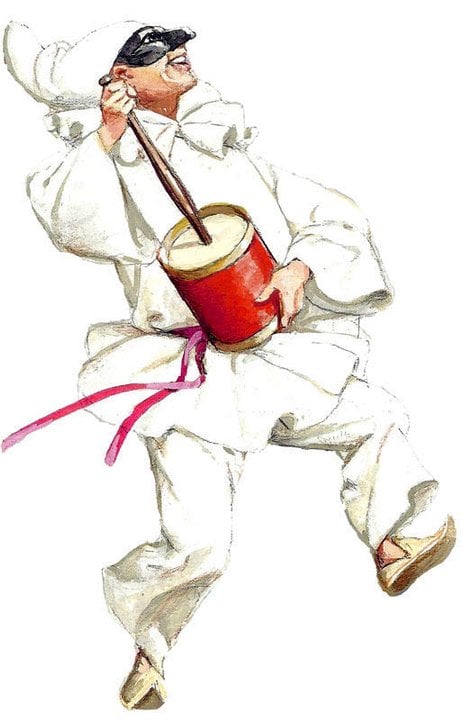
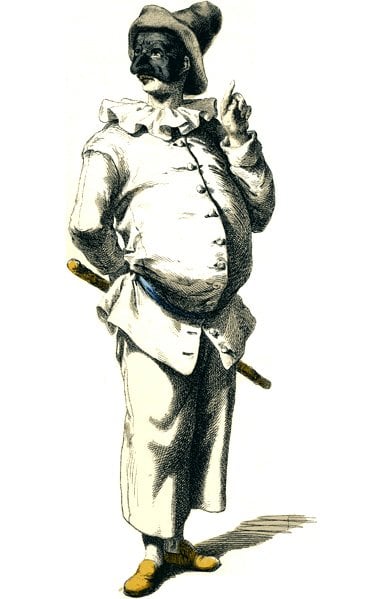
His visual appearance includes a humpback, a crooked nose, gangly legs, a potbelly, large cheeks, and a gigantic mouth. These traits were inherited from two stock characters of the Atellan Farce. He typically wears a conical hat. When depicted as a member of the upper class, Pulcinella is a cunning thief and schemer. When depicted as a member of the servant class, Pulcinella is a perverted country bumpkin. In either case, he is a social climber, striving to rise above his station in life. He is an opportunist who always sides with the winner in any situation and who fears no consequences. His main motivations are self-interest and self-preservation, yet Pulcinella tends to rescue other characters from trouble. He is said to be every character's savior, despite acting as a rebel and a delinquent.
Pulcinella embodies the Neapolitan plebeians, the simplest man who occupies the bottom place on the social scale, the man who, although aware of his problems, always manages to come out of them with a smile.
Pulcinella represents the soul of the people and its primitive instincts. He almost always appears in contradiction, so much so that he does not have fixed traits. He may be rich or poor, a bully or a coward—sometimes exhibiting both traits simultaneously. In addition to being a faithful servant, he adapts to all trades: baker, innkeeper, farmer, thief, seller of miraculous concoctions.
His movements are broad and laborious, allowing him to aggressively emphasize his speech while simultaneously exhausting him. He will also get excited about something and move very quickly and deliberately, leaving him with no choice but to halt the action to catch his breath. He is to be thought of as a rebellious delinquent in the body of an old man.
The quality that best distinguishes Pulcinella is his cunning, with which he manages to solve the disparate problems that arise in front of him—always, however, in favor of the weakest at the expense of the powerful.
Another famous characteristic of his is that of never being able to shut up; from this trait comes the expression in several European languages "Pulcinella's secret" (i.e., an open secret that everyone knows).
Pulcinella's repertoire is full of movements, gestures, acrobatics, and dances rooted in Neapolitan culture. Among his accessories are the broom, the horn, and the cowbells, all of which Neapolitans consider charms against the evil eye and bad luck.
Pulcinella has his origins in two stock characters of the ancient Roman Atellan Farce, Maccus and Bucco. Maccus is described as being witty, sarcastic, rude, and cruel, while Bucco is a nervous thief who is as silly as he is full of himself. This duality manifests itself in both how Pulcinella is shaped and the way he acts. Physically, the characteristics Pulcinella has inherited from his ancestors contribute to his top-heavy, bird-like shape. His humpback, his large, crooked nose, and his gangly legs come from Maccus, while his potbelly, large cheeks, and gigantic mouth come from Bucco.
Due to this duality of heredity, Pulcinella can be portrayed as either a servant or a master, depending on the scenario. "Upper" Pulcinella is more like Bucco, with a scheming nature, an aggressive sensuality, and great intelligence. "Lower" Pulcinella, however, favors Maccus, and is described by Pierre Louis Duchartre as being "a dull and coarse bumpkin". This juxtaposition of proud, cunning thief from the upper class and loud, crass pervert from the servant class is key to understanding Pulcinella's behaviors.
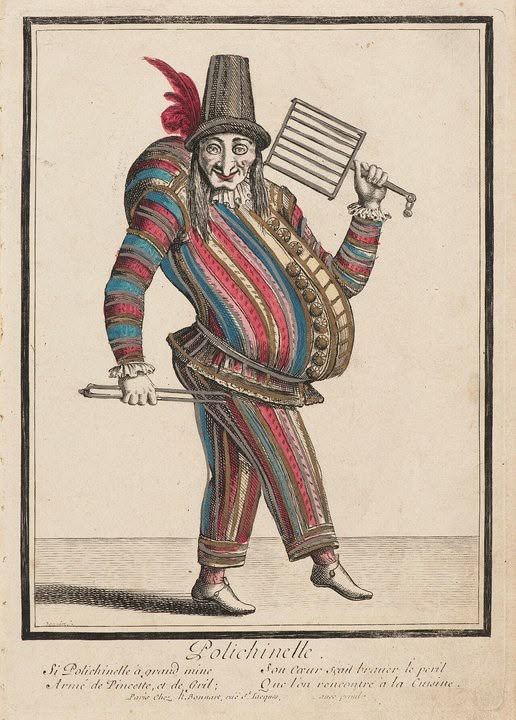
Polichinelle, c.1680 by French artist Nicolas Bonnart. The first of a set of five etching entitled Five Characters from the Commedia dell'Arte. Etching with hand coloring on laid paper. Pulcinella is a dualistic character: he either plays dumb, although he is very much aware of the situation, or he acts as though he is the most intelligent and competent one on the stage, despite being woefully ignorant. He incessantly attempts to rise above his station while not intending to work for it. He is a social chameleon who tries to get those below him to think highly of him but is quick to appease the powerful. Pulcinella's closing couplet translates to: "I am Prince of everything, Lord of land and main. Except for my public whose faithful servant I remain." However, because his status is often that of a servant, he has no real investment in preserving the socio-political world of his master. He is always on the side of the winner, although he often does not decide this until after they have won. No matter his initial intent, Pulcinella always manages to win. If something ends poorly, another thing is successful. If he is put out in one sense, he is rewarded in another. This often accidental triumph is his norm. Another important characteristic of Pulcinella is that he fears nothing. He does not worry about consequences as he will be victorious no matter what. It is said that he is so wonderful to watch because he does what audience members would do were they not afraid of the consequences.
Pulcinella is the ultimate self-preservationist, looking out for himself in most every situation, yet he still manages to sort out the affairs of everyone around him. Antonio Fava, a world-renowned maskmaker and Maestro of commedia dell'arte, is particularly fond of the character in both performance and study due to Pulcinella's influence and continuity throughout history. Fava explains that, "Pulcinella, a man without dignity, is nevertheless indispensable to us all: without [him] ... none of his countless 'bosses' could ever escape from the awkward tangle of troubles in which they find themselves. Pulcinella is everyone's saviour, saved by no one." This accidental helpfulness is key to his success. He goes out of his way to avoid responsibility, yet always ends up with more of it than he bargained for.
Traditionally made of leather, Pulcinella's mask is either black or dark brown, to imply weathering from the sun. His nose varies in shape, but it is always the most prominent feature of the mask. It can be long and curved, hooking over the mouth, or it can be shorter with a more bulbous bridge. Either way, the nose is designed to resemble a bird's beak. There is often a wart somewhere on the mask, typically on the forehead or nose. Furrowed eyebrows and deep wrinkles are also important, although there is room for artistic interpretation. He can have a protruding brow ridge, knitted brows, a furrowed brow, or simply raised eyebrows, as long as they are prominent enough to match the exaggerated style of commedia dell'arte masks. The mask used to feature a bushy black mustache or beard, but this was mostly abandoned after the 17th century.
This page is a permanent link to the reply below and its nested replies. See all post replies »