

This page is a permanent link to the reply below and its nested replies. See all post replies »

QuixoticSoul · 41-45, M
A national/worldwide shutdown over an illness with a .02% CFR would be completely insane. That's literally less deadly than seasonal flu.
What could possibly explain the enormous difference this event and the covid19 event?
That explains the enormous difference, it's a very simple number.
Budwick · 70-79, M
@QuixoticSoul
So, doing nothing is the next best step?
A national/worldwide shutdown would be completely insane.
So, doing nothing is the next best step?
Budwick · 70-79, M
@QuixoticSoul They rolled out tests for further testing in that time frame.
You have lied once again.
You have lied once again.
Budwick · 70-79, M
@QuixoticSoul
Nope - you and the media!
Pants on fire!
In END OF SEPTEMBER 2009 - CDC reported the following -
"Sep 29, 2009 · There are laboratory tests available that can tell the difference between 2009 H1N1 and other strains of flu, but these can take one to several days to provide results and this season, CDC has recommended that this testing be focused on 1) people who are hospitalized with suspected flu; 2) people such as pregnant women or people with weakened immune systems, for whom a diagnosis of flu will help their doctor make decisions about their care. "
Nobody is lying,
Nope - you and the media!
Pants on fire!
In END OF SEPTEMBER 2009 - CDC reported the following -
"Sep 29, 2009 · There are laboratory tests available that can tell the difference between 2009 H1N1 and other strains of flu, but these can take one to several days to provide results and this season, CDC has recommended that this testing be focused on 1) people who are hospitalized with suspected flu; 2) people such as pregnant women or people with weakened immune systems, for whom a diagnosis of flu will help their doctor make decisions about their care. "
QuixoticSoul · 41-45, M
@Budwick Those dates come from the CDC, not the media.
And your own blurb demonstrates that tests were, indeed, available.
And your own blurb demonstrates that tests were, indeed, available.
Budwick · 70-79, M
@QuixoticSoul Yes, the CDC.
NAturally, the media got it wrong.
And the tests were were available, with lot's of caution , in September - 7 months later then you originally said.
You LIED!
NAturally, the media got it wrong.
And the tests were were available, with lot's of caution , in September - 7 months later then you originally said.
You LIED!
Budwick · 70-79, M
QuixoticSoul · 41-45, M
@Budwick The only one calling anyone a liar here is you bud.
I just think you have reading comprehension issues and a strange set of blinders on this topic. I’m not even sure how you’re trying to spin “There are laboratory tests available” into “Tests were not available until September”.
I just think you have reading comprehension issues and a strange set of blinders on this topic. I’m not even sure how you’re trying to spin “There are laboratory tests available” into “Tests were not available until September”.

daisymay · 51-55, T
@QuixoticSoul
It's because they have to hold on to the "Democrats/media hoax" angle as much as they can. They literally have nothing else to save Little Donnie Ladyfingers from his own ineptitude. So, my making an apples to horseshit comparison, they think they've got a smoking gun.
That's my best guess. Who knows what "thoughts" are lurking in the fevered cesspool of the Ttumpansy brain 🤷♀️
I’m not even sure how you’re trying to spin “There are laboratory tests available” into “Tests were not available until September”.
It's because they have to hold on to the "Democrats/media hoax" angle as much as they can. They literally have nothing else to save Little Donnie Ladyfingers from his own ineptitude. So, my making an apples to horseshit comparison, they think they've got a smoking gun.
That's my best guess. Who knows what "thoughts" are lurking in the fevered cesspool of the Ttumpansy brain 🤷♀️
Budwick · 70-79, M
@QuixoticSoul Gosh Don, it sounds like you are upset having been repeatedly called a liar!
It sounds like you think that label is unwarranted - unfair.
Maybe you realize some details are maybe incorrect or sources disagree but the substance is correct and you've been treated unfairly.
Anything like that?
It sounds like you think that label is unwarranted - unfair.
Maybe you realize some details are maybe incorrect or sources disagree but the substance is correct and you've been treated unfairly.
Anything like that?
Budwick · 70-79, M
@QuixoticSoul
Even though the CDC reported sending them in September.
Got it.
Liar.
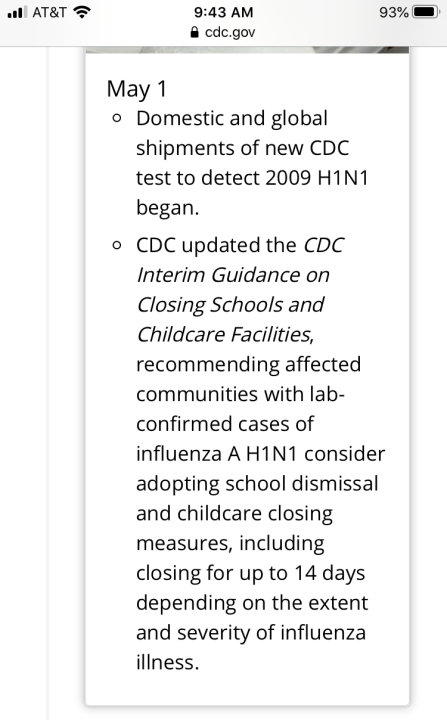
H1N1 tests went out in May
Even though the CDC reported sending them in September.
Got it.
Liar.
daisymay · 51-55, T
Gosh Don, it sounds like you are upset having been repeatedly called a liar!
It sounds like you think that label is unwarranted - unfair.
@QuixoticSoul It sounds like you think that label is unwarranted - unfair.
I think I've cracked the code here. See, DipShit gets very upset when it's pointed out over and over again that he's both a disingenuous chucklefuck and a lying piece of shit.
QuixoticSoul · 41-45, M
@Budwick No, the CDC did not report sending them in September. You need to learn to assimilate information better. Re-read your quote and think about what it actually says. You’re just being dumb here, shape up.
By Sept, the CDC was long out of the testing game.
By Sept, the CDC was long out of the testing game.
While initial efforts were underway to develop a safe and effective vaccine to protect people against 2009 H1N1, work also was being done at CDC to help laboratories supporting health care professionals to more quickly identify the 2009 H1N1 virus in samples from patients. The real-time PCR test developed by CDC was cleared for use by diagnostic laboratories by FDA under an Emergency Use Authorization (EUA) on April 28, 2009, less than two weeks after identification of the new pandemic virus. Prior to the availability of this EUA, public health laboratories had been able to identify whether influenza A viruses were seasonal influenza viruses or were a novel strain, but the new diagnostic kits allowed labs to confirm a virus as 2009 H1N1. On May 1, 2009, CDC test kits began shipping to domestic and international public health laboratories. (Each test kit contained reagents to test 1,000 clinical specimens). From May 1 through September 1, 2009, more than 1,000 kits were shipped to 120 domestic and 250 international laboratories in 140 countries. Once labs had the test kits and verified that their testing was running properly, they were able to identify new cases more quickly than before and no longer needed to send samples to CDC for lab confirmation. The transition away from CDC lab confirmation testing didn’t happen overnight though - between April 23 and May 31, 2009, CDC influenza laboratory analyzed about 5,000 influenza virus samples, five times the number that were processed in a similar timeframe in 2008, and more than during any previous influenza season. By May 18, 2009, 40 states had been validated to conduct their own 2009 H1N1 testing, with eight states having multiple laboratories able to do their own testing. CDC alerted the public that the expansion in testing capacity would likely result in a jump in the number of 2009 H1N1 cases, but that this would actually present a more accurate picture of the true scope of 2009 H1N1 influenza in the United States.