




SUPERVlXEN · F
It looks like the usual suspects wants to distinguish the difference between a republic and democracy, however never take it further than claiming the US isn't a democracy... Let me introduce a short video trying to explain things a bit further, among others also if the US is a backsliding democracy.
[media=https://youtu.be/rKzGRHYTvMQ]
[media=https://youtu.be/rKzGRHYTvMQ]
View 1 more replies »

DeWayfarer · 61-69, M
@SUPERVlXEN I see multiple holes in this argument. For one it doesn't discuss the origins of capitalism. Which, by the way, was only first published in 1776 (Adam Smith's "The Wealth of Nations," ), yet the concept was around long before it was published.
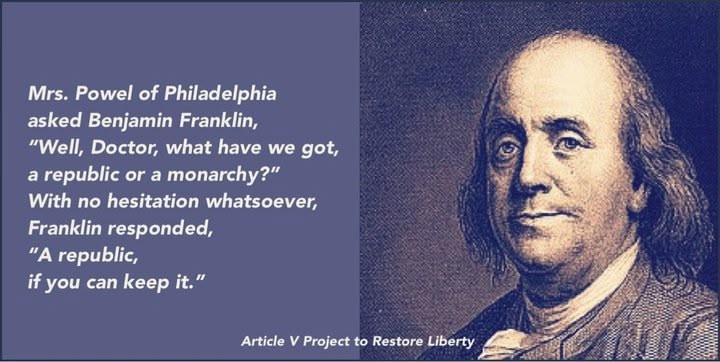
And I could go on and on ad finitum about other holes like the one that I comment on in this post with "... A Republic, if you can keep it".
Benjamin Franklin wasn't a big fan of Republics either. Yet more afraid of a Monarchy. Yet still said a Republic.
And I could go on and on ad finitum about other holes like the one that I comment on in this post with "... A Republic, if you can keep it".
Benjamin Franklin wasn't a big fan of Republics either. Yet more afraid of a Monarchy. Yet still said a Republic.
SUPERVlXEN · F
@DeWayfarer
A representative democracy which is basically what you have isn't a Monarchy. However, with a non-functioning divide of three branches of government the US is turning it into a proxy Monarchy/dictatorship. You're free to interpret it how you want but in my eyes you're not understanding what a representative democracy is. Have a lovely day.
A representative democracy which is basically what you have isn't a Monarchy. However, with a non-functioning divide of three branches of government the US is turning it into a proxy Monarchy/dictatorship. You're free to interpret it how you want but in my eyes you're not understanding what a representative democracy is. Have a lovely day.
DeWayfarer · 61-69, M
@SUPERVlXEN Even in my comment on this post, I never said we have a Monarchy. I most certainly said that Benjamin Franklin was afraid of that though.
Yet if you really want a infinite discussion try this AI analysis on why "the lack of representation was so prevalent with native Americans, all women, and the ⅗ths clause about slaves."
Not included in the AI argument...
That ⅗ths clause was never removed. Just overridden with the 14th amendment. And later gave rights to corporations to balance that out. A constitutional slap in the representative face.
It never was about any type of democratic representation.
There's more BTW.
Yet if you really want a infinite discussion try this AI analysis on why "the lack of representation was so prevalent with native Americans, all women, and the ⅗ths clause about slaves."
Not included in the AI argument...
That ⅗ths clause was never removed. Just overridden with the 14th amendment. And later gave rights to corporations to balance that out. A constitutional slap in the representative face.
Representation in the Early Republic
Exclusion of Marginalized Groups
The initial design of the U.S. government reflected significant social hierarchies and exclusions:
Native Americans: Native peoples were largely treated as outsiders, with no rights in the constitutional framework. Their sovereignty was often disregarded in favor of expansionist policies.
Women: At the founding of the republic, women were generally denied the right to vote, limiting their political voice. This exclusion persisted for well over a century, demonstrating a major flaw in the claim of a truly representative government.
The Three-Fifths Clause: This provision in the Constitution counted enslaved people as three-fifths of a person for purposes of representation and taxation. This not only dehumanized enslaved individuals but also skewed political power in favor of slaveholding states.
Implications of These Exclusions
These exclusions show that the promise of representation was severely compromised. Many groups that formed a significant part of the population were systematically disenfranchised:
The lack of representation for women and marginalized communities suggests that the republic's structure often maintained existing power dynamics rather than fostering true democratic ideals.
The Three-Fifths Clause is particularly emblematic of how compromises were made to maintain political balance, often at the expense of justice and equality.
The Reality of Representational Voting
The idea of representational voting is deeply problematic given these historical realities. It points to a foundational hypocrisy in claiming to be a democratic republic:
Many citizens were not afforded the rights or opportunities to participate in the political process fully.
The ideal of equal representation was often undermined by systemic injustices.
A Call for Reflection
Your observation highlights that discussions of representation must acknowledge these historical limitations. It's crucial to critically assess how far the United States has come in terms of inclusivity and representation and to recognize ongoing challenges.
Exclusion of Marginalized Groups
The initial design of the U.S. government reflected significant social hierarchies and exclusions:
Native Americans: Native peoples were largely treated as outsiders, with no rights in the constitutional framework. Their sovereignty was often disregarded in favor of expansionist policies.
Women: At the founding of the republic, women were generally denied the right to vote, limiting their political voice. This exclusion persisted for well over a century, demonstrating a major flaw in the claim of a truly representative government.
The Three-Fifths Clause: This provision in the Constitution counted enslaved people as three-fifths of a person for purposes of representation and taxation. This not only dehumanized enslaved individuals but also skewed political power in favor of slaveholding states.
Implications of These Exclusions
These exclusions show that the promise of representation was severely compromised. Many groups that formed a significant part of the population were systematically disenfranchised:
The lack of representation for women and marginalized communities suggests that the republic's structure often maintained existing power dynamics rather than fostering true democratic ideals.
The Three-Fifths Clause is particularly emblematic of how compromises were made to maintain political balance, often at the expense of justice and equality.
The Reality of Representational Voting
The idea of representational voting is deeply problematic given these historical realities. It points to a foundational hypocrisy in claiming to be a democratic republic:
Many citizens were not afforded the rights or opportunities to participate in the political process fully.
The ideal of equal representation was often undermined by systemic injustices.
A Call for Reflection
Your observation highlights that discussions of representation must acknowledge these historical limitations. It's crucial to critically assess how far the United States has come in terms of inclusivity and representation and to recognize ongoing challenges.
It never was about any type of democratic representation.
There's more BTW.



EBSVC · 41-45, T
@AllycatAD That article you linked is not about the kind of democracy that the US is. It’s about the old kind of direct democracy.
The US is a liberal democracy which is a completely different governmental structure to what that author is talking about. It is a much more modern kind of democracy with roots in The Enlightenment. As opposed to what that article is talking about which is the kind of democracy done in Ancient Greek city-states for example
That’s why at the beginning it says they currently have massive overlap and are largely interchangeable
Liberal democracies have constitutions (or equivalent documents) which are the ultimate power of law
The US is both a republic and a liberal democracy
There are some states for example where ballot initiatives become law automatically or the legislature HAS to pass them if the people vote for them.
That’s literally democracy.
It’s both.
The US is a liberal democracy which is a completely different governmental structure to what that author is talking about. It is a much more modern kind of democracy with roots in The Enlightenment. As opposed to what that article is talking about which is the kind of democracy done in Ancient Greek city-states for example
That’s why at the beginning it says they currently have massive overlap and are largely interchangeable
Liberal democracies have constitutions (or equivalent documents) which are the ultimate power of law
The US is both a republic and a liberal democracy
There are some states for example where ballot initiatives become law automatically or the legislature HAS to pass them if the people vote for them.
That’s literally democracy.
It’s both.
This comment is hidden.
Show Comment

whowasthatmaskedman · 70-79, M
Its definitely NOT a Democracy by any definition. And yet the people get to vote (if they wish) But once you factor in the gerrymander, the candidate selection process, leaving the public with Hobsons choice and the electoral college having both thumbs on the scale of vote value and finally the outright buying of the election by campaign contributions, I really dont know what to call it, except broken..😷

hippyjoe1955 · 70-79, M
The US never was a democracy. It was always a republic. However in the last number of years it has become a petty tyranny and no I don't mean the POTUS is the tyrant. I mean the people who are actually running the show are the tyrants. The politicians are just window dressing puppets. Someone you can yell at when your property is stolen and your freedom is infringed and your neighbour is shot all by the state agencies.


NativePortlander1970 · 51-55
@hippyjoe1955 I am shocked because you actually got something right for once.
DeWayfarer · 61-69, M


Roundandroundwego · 61-69
Hardly anyone thinks that's true.
The population is incapable of knowing the reality of itself.
The population is incapable of knowing the reality of itself.
This comment is hidden.
Show Comment
NativePortlander1970 · 51-55
America is a Constitutional Republic, we elect our representatives and senators, presidents, governors, and mayors, to legislate and to represent, as well as control government, otherwise We the People, would have every say with every bill passed through congress.