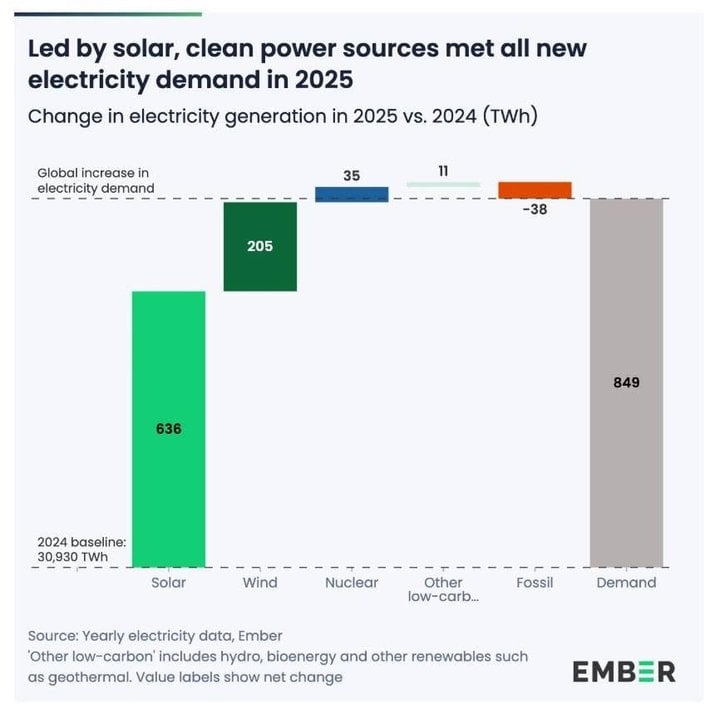
For the first time in history, clean power met every single unit of new global demand. Fossil generation didn't just plateau, it fell by 38 TWh, even as the global economy grew by 3.2%. No recession needed to kill the rise: this is structural.
Solar alone met 75% of new global demand in 2025.
Renewables (33.8%) officially overtook coal (33.0%) for the first time in 100 years.
Total fossil generation is now in a permanent terminal plateau.
If you think gas is the "bridge," it’s already burning. With stationary battery costs down a staggering 45% in just 1 year, there is nowhere left for gas to hide when the sun goes down.
The economics are settled. The electrification of everything is accelerating. Betting on fossil fuels today is exactly like betting on whale oil while Edison was turning on the lightbulb.
Even the anti- "green energy" campaigners will have to face that natural-gas, coal and petroleum-derivative fuels are coming to their end anyway, by depletion even if not also by policy.
Yes, there are still untapped deposits but they are becoming rarer, harder and costlier to find and exploit.
However, there is another problem... Although most metals are recoverable, and should be recovered, from expired items, solar and more particularly wind power, and electricity distribution, depend very heavily on irrecoverable materials made from petroleum derivatives.
Will we have suitable replacements for them?
Indeed, more broadly, will we have suitable, practical and environmentally-sensible replacements for all the petroleum-derivatives based materials we take so for granted?
And without coal (distilled to leave coke), how will anyone smelt iron-ore?
Iron is the most important metallic element we use - indeed the most valuable, which is not the same as most costly.
We can and do refine scrap iron and steel, with some attrition. We can stop mere waste like sinking huge ships as divers' playgrounds. Yet the world still needs make new iron, and in large volumes. Cast iron is still important for many mechanical components. Pure iron is vital for electrical equipment and as the base for the huge range of alloys generically called "steel".
(Iron-ore can be smelted in special arc furnaces, as used over a hundred years ago in Germany, Sweden and America; but these need huge, sacrificial electrodes made from the finite mineral graphite, still need a reducing-agent such as coke or hydrogen plus limestone as flux, and use prodigious amounts of electricity.)
@ArishMell OK well you’re raising some fair concerns here, but a few of your conclusions go further than the evidence really supports. On fossil fuels, yes the easiest reserves were used first and newer ones are harder and more expensive to extract. But I don't think depletion is the main force behind the shift away from them, simple economics quite apart from anything else is already driving change. Solar and wind are now cheaper than fossil fuels pretty much everywhere.
Your point about petroleum derived materials is overstated I think. Renewable systems do use plastics, resins, and other oil based products, but they're not fundamentally tied to petroleum. They can be made from biomass, recycled sources, or synthetic chemical processes. The issue is scaling and cost, not whether it’s possible. And most of the bulk in these systems is still steel, concrete, glass, and copper, which are largely recyclable. It's also true that nothing is perfectly recoverable and some losses always occur. But key metals like steel and aluminum already have high recycling rates. So the idea that renewables rely heavily on irrecoverable materials doesn’t quite match how the material flows actually look.
Steelmaking for sure is a problem as blast furnaces use coal, and global demand for new steel is still huge. But electric arc furnaces are widely used and can run mostly on scrap. More importantly, hydrogen based iron reduction is moving into real world use, replacing coke with hydrogen and producing water instead of carbon dioxide.
You’re also right that these alternatives need a lot of energy and new inputs. That’s really the shift taking place. The constraint moves from fossil fuels to electricity and infrastructure.
@jshm2 Well, quite apart from the fact that Ember are a non-profit thinktank...
A single year plateau proves very little on its own, true. But serious analysis does not rest on a single year. It looks at trajectories. What matters is that most new electricity demand is now being met by renewables, not fossil fuels. That is how systems change, not through sudden collapse, but through steady displacement.
Your fixation on existing combustion engines misses the point entirely. Transitions are driven at the margin. The question is not what is already on the road, but what is being sold and built. By that measure, the shift is unmistakable. The battery argument is another straw man. No one serious claims that falling battery prices alone will make gas vanish. They are one part of a wider economic shift that is eroding the case for fossil generation.
As for your analogies, phones versus PCs is irrelevant. Those technologies coexist because they serve different functions. Electricity generation does not work like that. One source can and does replace another.
And yes, technologies can stall. But invoking 19th century electric cars as if nothing has changed since is not insight, it's evasion. We have climate policies, industrial scale manufacturing, and a completely different technological base.This is not inevitability in the sense of a guaranteed outcome. But it is a powerful convergence of economics, policy, and engineering. Dismissing it with glib analogies does not make it disappear.