Did you know: about the lamprey? Have I done this one before? Kinda interesting.
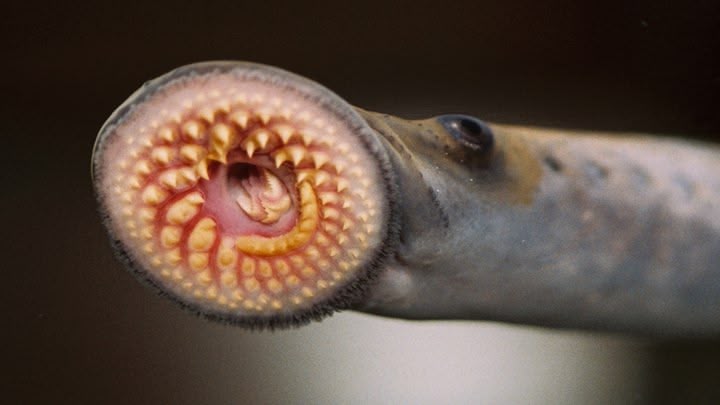
Lampreys are primitive, jawless fish that have existed for over 340 million years. They are characterized by their long, snake-like bodies, a sucking disc around their mouth, and the absence of scales, paired fins, and bones. Some species, like the sea lamprey, are parasitic as adults, attaching to other fish and feeding on their blood
Key Characteristics: Jawless: Lampreys lack jaws and instead have a suction-cup like mouth with teeth. Scaleless: They have smooth, scaleless skin. Primitive: They are considered one of the oldest fish on Earth. Parasitic: Some species, like the sea lamprey, are parasitic as adults, attaching to other fish and feeding on their blood and body fluids. Anadromous: Many lamprey species are anadromous, meaning they are born in freshwater, migrate to the ocean as adults, and then return to freshwater to spawn. Life Cycle: 1. Larvae: Lampreys hatch from eggs and spend their early years as larvae in freshwater, feeding on drifting plankton. 2. Migration: As they mature, they migrate to the ocean and start the parasitic phase of their life. 3. Parasitism: As adults, they attach to host fish and feed on their blood and body fluids. 4. Spawning: After a period of parasitism, they return to freshwater to spawn and die. Examples: Sea Lamprey (Petromyzon marinus): Native to the Atlantic Ocean, they are also invasive in the Great Lakes, where they prey on other fish
Pacific Lamprey: Found in the Pacific Ocean and its associated rivers, they are important to Native American Tribes. Ecological Impact: Invasive Species: Sea lampreys in the Great Lakes have had a significant negative impact on native fish populations and fisheries. Predation: They prey on a variety of fish species, including salmon and lake trout. Cultural Significance: Pacific lampreys are culturally significant to Native American Tribes, who have harvested them for subsistence, ceremonial purposes, and medicine for centuries
Found in the Pacific Ocean and its associated rivers, they are important to Native American Tribes. Ecological Impact: Invasive Species: Sea lampreys in the Great Lakes have had a significant negative impact on native fish populations and fisheries. Predation: They prey on a variety of fish species, including salmon and lake trout. Cultural Significance: Pacific lampreys are culturally significant to Native American Tribes, who have harvested them for subsistence, ceremonial purposes, and medicine for centuries
And if you have few minutes, I always enjoy her videos [media=https://youtu.be/IuCcXto1vPk]
This page is a permanent link to the reply below and its nested replies. See all post replies »
They used to be a real problem here and decimated the lake trout. They would spawn in streams and the streams were poisoned to kill them. We used to find not only marks on salmon or trout that we caught where they had latched on for a meal and more than once we would catch a fish with them still attached. I put one in an aquarium once but it only lived for a few weeks...They are freaky things.
@goliathtree they are interesting but since i don't have them here, i know my interest is Curiosity. I understand the devastation that invasive species do though