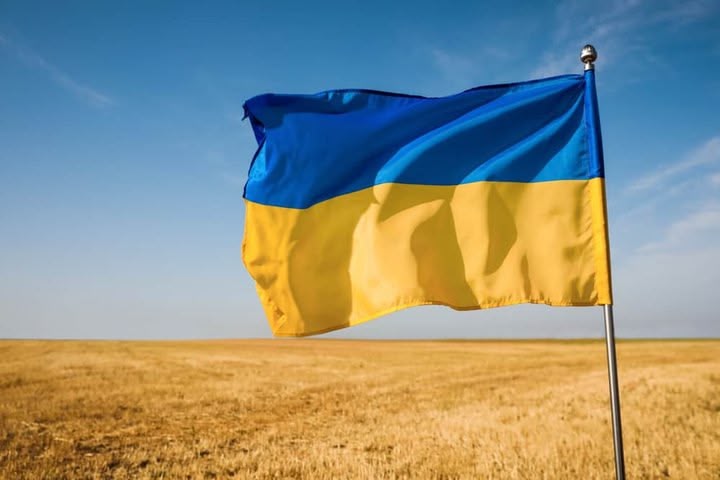
The national flag of Ukraine (Ukrainian: Державний прапор України, romanized: Derzhavnyi prapor Ukrayiny,) consists of equally sized horizontal bands of blue and yellow.
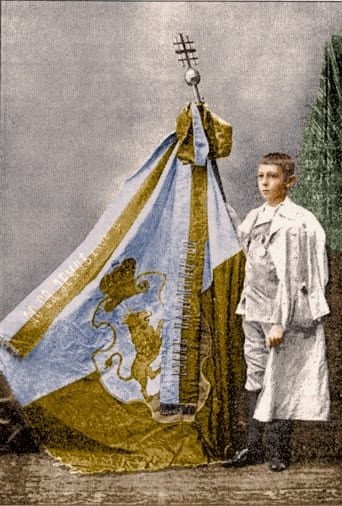
The blue and yellow bicolor flag was first seen during the 1848 Spring of Nations in Lemberg (Lviv), the capital of the Kingdom of Galicia and Lodomeria within the Austrian Empire. It was later adopted as a state flag by the short-lived Ukrainian People's Republic, the West Ukrainian People's Republic, and the Ukrainian State following the Russian Revolution.
In March 1939, it was also adopted by Carpatho-Ukraine. However, when Ukraine was part of the Soviet Union, the use of the bicolor flag was banned, and it was replaced by the flag of the Ukrainian Soviet Socialist Republic. This flag featured a red background, with an azure bottom and a golden hammer and sickle, along with a golden-bordered red star on top. When the Soviet Union dissolved in 1991, the bicolor flag gradually returned to use before being officially adopted again on 28 January 1992 by the Ukrainian parliament.
Ukraine has celebrated the Day of the National Flag on 23 August since 2004.
The roots of Ukrainian national symbols come from pre-Christian times when yellow and blue prevailed in traditional ceremonies, reflecting fire and water. The most solid proof of yellow and blue colours can be traced back as far as the Battle of Grunwald in 1410, in which militia formations from the Ruthenian Voivodeship participated.
Blue-yellow, red-black, crimson-olive and especially raspberry colour banners were widely used by Ukrainian Cossacks between the 16th and 18th centuries. These were not the only possible combinations, since normally Cossacks would fly their hetman's banners, which were similar to the coats of arms of the nobility. Also, yellow and blue were the colours common on coats of arms in Galicia. In fact, the coat of arms of Lviv to this day remains a golden lion on a blue field.
Some put the starting point of the adoption of the current national flag of Ukraine to 1848 when, during the Spring of Nations on 22 April 1848, a blue-and-yellow banner was adopted by the Supreme Ruthenian Council in Lemberg (Lviv), the capital of the Kingdom of Galicia and Lodomeria (a crownland of the Austrian Empire). On 25 June 1848 two blue and yellow banners flew over the city's magistrate (Rathaus) for the first time. It is unknown who hang the banners and the Austrian authorities dissociated themselves from this action, as did the Supreme Ruthenian Council itself. The banners hung for almost a week. At the request of the Supreme Ruthenian Council, on 15 May 1849 a yellow-and-blue flag hang again on the Rathaus, this time for one day. Although this move did not have significant consequences, the newly formed Ukrainian divisions in the Imperial-Royal Landwehr of the Austro-Hungarian Army used blue-and-yellow banners in their insignia.
During the Russian Revolution of 1905, this flag was used by Ukrainians of the Dnieper Ukraine.
Both blue-yellow and yellow-blue flags were widely used during the Ukrainian struggle for independence in 1917. For the first time in the history of the Russian Empire, the blue-yellow flag was flown on 25 March 1917 in Petrograd during a 20,000-strong mass demonstration. On the territory of Ukraine the national flag was flown for the first time in Kyiv on 29 March 1917 by soldiers. On 1 April 1917, Kyiv saw a 100,000-strong demonstration where over 320 national flags were flown. Afterwards, similar demonstrations with Ukrainian flags took place across the entire Russian Empire, even beyond ethnic Ukrainian lands. Numerous famous Ukrainian politicians wrote about the 1 April demonstration, including Mykhailo Hrushevsky and Serhiy Yefremov, noting that there were blue-and-yellow flags, while Dmytro Doroshenko claimed that they were yellow and blue. The blue-yellow flag was flown at the First Ukrainian Military Congress on 18 May 1917.
The official flag established by the Ukrainian People's Republic in 1918 was blue-yellow. Instead, they refer to the decision on the Fleet Flag, which was to be light blue–yellow, as an indication that the official flag was light blue–yellow. Also adopted were several other service flags of the Ukrainian People's Republic.
The official flag of Pavlo Skoropadsky's Hetmanate was also light blue-yellow and remained the same under the Directorate of Symon Petlura. The flag of the West Ukrainian People's Republic was blue-yellow. The stateless Makhnovshchina, which existed during the Ukrainian War of Independence, used the black flag.
Among Ukrainian immigrant organisations, there were proponents of both blue-yellow and yellow-blue flags. Eventually, an agreement was reached to use the blue-yellow flag until the issue could be resolved by an independent Ukraine.
During Soviet rule, the Ukrainian flag was banned, and anyone displaying it could be criminally prosecuted for "anti-Soviet propaganda". The first flag of the Ukrainian Soviet Socialist Republic was adopted on 10 March 1919, to serve as the symbol of state of Soviet Ukraine. Details of the official flag changed periodically before the break-up of the Soviet Union in 1991, but all were based on the red flag of the October Revolution in Russia and an exact replica of the flags of the neighbouring Russian SFSR. The first flag was red with the gold Cyrillic sans-serif letters У.С.С.Р. (U.S.S.R., acronym for Ukrainskaya Sotsialisticheskaya Sovetskaya Respublika in the Russian language). In the 1930s, a gold border was added to the flag. In 1937, a new flag was adopted, with a small gold hammer and sickle added above the gold Cyrillic serif У.Р.С.Р. (U.R.S.R., for Ukrainska Radianska Sotsialistychna Respublika in the Ukrainian language).
The Organisation of Ukrainian Nationalists is a Ukrainian political organisation which as a movement was originally created in 1929 in Western Ukraine (interwar Poland at the time). For a long time, the OUN did not officially have its own flag; however, during the Hungarian and Polish aggression against the Republic of Carpathian Ukraine in 1939, Carpathian Sich, a militarised wing of the OUN, adopted as its flag a design taken from the OUN's emblem – a golden nationalistic trident on a blue background. The flag was finalised and only officially adopted by the organisation in 1964 at the 5th Assembly of Ukrainian Nationalists.
The Ukrainian Insurgent Army was a Ukrainian nationalist paramilitary and later partisan army that engaged in a series of guerrilla conflicts during World War II against Nazi Germany, the Soviet Union, Czechoslovakia, and both underground and communist Poland. The group was the military wing of the Organisation of Ukrainian Nationalists — Bandera faction (the OUN-B), originally formed in Volyn in the spring and summer of 1943. Its official date of creation is 14 October 1942. The battle flag of the UPA was a 2:3 ratio red-and-black banner. The flag continues to be a symbol of the Ukrainian nationalist movement. The colours of the flag symbolise 'Ukrainian red blood spilled on Ukrainian black earth'.
In 1949, the flag of the Soviet Ukraine was changed once again.The Soviet Union managed to obtain two additional seats in the United Nations by adding Ukraine and Byelorussia as member states.The flag change came about because all the Soviet flags were the same. The new Ukrainian flag consisted of red (top, 2/3) and azure (bottom, 1/3) stripes, with the golden star, hammer and sickle in the top left corner. Communist party leaders such as Nikita Khrushchev and Lazar Kaganovich feared using words like 'light blue' and 'blue' in the official flag colours, as they were the terms used by the Ukrainian diaspora.
During the Soviet period, multiple unsanctioned attempts to hoist the national blue-and-yellow flag were made. In 1958, an underground group was established in the village of Verbytsia, Khodoriv Raion; its members raised national flags and spread anti-Soviet pamphlets under cover of darkness.
Under the influence of Mikhail Gorbachev's policies of perestroika and glasnost, individual Soviet republics gained a strengthened sense of national identity, leading to the collapse of the Soviet Union in 1991. This was particularly true for the three Baltic states and Western Ukraine, which were the last territories annexed into Soviet Union. The national awakening was accompanied by attempts to restore historical national symbols. In 1988, the Supreme Soviet of the Lithuanian SSR re-established Lithuania's national flag and coat of arms as the state symbol. The parliaments of Latvia and Estonia soon followed suit.
The events in the Baltic countries soon led to similar patterns in Ukraine. In particular, West Ukraine and the Ukrainian SSR's capital city of Kyiv were the scenes of near-constant political demonstrations, in which yellow-and-blue flags were waved by demonstrators.
On 14 March 1990, the Ukrainian flag was raised for the first time since the establishment of the Soviet Union in the small city of Stryi. On 20 March 1990, the Ternopil town council voted on the use and re-establishment of the yellow-and-blue flag and the tryzub and Shche ne vmerla Ukrainy national anthem. The same day, the yellow-and-blue national flag was flown for the first time in 80 years on a governmental building in Kyiv, replacing the then-official red-azure flag of the Ukrainian SSR.
On 28 April 1990, the Lviv oblast council (oblasna rada) also allowed the use of the national symbols of Ukraine within the Oblast. On 29 April 1990, the yellow-and-blue flag was flown from the Ternopil city theatre's flagstaff without the flag of the Soviet Union hanging above it.
After 24 July 1990, the yellow-and-blue flag was flown for the first time over an official governmental building, the Kyiv City Council, on Maidan Nezalezhnosti Square of Khreshchatyk Street.
After the declaration of independence of Ukraine on 24 August 1991, the national yellow-and-blue flag flew for the first time over the Ukrainian Parliament (Verkhovna Rada) building on 4 September 1991.
As the Soviet red and azure flag remained the de jure flag of the newly-independent Ukraine, the blue and yellow flag was provisionally adopted for official ceremonies in August 1991 following Ukrainian independence, before officially being restored on 28 January 1992 by the Parliament of Ukraine. At the beginning of the 2022 Russian invasion of Ukraine, landmarks all over the world were lit up with the colours of the Ukrainian flag, while numerous cities raised the Ukrainian flag in solidarity. Kastuś Kalinoŭski Regiment, an independent Belarusian volunteer regiment, also adopted the colours of the Ukrainian flag in its insignia.