
On this day
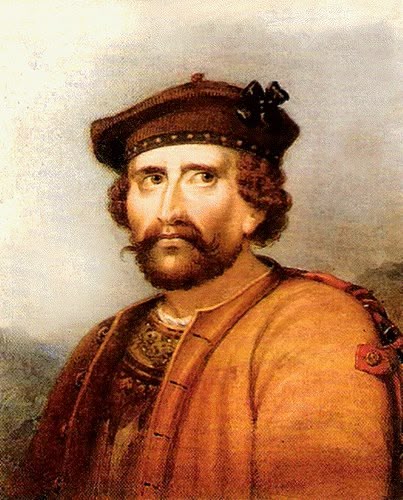
December 28th, 1734, Rob Roy MacGregor, Scotland’s infamous outlaw and folk hero, died. Known for his fiery red hair and daring exploits, Rob Roy 'guarded' cattle if farmers paid a fee. After financial ruin in 1712, he turned to theft, clashing with the Duke of Montrose and joining the Jacobite uprising. A royal pardon in 1727 let him retire, though his legend lived on, immortalised by Sir Walter Scott.
Rob Roy (1817) is a historical novel using the real outlaw Robert Roy MacGregor as its inspiration, blending historical events like the 1715 Jacobite Rising with fictional adventure and romance, creating a legendary figure (the 'Robin Hood' of Scotland) while taking significant creative liberties with his life for dramatic effect, making the novel more about Scottish culture and the era's conflicts than strict historical accuracy.
Hystorically, the Marquesses and Dukes of Argyll were always staunch anti-Jacobites, using their powerful Clan Campbell and even military resources to defend the Hanoverian dynasty, particularly during the major risings of 1715 and 1745. In traditional genealogies of Clan Campbell, the clan's origins are in the ancient Britons of Strathclyde.
The very first Earl of Argyll was Colin Campbell, 1st Earl of Argyll, a prominent Scottish nobleman was created earl in 1457, succeeding his father as Lord Campbell and becoming a powerful figure in Scottish politics, holding roles like Lord Chancellor under Kings James III and James IV (and James I of England).
At the Battle of Inverlochy (February 2nd, 1645), the Scottish Covenanter forces against King Charles I led by Archibald Campbell, First Marquess of Argyll were defeated by the Royalist forces of James Graham, First Marquess of Montrose whose army was mainly made up of Scots of the Clan MacDonald.
The MacDonald clan origins trace back to the 12th-century Norse-Gaelic warrior Somerled, whose grandson, Donald, became the clan's namesake, establishing a powerful dynasty in the Scottish Hebrides as the Lords of the Isles, a semi-independent sea kingdom challenging Scottish royalty.
The Montrose connection links it also to the MacDonalds of Glencoe and more specific to figures like Alasdair MacColla (Colkitto), a famous left-handed lieutenant of the Marquess of Montrose during the Civil Wars, known for his military prowess and bringing Irish troops to Montrose's aid.
The infamous 'Massacre of Glencoe' (February 13, 1692) was done by pro-Hanoverian soldiers (primarily Clan Campbell), murdering members of Clan MacDonald of Glencoe after being hosted by them for nearly two weeks, violating Highland hospitality and sparking outrage over the treachery, resulting in around 38 direct deaths and more perishing from exposure.
Concerning Scott's novel, both First Marquesses of Argyll and Montrose lived well before the main Jacobite Risings (1715, 1745), but Montrose's fight for King Charles I from the previous century established a powerful precedent and narrative for defending the Stuart monarchy, making him a legendary Scottish Highland figure and inspiration for later Jacobites.
In 1745 'Bonnie Prince Charlie' received significant support from many Highland clans who were swayed by his personal charm, promises of French aid, and loyalty to the Stuart cause, allowing him to raise a formidable army despite initially arriving with few men, though not all clans supported him, and some with reservations.
Key clans like the MacDonalds, Camerons, and Stewarts rallied to him, forming the backbone of his forces after he raised his standard at Glenfinnan. However, the Duke of Argyll and the Campbell clan stayed staunch supporters of the British Hanoverian government and were major opponents of Bonnie Prince Charlie and the Jacobite cause.
In truth, the MacDonald clans were significantly divided, with several key Highland branches strong supporters of the Prince and forming a core part of his army. The First Duke of Montrose became and stayed always a staunch Hanoverian and a key figure against the risings, actively supporting the Protestant Succession and the Union of Scotland with England, contrasting with his famous ancestor, the First Marquess of Montrose, the real Royal Stuart hero
[media=https://youtu.be/QvH5O4fkso8]


