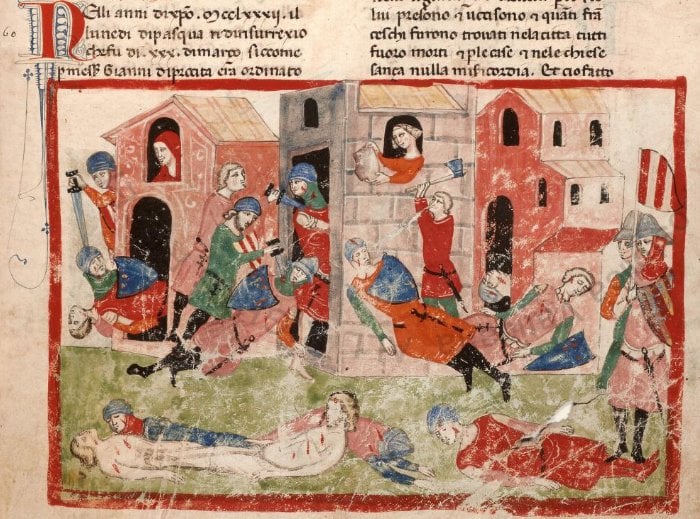
The Sicilian Vespers (Italian: Vespri siciliani; Sicilian: Vespiri siciliani) was a successful rebellion on the island of Sicily that broke out at Easter 1282 against the rule of the French-born king Charles I of Anjou. Since taking control of the Kingdom of Sicily in 1266, the Angevin government had made itself unpopular with its exploitative policies and exclusion of native Sicilians from power.
Sparked by an incident in Palermo, the revolt quickly spread to the majority of Sicily. Within six weeks, approximately 13,000 French men and women were slain or expelled by the rebels, and the government of Charles lost control of the island. Seeking support for the rebellion, the Sicilians offered the throne to Peter III of Aragon, who claimed the crown on behalf of his wife, Constance of Sicily. The Aragonese intervention in the rebellion led to an expansion of the conflict into the War of the Sicilian Vespers.
After leaders were elected in Palermo, messengers spread word across the island for the rebels to strike before the French had time to organise resistance. In a fortnight the rebels gained control over most of the island, and within six weeks it was all under rebel control, except for Messina which was well fortified, and whose leading family, the Riso, remained faithful to Charles. But on 28 April it too broke into open revolt under the command of Captain of the People Alaimo da Lentini and, most significantly, the islanders' first act was to set fire to Charles's fleet in the harbour. It is reported that upon hearing of the fleet's destruction, King Charles exclaimed "Lord God, since it has pleased You to ruin my fortune, let me only go down in small steps."
Charles' Vicar Herbert and his family were safely within castle Mategriffon, but after negotiations the rebels granted Herbert and his family safe conduct to leave the island upon a promise that they never return. After the restoration of order in the city, the townsmen announced themselves a free commune answerable only to the pope. They elected leaders, one of whom was Bartholomaeus of Neocastro who was prominent in the unfolding events and would later chronicle much of the revolt in Historia Sicula, an important if sometimes contradictory source of information for historians. Again significantly, the leaders' next act was to send word, via a Genoese merchant named Alafranco Cassano, to the Emperor Michael advising him that his nemesis Charles had been crippled. Only thereafter were ambassadors sent to Pope Martin IV pleading for each city on the island to be recognised as a free commune under the sole suzerainty of the Holy Church. The islanders were hoping for status similar to that enjoyed by Venice, Genoa, Pisa and other cities, which were free to form their own government but morally answerable only to the Pope, who would hold a vague and unstable suzerainty. However, the French pope was firmly in Charles' camp and he directed the Sicilians to recognize Charles as their rightful king. But Martin underestimated the Sicilians' hatred of the French, and especially of Charles, who ruled from Naples rather than Palermo, where he could have seen the suffering caused by his officials. Charles' island officials were far removed from his oversight; he did not see the avarice, the rape, theft and murder, nor did he see the high taxes levied against the meager possessions of the peasants, which kept them impoverished, but made no improvement in their lives.