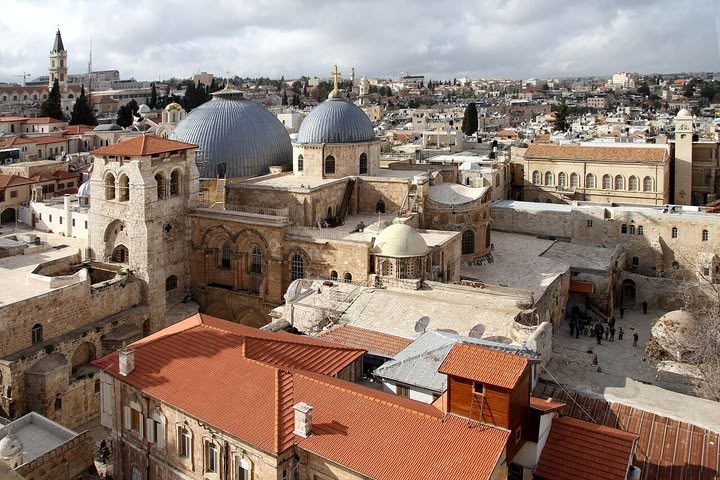
The list of Christian holy places in the Holy Land outlines sites within cities located in the Holy Land that are regarded as having a special religious significance to Christians, usually by association with Jesus or other persons mentioned in the Bible.
The identification of the Christian holy sites became of increased importance especially from around the time of Constantine the Great of the Roman Empire. Interest was also strong during Emperor Charlemagne, as was also the case during the Crusades, when Christian pilgrims often sought out holy places in the Outremer, especially in early 12th century immediately after the capture of Jerusalem.
The search for the Christian holy places was the foundation of 19th-century European Biblical archaeology in Ottoman Syria and later in the British Mandatory Palestine.
Judea was a region inhabited mainly by Jews. Today it is split between Israel and the West Bank, Palestine, the latter parts being occupied by Israel.
Jerusalem was the main city of Judea and the historical capital of the Kingdom of Judah, occupied at the time by Rome. It is the site of some of Jesus' teaching; of the Last Supper from which the Holy Eucharist evolved; of his crucifixion on a nearby hill, Golgotha or Calvary; and of his entombment.
Temple Mount: Jesus was brought as an infant to the Temple. He was found there at the age of twelve discussing with the elders. He threw out the money changers from the Temple grounds. Golgotha, the site of Jesus' crucifixion and the Tomb of Jesus are traditionally located in the Church of the Holy Sepulchre (the Garden Tomb is an alternative site considered by a number of evangelical Anglicans to be site of Golgotha). Located next to the Church of the Holy Sepulchre is the Evangelical-Lutheran Church of the Redeemer. Via Dolorosa, the traditional "Way of Sorrows" walked by Jesus from his trial by Pilate to the site of execution Mount Zion, with the Cenacle (the site of the Last Supper) and the nearby site of the Dormition of Mary Mount of Olives, whose western flank is facing Jerusalem (for sites on its eastern side see Bethany and Bethphage). Here are the traditional sites of a cave in which Jesus taught his disciples, of the Ascension of Jesus and, in the Orthodox tradition, of the Assumption of Mary Gethsemane, the site of the Agony in the Garden marked by the Church of All Nations. Nearby is the Tomb of Mary.
Mount of Olives (eastern flank, facing the Judaean desert; for its western side see Jerusalem) with Bethany (the home of Martha, Mary and Lazarus) and Bethphage (Jesus' starting point towards his triumphal entry into Jerusalem; see Palm Sunday). Bethlehem, where the Church of the Nativity is believed to mark the birthplace of Jesus. The nearby Shepherds' Fields in the modern village of Beit Sahour is the traditional site of the angel's visitation to the shepherds to announce the birth of Christ. Emmaus has been identified by Byzantines, Crusaders and archaeologists with at least four different locations Jericho, where Jesus restored sight to the blind Bartimeus and met with Zacchaeus Mount of Temptation at Jericho, where Satan twice attempted to tempt Jesus (Matthew 4:8) The road from Jericho to Jerusalem, along which the parable of the Good Samaritan is located.
The Jordan River borders several regions from the time of Jesus - Gaulanitis and Galilee, Decapolis, Samaria, Perea and Judea.
The Jordan River: John the Baptist preached and baptised at several sites along the river. The most important site is that of the Baptism of Jesus, traditionally identified with the site of Al-Maghtas on the East Bank in Jordan and extending onto the West Bank at Qasr al-Yahud.