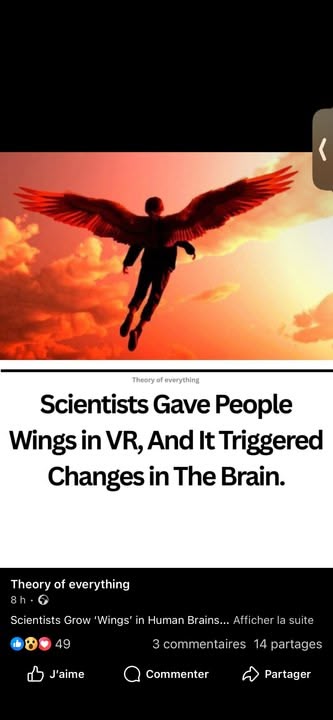
Scientists Grow ‘Wings’ in Human Brains Through Virtual Reality Experiment
Scientists in China have discovered that giving people virtual wings in VR can actually change how the brain recognizes the body, revealing just how adaptable the human mind may be.
Researchers from Beijing Normal University and Peking University placed 25 volunteers into immersive virtual reality sessions where their arms were replaced with large feathered wings. Over the course of a week, participants completed flying exercises such as soaring through rings in the sky while controlling the wings as if they were part of their own bodies.
Brain scans showed that after the training, a region known as the occipitotemporal cortex — responsible for recognizing body parts — began responding to the virtual wings more like it responds to real human arms. Researchers say this demonstrates a remarkable level of brain plasticity, meaning the brain can adapt to entirely new body forms that humans never evolved to possess.
The study also found stronger communication between visual-processing areas and regions involved in movement planning and coordination, suggesting the brain was actively integrating the wings into its internal body map.
Scientists believe the findings could eventually help improve prosthetic limb technology, physical rehabilitation, and future human interaction with virtual reality systems.
The researchers emphasized that the wings did not fully become part of the brain’s natural body representation, but the neural responses moved significantly in that direction.
The study was published in the journal Cell Reports.