Fulfilled Bible Prophecy: The Unmistakable Mark of the Messiah
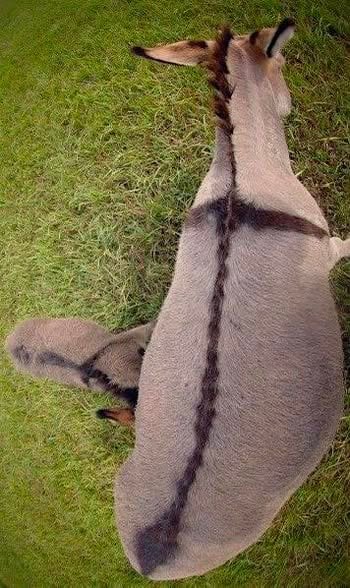
Many people overlook this, but the natural markings on the back of a donkey, often form the shape of a cross.
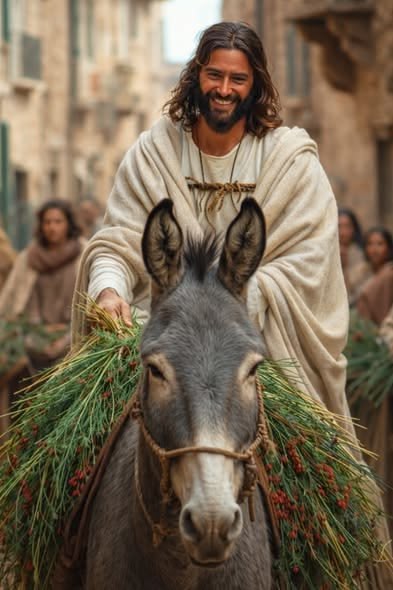
For centuries this has been called the “Jerusalem cross.” It’s part of the animal’s design, yet it is interesting that Jesus wrote In to Jerusalem on a donkey, signifying humble beginnings.
Jesus did not enter Jerusalem on a war horse.
He did not arrive with intimidation, dominance, or earthly power.
Matthew 21:5 fulfills the prophecy from Zechariah 9:9, which describes the Messiah's humble arrival in Jerusalem, riding on a donkey, signifying a king of peace, rather than war... confirming Jesus' identity as the promised Messiah. This prophecy also draws from Isaiah 62:11, highlighting the coming of salvation to Zion.
Bible scholars agree Jesus fulfilled hundreds of Old Testament prophecies, ranging from over 300 to more than 400 specific Messianic prophecies concerning His life, death, and resurrection, including details about His birthplace (Bethlehem), virgin birth, ministry, and crucifixion, highlighting the mathematical improbability of one person fulfilling so many.
Examples of Fulfilled Prophecies Marking Jesus as the Messiah
Birthplace: Bethlehem (Micah 5:2).
Virgin Birth: Isaiah 7:14.
Ministry in Galilee: Isaiah 9:1-2.
Healing: Psalm 147:3 (Heal the brokenhearted).
Entry to Jerusalem: Riding a donkey (Zechariah 9:9).
Crucifixion Details: Mockery, specific taunts, and being numbered with the wicked (Psalm 22, Isaiah 53).
Mathematical Proof
Mathematician Peter Stoner calculated the odds of one person fulfilling just eight specific prophecies as 1 in 10^17 (1 in 100 quadrillion), and for 48 prophecies, it was 1 in 10^157, demonstrating the immense improbability if Jesus were not the Messiah.
From the entrance into the city, to the sacrifice outside its walls, the cross weaves the entire story together.
Nothing was accidental. Nothing was overlooked.
Redemption was never a reaction. It was always the plan.
This page is a permanent link to the reply below and its nested replies. See all post replies »
SW-User
The markings on an ass likely date back to a time before the first religion was conceived. That's a lot of pre-planning.
@SW-User The donkey is not the emphasis. God's timing is always right, and the fact remains that Jesus fulfilled numerous prophecies in His life, death, and resurrection. Perhaps it's worth considering the significance of these events and the impact they've had on the world. We would do best to focus on understanding and respecting each other's perspectives.
SW-User
@LadyGrace I've heard of reliance on animal signs in other religions before. I found that part interesting from a sociological perspective.
@SW-User That's an interesting observation. For Christians, the significance of the donkey, lies in the fulfillment of Old Testament prophecies about the Messiah's arrival, specifically in Zechariah 9:9. It's not about relying on animal signs, but rather about the biblical narrative and its coherence. The prophecies and their fulfillment are a key part of what strengthens faith in Jesus as the Messiah.
God's way are miraculous I believe there is no situation one is going through so far you put God first there is a way it will all align back and you'd be shocked how everything will turned out to be.